
Why bogie hunting speed metrics can mislead selection

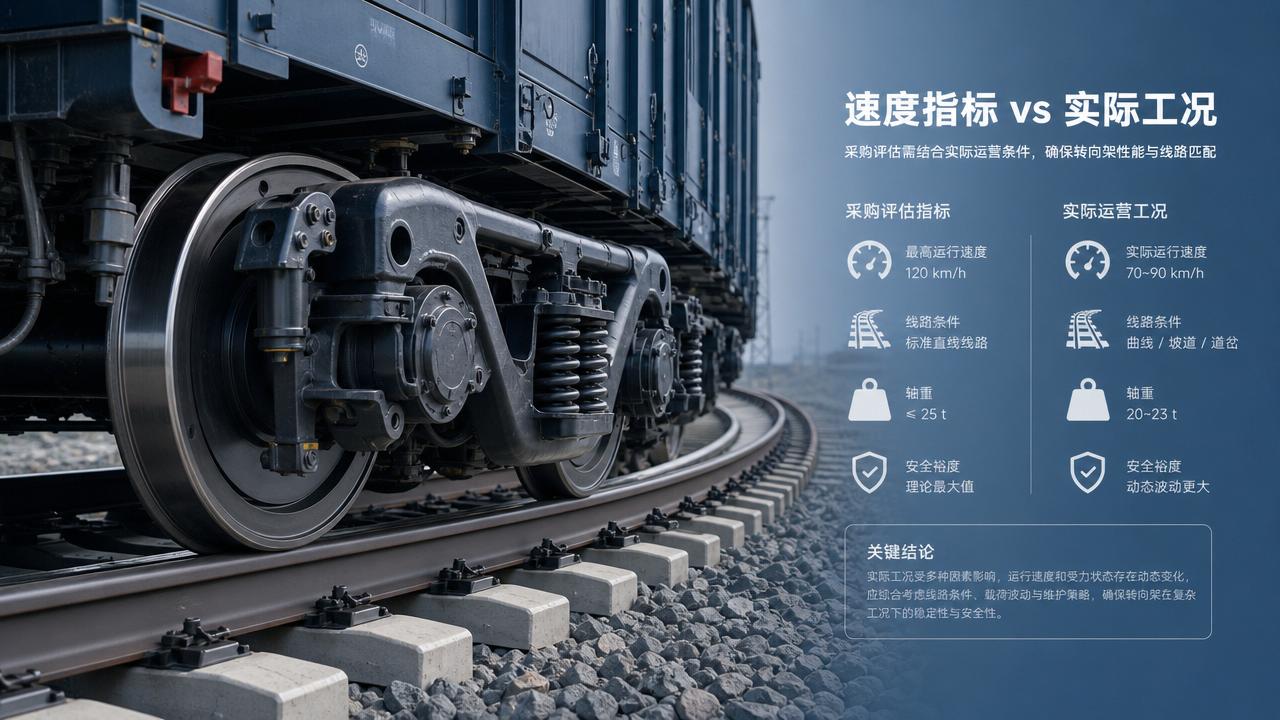
For procurement teams evaluating rolling stock, bogie hunting speed metrics can look like a clear technical shortcut. In practice, however, they rarely predict whether a wagon or bogie will perform well across your actual corridor, maintenance regime, and loading profile.
The core issue is simple: a strong bogie hunting speed number may reflect test conditions rather than service reality. If buyers treat that metric as a primary selection filter, they risk overpaying for the wrong design or underestimating lifecycle and safety exposure.
For railway-freight procurement, the better question is not “Which bogie has the highest hunting speed metric?” It is “Which bogie remains stable, maintainable, standards-compliant, and economical under our infrastructure and operating constraints?”
Why procurement teams search for bogie hunting speed metrics in the first place
When buyers compare rolling stock offers, they want one reliable indicator of dynamic quality. Bogie hunting speed metrics seem useful because they appear objective, engineering-based, and easy to compare across suppliers during technical evaluation.
That appeal is understandable. Procurement teams are often asked to balance safety, performance, compliance, and cost under tight timelines. A single headline number can look like a defensible way to shortlist vendors quickly.
But this is exactly where selection risk begins. Bogie hunting speed metrics are not meaningless, yet they are conditional. Without understanding the test setup and the operating envelope, that number can become a misleading proxy for suitability.
What bogie hunting speed metrics actually tell you—and what they do not
In general terms, hunting describes self-excited lateral oscillation of a wheelset or bogie at speed. The hunting speed metric usually indicates the velocity at which oscillatory behavior becomes unstable or exceeds acceptable limits under defined conditions.
That means the metric can help identify whether a bogie design has adequate dynamic stability margin. It matters for safety, ride behavior, wheel-rail interaction, and the protection of both rolling stock and track assets.
However, the metric does not automatically tell you how the bogie will behave on mixed track quality, with variable axle loads, under component wear, after imperfect maintenance, or across different track geometries and rail conditions.
It also does not tell you whether the design is commercially practical. A bogie with an excellent test metric may require tighter tolerances, more expensive parts, more frequent inspection, or more disciplined maintenance than your network can support.
Why a high hunting speed value can still lead to the wrong purchase decision
The first trap is assuming that a higher value always means a better bogie. In procurement reality, the “best” bogie is the one that fits the service environment, not the one that posts the most impressive isolated laboratory or certification figure.
A bogie optimized to maximize hunting stability at very high speed may involve suspension characteristics that are unnecessary for your freight corridor. If your operation is heavy-haul, mixed-quality, and maintenance-sensitive, other design attributes may matter more.
For example, robustness to track irregularity, predictable wear behavior, ease of overhaul, and tolerance to loading variation may create more operational value than a superior headline hunting threshold tested under ideal conditions.
Procurement teams should therefore treat bogie hunting speed metrics as one element in a wider performance matrix. Used alone, they can distort trade-off decisions and shift attention away from real-life cost and reliability drivers.
Track condition is one of the biggest reasons the metric can mislead selection
Many bogie hunting speed metrics come from tests or simulations based on controlled track quality. Yet freight buyers rarely operate on perfectly maintained, homogeneous infrastructure across the full route network.
Corridors may include tangent track, tight curves, variable rail profiles, worn turnouts, differential settlement zones, and regional maintenance inconsistencies. These conditions materially affect dynamic behavior, wear patterns, and stability margins.
A bogie that performs impressively on high-quality track may lose its advantage where alignment quality fluctuates or where rail-wheel contact conditions vary by climate, contamination, or maintenance backlog.
For procurement teams, this means the relevant question is not just certified hunting speed. It is sensitivity to the actual infrastructure quality distribution across the planned service corridor, including degraded and transition sections.
When buyers ignore that distinction, they can end up selecting a bogie whose real-world behavior is less forgiving than alternatives with less impressive but more operationally relevant bogie hunting speed metrics.
Loading profile matters more than many tenders acknowledge
Freight rolling stock rarely operates at one neat test load. Actual service may involve empty runs, partial loads, maximum axle loads, asymmetric cargo distribution, shifting centers of gravity, and commodity-specific loading behavior.
All of these factors influence suspension response, wheel unloading risk, yaw behavior, and overall running dynamics. A bogie’s hunting-related performance can therefore change significantly across the operating load spectrum.
This is especially important for procurement teams buying wagons for intermodal, bulk, mineral, or mixed freight service. A bogie that is stable at one representative test condition may be less convincing across the full commercial duty cycle.
Suppliers should be asked to provide performance evidence under empty, tare, and laden conditions, not only under one favorable load case. If they cannot, the headline metric should be weighted carefully in the evaluation model.
Suspension design details can outweigh the headline metric
Primary suspension stiffness, damping behavior, friction characteristics, yaw restraint strategy, and component consistency all shape dynamic stability. Two bogies with similar hunting speed metrics may behave very differently in service.
One design may achieve stability through carefully tuned damping but be highly sensitive to wear or maintenance drift. Another may offer slightly lower peak performance on paper while remaining more forgiving over long maintenance intervals.
That distinction matters commercially. Procurement does not buy a fresh-from-test configuration only once; it buys years of performance through maintenance cycles, supplier networks, spare parts availability, and workshop execution quality.
In other words, a bogie with less spectacular bogie hunting speed metrics may still be the better asset if its suspension architecture holds acceptable stability over time with realistic maintenance resources.
Maintenance tolerance is often the hidden selection criterion
This is where many technically attractive offers become risky procurement choices. Dynamic stability in test conditions may depend on precise setup, tight wear limits, and consistent replacement of components such as dampers, bushes, or springs.
If your operator or leasing environment cannot reliably sustain those conditions, the certified metric becomes less meaningful. What matters more is the bogie’s tolerance to wear, contamination, adjustment drift, and inspection variability.
Buyers should ask practical questions. How quickly does performance degrade as components age? Which dimensions are critical? How narrow are wear tolerances? What field data support interval assumptions? What skills do depots need?
These issues directly affect lifecycle cost, availability, and safety exposure. For procurement teams, maintainability can be more decisive than nominal bogie hunting speed metrics because it determines whether the design remains stable between overhauls.
Standards compliance does not eliminate application risk
A supplier may correctly state that a bogie meets relevant UIC, EN, or AAR requirements. That is important, but compliance alone does not guarantee ideal fit for every route, operating speed, cargo mix, or maintenance environment.
Standards define accepted methods and thresholds, not complete commercial suitability. The pass result tells you the design achieved compliance within the tested framework. It does not mean all compliant bogies deliver equal service value.
Procurement teams should therefore avoid treating standards-based bogie hunting speed metrics as interchangeable. The same compliant number can be associated with very different assumptions, margins, and practical operating consequences.
A more mature evaluation combines compliance review with route relevance, maintenance realism, and evidence from comparable service conditions. That approach is especially important for cross-border freight corridors and mixed-infrastructure networks.
How corridor-specific operating demands should reshape your evaluation model
Rolling stock selection should begin with mission definition. Is the asset intended for heavy-haul bulk traffic, intermodal service, long-distance mixed freight, port shuttle operation, or cross-border corridor deployment with varying track standards?
Each application shifts the importance of performance criteria. For high-speed freight, dynamic stability margin may carry more weight. For heavy-haul and rougher infrastructure, durability, wear tolerance, and maintenance resilience may dominate.
Climate also matters. Temperature extremes, dust, sand, moisture, snow, and contamination can alter friction and degradation behavior. Those factors may reduce the practical relevance of idealized bogie hunting speed metrics.
Route topology should also be part of the procurement file. Curvature, gradients, turnout density, rail section diversity, and maintenance maturity all shape what “good performance” really means for the buyer’s network.
In short, corridor context should determine metric weighting. Procurement mistakes happen when teams apply generic technical scoring to a corridor-specific asset decision.
What procurement teams should request from suppliers beyond the headline number
To make a defensible selection, buyers should ask for more than a stated hunting speed threshold. They need the conditions behind the result and the sensitivity of that result to real operational variables.
Useful requests include test methodology, wheel and rail profile assumptions, track quality class, load cases, suspension condition, wear state, damping assumptions, and evidence of behavior under empty and fully laden configurations.
Suppliers should also provide service references from comparable freight applications. Laboratory or simulation results are important, but fleet evidence on similar infrastructure often reveals the practical value of the design more clearly.
Maintenance documentation matters as well. Ask for inspection intervals, wear limits, critical components, overhaul procedures, spare part lead times, and known failure modes that influence dynamic stability over life.
If a vendor cannot explain how bogie hunting speed metrics translate into sustained corridor performance, procurement should reduce the weight of that metric in final scoring.
A practical decision framework for buyers
A strong procurement process starts by treating bogie hunting speed metrics as a screening input, not a final decision driver. The number should trigger questions, not end the evaluation discussion.
First, confirm operational relevance. Does the tested condition resemble your speeds, loads, track quality, and maintenance regime? If not, the metric should not be used as a direct comparative ranking tool.
Second, evaluate stability across variability. Look for evidence of acceptable behavior under load changes, component wear, infrastructure dispersion, and environmental stress. Stable performance across variation is often more valuable than peak performance.
Third, quantify lifecycle implications. Compare not only acquisition cost but also wheel and rail wear, inspection burden, spare parts demand, downtime risk, and workshop capability requirements.
Fourth, align with corridor strategy and regulatory expectations. For institutional buyers and large freight operators, the correct bogie is the one that supports network reliability, asset longevity, and standards-aligned operation over years, not just certification events.
Common procurement mistakes when using bogie hunting speed metrics
One common error is rewarding the highest number without checking test assumptions. Another is comparing metrics from different methodologies as if they were directly equivalent across suppliers and bogie architectures.
Buyers also sometimes ignore empty-load behavior, even though empty running can be critical for freight stability and asset utilization. A design that performs well when laden may still create issues in empty return service.
Another mistake is separating engineering evaluation from maintenance planning. If maintenance teams are not involved early, procurement may select a dynamically attractive bogie that is difficult to sustain in the field.
Finally, some tenders underweight infrastructure reality. That creates a mismatch between laboratory strength and corridor performance, which is exactly why bogie hunting speed metrics can mislead selection.
Conclusion: use the metric, but do not let it use you
Bogie hunting speed metrics are valuable, but only when interpreted in context. They can help indicate dynamic stability margin, yet they do not by themselves define whether a bogie is right for your freight operation.
For procurement teams, the smarter approach is to combine the metric with corridor conditions, loading profile, suspension design logic, maintenance tolerance, standards framework, and lifecycle economics. That wider view leads to safer and more cost-effective buying decisions.
The most reliable purchase is rarely the one with the most impressive isolated number. It is the one that remains stable, serviceable, and commercially efficient under the real conditions your network will impose every day.
Industry Briefing
Get the top 5 industry headlines delivered to your inbox every morning.