
What Railway Suspension Damping Data Reveals About Ride Stability

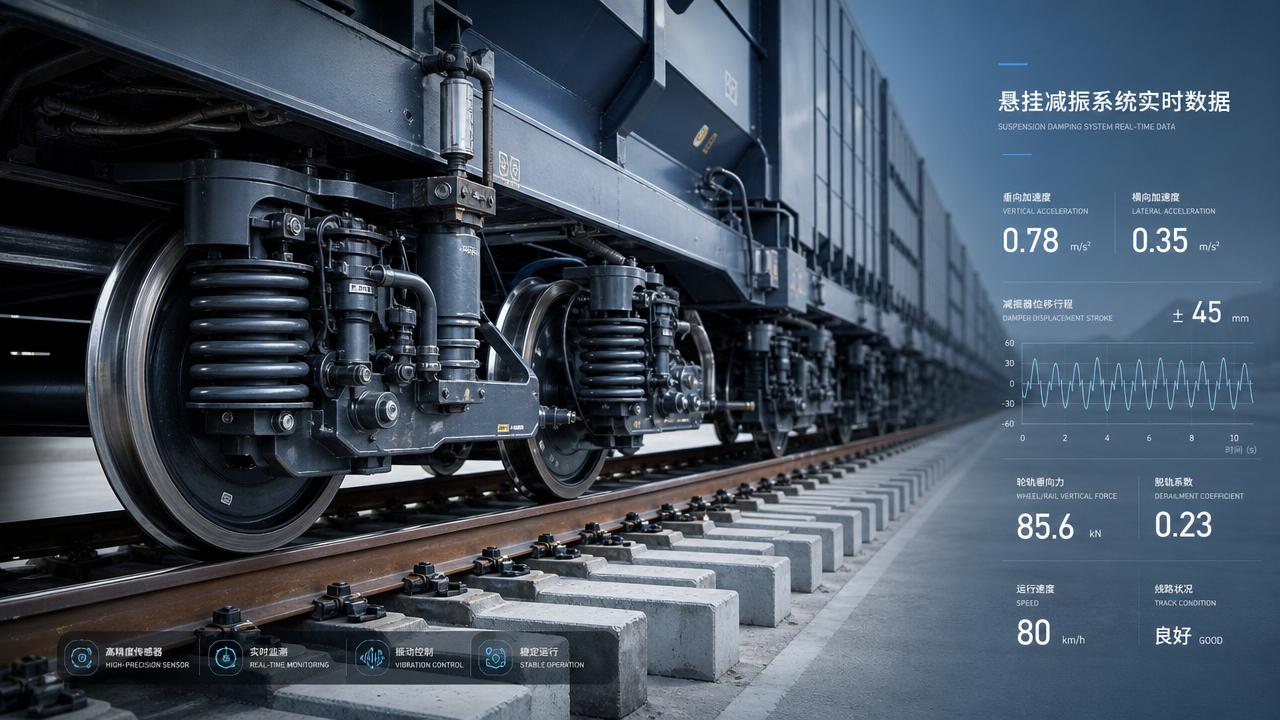
For technical evaluators, railway suspension damping data is not just a test output. It shows how a rail vehicle reacts to vibration, load transfer, wheel-rail excitation, and track defects. When read correctly, these signals explain ride stability, structural stress, maintenance timing, and operational safety across freight corridors, mixed-traffic routes, and heavy engineering programs.
What does railway suspension damping data actually measure?
At its core, railway suspension damping data describes how fast suspension movement is controlled after disturbance. It tracks oscillation decay, force response, displacement, acceleration, and resonance behavior.
In railway systems, damping sits between stiffness and mass. Springs carry load and allow movement. Dampers dissipate energy and prevent repeated bouncing, hunting, rolling, or pitch amplification.
Measured values often come from instrumented tests. These include accelerometers, bogie sensors, carbody motion channels, wheelset vibration pickups, and track geometry correlation records.
For G-RFE-style evaluation, the value of railway suspension damping data increases when it is linked with UIC, EN, or AAR acceptance logic. Raw numbers alone rarely support a reliable engineering decision.
Typical parameters reviewed in damping analysis
- Damping coefficient and effective damping ratio
- Vertical, lateral, and longitudinal acceleration trends
- Bounce, roll, yaw, and pitch response
- Frequency-domain peaks near critical modes
- Load-dependent response under empty and fully laden conditions
- Temperature-sensitive damper consistency
How does railway suspension damping data reveal ride stability?
Ride stability depends on how quickly energy is absorbed after the vehicle meets disturbance. A stable vehicle settles smoothly. An unstable one continues oscillating or shifts energy into another motion mode.
This is why railway suspension damping data matters. It exposes whether motion remains controlled across speed bands, axle loads, curve transitions, switch passages, and irregular track zones.
If vertical damping is too low, wagons may bounce longer after welded-joint impact or dipped rail. If lateral damping is insufficient, hunting risks rise at speed.
Excessive damping can also create problems. Overdamped systems may reduce suspension compliance, transfer more shock into the carbody, and increase component fatigue elsewhere.
Signals that usually indicate stable behavior
- Short settling time after disturbance
- Limited amplitude growth at higher speed
- No strong resonance spikes near operating ranges
- Balanced response between empty and loaded states
- Predictable bogie-to-carbody motion transfer
For heavy-haul operations, stable damping is especially important. Freight composition, axle load variation, and route roughness can shift dynamic behavior quickly and unexpectedly.
Which operating scenarios make railway suspension damping data most useful?
The usefulness of railway suspension damping data grows in demanding environments. It is most valuable where loading, speed, infrastructure quality, and environmental conditions vary significantly.
Heavy-haul freight corridors
Long consists and high axle loads place continuous stress on primary and secondary suspensions. Damping trends help identify whether wagons remain stable under extreme payload conditions.
Intermodal rail-port systems
Container imbalance and variable center-of-gravity positions can change carbody motion. Damping records help confirm whether the same platform remains safe across multiple loading patterns.
Mixed-quality infrastructure networks
Routes with different maintenance standards produce changing excitation inputs. Here, railway suspension damping data helps separate vehicle weakness from track-caused disturbance.
Locomotive and rolling stock modernization
Retrofit programs often replace springs, dampers, or bogie parts. Comparative damping signatures show whether upgrades improve stability or simply move the problem into another frequency band.
How should railway suspension damping data be interpreted for engineering decisions?
Interpretation should never rely on a single peak value. Good analysis compares speed, load, track class, suspension stage, and environmental context together.
First, identify the disturbance source. A response spike may come from wheel defects, rail geometry, worn dampers, or poor mass distribution.
Second, separate transient issues from persistent patterns. One harsh event may not indicate instability. Repeated signatures across runs usually deserve deeper investigation.
Third, compare measured behavior against design intent. A wagon designed for bulk minerals behaves differently from a high-speed passenger coach or a dual-purpose maintenance vehicle.
Fourth, align results with compliance frameworks. Railway suspension damping data becomes more actionable when matched with acceptance thresholds, maintenance rules, and fleet reliability targets.
A practical review sequence
- Confirm sensor quality and calibration.
- Map the test route and track condition.
- Split data by load case and speed range.
- Check vertical, lateral, and roll modes together.
- Compare repeated runs for consistency.
- Translate findings into maintenance or redesign actions.
What common mistakes distort railway suspension damping data conclusions?
One common mistake is judging damping quality without load context. Empty wagons and fully loaded wagons may produce very different motion signatures.
Another mistake is ignoring track geometry. Poor alignment, dipped joints, corrugation, and turnout transitions can imitate suspension weakness.
Temperature is also underestimated. Damper fluid properties can shift, changing measured response in cold or hot climates.
A further error is reviewing channels separately. Railway suspension damping data should be interpreted as a system, not as isolated acceleration lines.
Finally, some teams chase comfort-style metrics when the actual concern is freight stability, wheel unloading, or structural durability. The decision target must remain clear.
Quick risk reminders
- Do not compare data from unmatched routes.
- Do not ignore wheel and track condition records.
- Do not treat one successful test as lifecycle proof.
- Do not separate damping review from maintenance history.
How can organizations use railway suspension damping data to improve reliability and cost control?
Well-managed railway suspension damping data supports predictive maintenance. It helps detect weakening dampers, imbalance, or deteriorating ride behavior before visible damage escalates.
It also improves procurement validation. Comparative damping data can show whether a new bogie, damper model, or retrofit kit actually performs better in service conditions.
For network planners, damping trends support route compatibility studies. Vehicles that behave well on premium track may react differently on older freight lines.
For engineering governance, the data creates a stronger link between rolling stock design, maintenance scheduling, safety management, and corridor modernization planning.
Across modern freight and engineering networks, railway suspension damping data reveals how vehicles truly behave, not how they are expected to behave on paper. It turns motion, vibration, and load response into usable evidence for safer and more efficient operation.
The best next step is to review damping records together with track condition, loading patterns, maintenance history, and compliance benchmarks. That integrated view supports stronger fleet decisions and more resilient railway performance.
Industry Briefing
Get the top 5 industry headlines delivered to your inbox every morning.