
Railway wheelset wholesale quality checks that affect service life

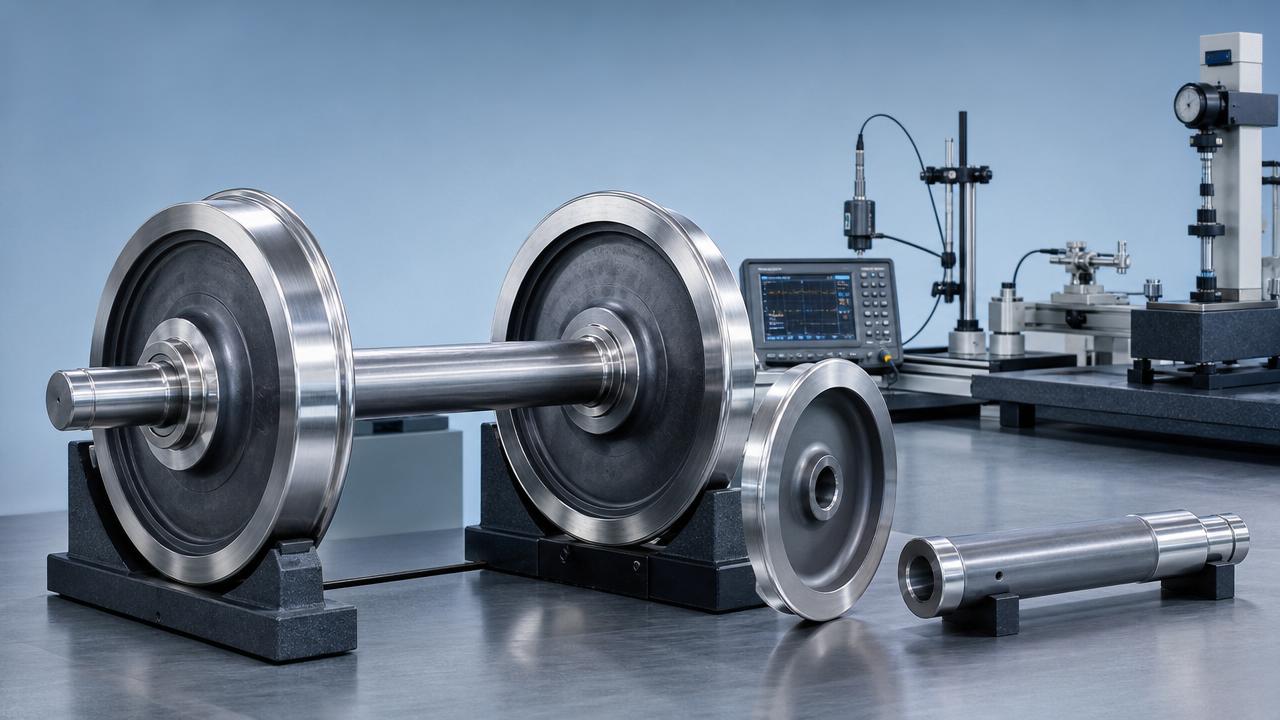
In railway wheelset wholesale, service life is determined long before installation—through disciplined quality checks on steel chemistry, heat treatment, dimensional accuracy, axle-fit tolerance, and fatigue resistance. For technical evaluators, understanding which inspection points truly predict field durability is essential to reducing lifecycle cost, preventing premature failure, and selecting suppliers that meet demanding freight and engineering standards.
Why do quality checks matter so much in railway wheelset wholesale?
For technical assessment teams, railway wheelset wholesale is not simply a price comparison between assemblies that look similar on a drawing. A wheelset is a fatigue-critical system made of wheels, axle, press-fit interfaces, and machined reference surfaces that must work together under repeated load cycles, braking heat, track irregularity, and environmental contamination. Small deviations introduced during steelmaking, forging, heat treatment, machining, or assembly can shorten service life dramatically even when the product appears acceptable at first delivery.
This is why quality checks in railway wheelset wholesale should be treated as predictors of in-service behavior rather than paperwork milestones. Freight operators, rolling stock builders, and EPC contractors need wheelsets that can survive high axle loads, long-haul mileage, curve negotiation, impact loading during shunting, and strict maintenance intervals. A weak quality control system may still produce passing certificates, but if the process capability is unstable, the result can be premature flange wear, thermal cracking, axle seat fretting, out-of-round wheels, or even catastrophic fatigue failure.
From an institutional perspective, especially in cross-border procurement governed by UIC, EN, and AAR expectations, the quality check regime is often more important than the nominal specification itself. Evaluators should therefore ask not only “Does the supplier meet the drawing?” but also “Which controls prove repeatable metallurgy, fit accuracy, and defect detection across batches?”
Which incoming material checks have the strongest effect on wheelset service life?
The first major checkpoint in railway wheelset wholesale is the integrity of raw material and forged blank quality. Service life starts with steel cleanliness. Non-metallic inclusions, segregation, hydrogen content, and chemistry variation can all create sites for crack initiation under cyclic stress. A supplier that only provides a basic mill certificate is rarely giving enough evidence for long-life freight applications.
Technical evaluators should review whether the wheel and axle steels are controlled for chemical composition ranges, deoxidation practice, grain structure, and internal soundness. For axles in particular, ultrasonic inspectability and low inclusion content are crucial because subsurface defects can grow over millions of cycles before becoming visible. Wheels require similar discipline because rim and web areas experience combined mechanical and thermal stress during operation and braking.
Questions worth asking suppliers include whether heat numbers remain traceable through forging and machining, whether macro-etch examinations are performed, how they verify freedom from laps and seams, and whether ultrasonic testing is conducted before and after major machining stages. In railway wheelset wholesale, traceability is not a clerical extra; it is the backbone of root-cause analysis if field failures occur.
What should a technical evaluator verify in material records?
How do heat treatment and hardness checks influence durability in railway wheelset wholesale?
Heat treatment is one of the most decisive factors in railway wheelset wholesale because it translates raw metallurgy into actual field performance. Correct heat treatment develops the balance between hardness, toughness, residual stress condition, and wear resistance. If the wheel rim is too soft, wear accelerates and reprofiling intervals shorten. If it is too hard or non-uniform, brittleness and crack sensitivity increase. For axles, insufficient toughness or unfavorable microstructure can undermine fatigue resistance even when tensile values appear compliant.
A capable supplier should not only report hardness values but also demonstrate process control: furnace calibration, quench uniformity, tempering consistency, and metallographic verification. Evaluators should look for hardness mapping rather than single-point readings, especially on wheel rims and critical axle transitions. Microstructure review can reveal whether the process actually achieved the required structure or whether decarburization, excessive residual stress, or abnormal transformation zones remain.
In practical terms, long service life comes from stability. A batch with average hardness in specification but wide piece-to-piece variation is less reliable than a slightly more conservative batch with excellent repeatability. In railway wheelset wholesale, consistency across production lots often predicts maintenance cost better than one excellent sample tested for approval.
Are dimensional accuracy and press-fit tolerance really as important as metallurgy?
Yes. Metallurgy determines intrinsic strength, but dimensional control determines whether that strength can be used safely in service. In railway wheelset wholesale, excellent steel can still fail early if wheel bore size, axle seat geometry, runout, concentricity, back-to-back spacing, or bearing journal dimensions drift outside a tightly controlled range. The press-fit interface between wheel and axle is especially sensitive because it must transmit torque and load without slippage or harmful residual stress concentration.
Technical evaluators should ask how the supplier controls machining reference systems, thermal conditions during measurement, gauge calibration, and statistical capability on fit-critical features. A single inspection report at final assembly is not enough. The best suppliers control dimensions through multiple gated inspections: after rough machining, after heat treatment, before press fitting, and after final assembly verification.
Poor fit tolerance can create several hidden risks: micro-movement at the interface, local overstress, assembly damage, distorted geometry, and reduced fatigue life at wheel seats. Excessive interference may damage components during pressing or leave harmful residual conditions. Insufficient interference can allow fretting or movement over time. For this reason, railway wheelset wholesale should always be evaluated through process capability data, not only nominal tolerance tables.
Which dimensional checks deserve the closest attention?
The most critical dimensional checkpoints usually include wheel bore diameter, axle wheel-seat diameter, roundness, coaxiality, wheel back-to-back distance, radial runout, bearing journal size, surface finish at press-fit zones, and geometric transitions such as fillets. These features affect assembly integrity, dynamic behavior, and long-term crack resistance. For freight applications with heavy axle loads, even modest instability in these values can multiply wear and vibration over time.
What non-destructive testing and fatigue checks should buyers expect?
In railway wheelset wholesale, non-destructive testing is the bridge between manufacturing intent and defect-free delivery. Ultrasonic testing is essential for axles and often for wheel zones where internal defects would be dangerous. Magnetic particle or similar surface-sensitive methods help identify cracks, laps, and grinding or machining damage at critical surfaces. The key question is not simply whether NDT is performed, but whether it is performed at the right stages by qualified personnel using validated procedures and calibrated equipment.
Fatigue validation deserves equal attention. Not every purchase order requires full-scale repeated type testing, but technical evaluators should understand what fatigue evidence supports the offered design and process route. This may include material fatigue data, destructive process validation, press-fit verification, residual stress evaluation, or historical service records from comparable duty cycles. A supplier with strong documentation can usually explain how design geometry, surface finish, and process control support fatigue life under freight duty.
When railway wheelset wholesale is sourced globally, NDT acceptance criteria should be aligned early. One market may be accustomed to one standard family, while another follows different defect grading language. Without agreement before production, disputes often arise at final inspection even when the hardware itself is acceptable.
What are the most common mistakes technical evaluators make during supplier comparison?
A frequent mistake is overvaluing certificate completeness while undervaluing process discipline. In railway wheelset wholesale, polished documentation can hide weak statistical control or inconsistent subcontract management. Another error is comparing hardness, tensile strength, or price without considering the whole wheelset system: wheel steel, axle steel, bore-seat matching, press-fit procedure, NDT sequence, and traceability architecture all interact.
Evaluators also sometimes assume that compliance with one recognized standard automatically means fitness for every operating environment. In reality, route curvature, braking profile, axle load, ambient climate, maintenance strategy, and wheel reprofiling practices all influence which quality checks matter most. A wheelset suitable for moderate passenger service may be poorly optimized for high-tonnage freight, even if both are technically compliant.
Another common risk in railway wheelset wholesale is insufficient audit depth. Buyers may review test reports but not inspect how dimensions are measured, how rejected parts are segregated, how pressing force is monitored, or how heat-treatment lots are managed. Service life depends on factory discipline, not just on final numbers.
A practical comparison checklist for railway wheelset wholesale
Before placing an order, what should be confirmed first?
Before finalizing railway wheelset wholesale, technical evaluators should confirm five practical points. First, align the operating duty: axle load, speed range, braking regime, route condition, and maintenance philosophy. Second, align the governing standard set and acceptance criteria, including any customer-specific deviations. Third, define the exact manufacturing and inspection hold points, including witness requirements and document package content. Fourth, verify batch traceability from steel heat to final wheelset serial number. Fifth, confirm how nonconformities, retests, and warranty investigations will be handled.
These discussions matter because railway wheelset wholesale often spans multiple countries, production sites, and inspection cultures. A technically strong supplier becomes much easier to approve when requirements are translated into measurable controls rather than broad quality promises. Conversely, vague purchase documents invite dispute, schedule delay, and inconsistent service outcomes.
For organizations managing critical freight corridors, the best procurement decision is rarely the lowest initial quote. It is the supplier whose quality checks most convincingly predict long service life, stable maintenance intervals, and dependable traceability under real operating stress. If you need to confirm a specific solution, parameters, qualification path, lead time, budget, or cooperation model, start by discussing operating duty, required standards, fit tolerances, NDT scope, traceability depth, and field-life expectations before comparing prices.
Industry Briefing
Get the top 5 industry headlines delivered to your inbox every morning.