How to Compare a Railway Axle Manufacturer Beyond Price

Choosing a railway axle manufacturer on price alone can expose procurement teams to hidden risks in safety, lifecycle cost, compliance, and delivery reliability. This guide shows how to evaluate suppliers through engineering capability, material standards, testing systems, certifications, and after-sales support, helping buyers make informed decisions that protect both operational performance and long-term project value.
Why price alone is a weak filter when selecting a railway axle manufacturer
For procurement teams in rail freight, infrastructure, and rolling stock projects, an axle is not a commodity in the ordinary sense. It is a safety-critical component that directly affects fatigue life, wheelset stability, maintenance intervals, and fleet availability. A low initial quote from a railway axle manufacturer may look attractive during tender comparison, but it can hide major differences in metallurgy, machining control, testing discipline, traceability, or packaging for long-distance export.
This is especially important in cross-border freight corridors, heavy-haul operations, and mixed-standard projects where UIC, EN, and AAR references may all influence specifications. In these environments, the right supplier decision depends less on headline price and more on whether the manufacturer can consistently deliver compliant axles under demanding load, climate, and inspection conditions.
From the perspective of G-RFE, which benchmarks rail engineering assets against international standards and practical operating demands, the smarter procurement question is not “Who is cheapest?” but “Which railway axle manufacturer can reduce technical, operational, and contractual risk over the full service life?”
- Initial unit price may exclude stricter ultrasonic testing, fatigue verification, or documentation packages required by project owners.
- A cheaper axle can raise downstream costs through more frequent inspection, higher rejection rates, or delayed wagon commissioning.
- If traceability is weak, warranty claims and root-cause analysis become difficult after field incidents.
What should procurement teams compare first?
Before comparing quotations from any railway axle manufacturer, procurement should align technical scope with actual operating duty. An axle for a metro maintenance vehicle, a standard freight wagon, and a heavy-haul ore train will not face the same dynamic loads, duty cycles, track quality, or maintenance strategy. That means a valid comparison starts with application conditions, not only with dimensions or basic drawings.
The table below gives a practical supplier assessment framework that buyers can use in RFQ review, technical clarification, and final vendor scoring.
A capable railway axle manufacturer should score well across all five areas, not just one or two. For procurement, this table also helps separate suppliers that can support long-term rail asset performance from those that mainly compete on nominal cost.
How to judge engineering capability behind the quotation
Look beyond the drawing and ask about process control
Many offers can match the same outline drawing, but the engineering discipline behind the part may differ sharply. Procurement should ask how the railway axle manufacturer controls raw material sourcing, forging reduction ratio, heat treatment windows, machining sequence, and final inspection release. Two axles with the same nominal dimensions can perform differently if process capability is unstable.
Check whether the supplier understands service conditions
A reliable supplier asks informed questions about axle load, route conditions, braking regime, wheel diameter, bearing arrangement, corrosion exposure, and maintenance intervals. That is a positive signal. It suggests the railway axle manufacturer is evaluating real operating stress rather than simply pricing a drawing file.
Review manufacturing evidence, not only brochures
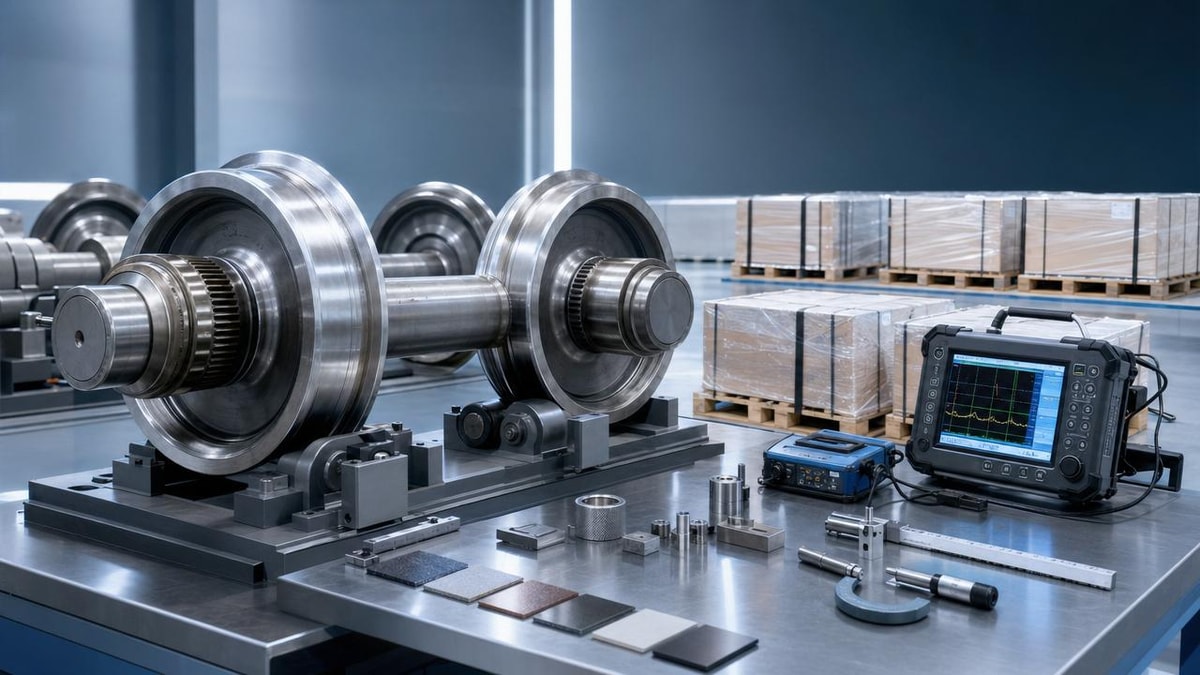
Procurement teams should request sample inspection plans, example material certificates, dimensional check sheets, and non-destructive testing records from prior production batches. Even where project confidentiality applies, a serious manufacturer can usually provide sanitized quality evidence that shows control maturity.
- Ask whether the supplier performs process capability monitoring on critical dimensions.
- Confirm if heat treatment records are linked to each axle serial or batch number.
- Verify how rejected parts are segregated and how concession requests are managed.
Which technical and quality indicators matter most for a railway axle manufacturer?
In rail procurement, the most useful indicators are those that reveal whether quality is built into the process rather than checked only at the end. Buyers do not need to become axle designers, but they do need to know which technical signals indicate lower lifecycle risk.
The table below summarizes key indicators that can support a more rigorous comparison of a railway axle manufacturer during technical review.
For buyers managing regional or international rail projects, these indicators provide a stronger basis for supplier comparison than price variance alone. They also align with the kind of evidence-based assessment that G-RFE promotes across rolling stock and freight corridor procurement.
How standards, certification, and documentation affect approval risk
A railway axle manufacturer may offer acceptable production quality but still become a poor fit if project documentation is incomplete or misaligned with the applicable standard framework. For cross-border tenders, consultant-reviewed packages, or authority-linked rail programs, document readiness can be as important as production readiness.
Common compliance checkpoints
- Alignment with project-referenced standards such as UIC, EN, AAR, or operator-specific specifications.
- Availability of material certificates, heat treatment records, NDT reports, and dimensional inspection reports.
- Clear marking and serial traceability for each axle or batch.
- Defined inspection and test plan for witness points, hold points, and final release.
When documentation is weak, the cost impact appears later: delayed approvals, repeated clarifications, port holds, site rejection, or extended FAT and incoming inspection. Procurement teams should therefore evaluate compliance response speed during the bidding phase. Slow, vague, or generic answers often indicate future execution friction.
G-RFE’s standards-focused approach is useful here because rail procurement rarely happens in isolation. Axle decisions interact with wheelsets, bogies, maintenance practice, and corridor operating rules. A supplier that understands this wider system context is easier to qualify and manage.
What delivery reliability and service support reveal about the real supplier value
A railway axle manufacturer should be evaluated as a long-term supply partner, not only a one-time part vendor. In fleet expansion, wagon overhaul, or EPC rail packages, late deliveries can disrupt assembly schedules, commissioning milestones, and track possession plans. Procurement therefore needs visibility into production capacity, export packaging, lead time discipline, and response procedures for non-conformities.
- Confirm normal and peak lead times, including raw material dependence and machining bottlenecks.
- Ask how the supplier handles urgent replacement batches for maintenance or accident recovery.
- Review export packing methods for corrosion prevention, impact protection, and marking durability.
- Clarify the escalation process for quality claims, root-cause analysis, and corrective action timelines.
In practice, a supplier with moderate pricing but stable delivery and strong technical follow-up may create lower total procurement risk than a lower-cost source with uncertain schedule performance. This matters even more for institutional buyers serving national operators, Tier-1 rolling stock programs, or international freight corridors where schedule slippage has broad contractual consequences.
A practical procurement workflow for comparing railway axle manufacturers
To compare suppliers consistently, procurement teams should avoid informal judgment and adopt a structured review sequence. This reduces bias, improves internal alignment with engineering and quality teams, and makes award decisions easier to defend.
Recommended evaluation steps
- Define the operating case clearly, including axle load, service environment, maintenance philosophy, and referenced standards.
- Issue a technical RFQ that asks not only for price, but also for process flow, testing scope, documents, and delivery commitments.
- Screen each railway axle manufacturer for compliance completeness before commercial comparison.
- Conduct technical clarification with engineering, quality, and procurement stakeholders together.
- Apply a weighted scorecard that balances price, technical capability, compliance, lead time, and support.
- If the order value or risk level is high, plan an audit or remote process review before final award.
This method is particularly valuable for buyers managing diversified rail programs where wheelsets, bearings, braking, and track conditions all affect axle performance. It also reflects the system-level thinking used by G-RFE across heavy-haul rolling stock, rail infrastructure, and engineering procurement.
Common mistakes buyers make when evaluating a railway axle manufacturer
Mistake 1: treating the axle as a standard metal part
This underestimates the safety-critical nature of the component and leads to insufficient technical review. Even small process deviations can affect fatigue behavior and maintenance risk over time.
Mistake 2: comparing offers without harmonizing scope
One supplier may include broader NDT scope, better documentation, or stricter packaging, while another does not. If scope is not normalized, the cheapest bid may simply be the least complete bid.
Mistake 3: ignoring after-sales engineering response
In rail projects, issues rarely end at shipment. Buyers should know who will answer technical queries, review installation concerns, and support non-conformance handling after delivery.
Mistake 4: overlooking documentation lead time
Even when production is on time, incomplete certificates or inspection dossiers can delay project acceptance. For international shipments, document quality can be a major schedule variable.
FAQ: what procurement teams often ask
How do I compare two railway axle manufacturer quotations fairly?
Start by equalizing scope. Confirm that both quotations cover the same material grade, manufacturing route, testing scope, documentation package, marking, packaging, and delivery terms. Then compare lifecycle risk factors such as inspection rigor, traceability, and lead time reliability, not just the unit price.
Which documents should I request before purchase order placement?
Typical requests include material certificates, draft inspection and test plan, sample dimensional report format, NDT procedure summary, heat treatment record format, traceability method, packing method statement, and a list of applicable standards. The exact package depends on project requirements, but buyers should request enough evidence to assess process control before award.
Is the lowest-cost railway axle manufacturer ever the right choice?
Sometimes yes, but only if technical scope, compliance, and delivery performance are demonstrably equivalent. In many rail procurements, the apparent savings disappear if the lower-cost source causes reinspection, shipment delay, or early service issues.
When should I involve a technical advisor or platform like G-RFE?
It is especially useful when the project spans multiple standards, involves heavy-haul or international freight applications, or requires coordination between rolling stock hardware and wider corridor engineering requirements. An informed technical review can reduce specification ambiguity and improve supplier selection quality.
Why informed comparison creates better long-term value
The best railway axle manufacturer for a project is rarely defined by quote price alone. The stronger choice is the supplier that can support the target duty cycle, meet the required standard framework, provide reliable documentation, control manufacturing variation, and respond effectively when issues arise. For procurement teams, this approach reduces hidden cost and improves confidence in award decisions.
In the broader rail ecosystem, axle sourcing should be evaluated within the realities of wagon performance, maintenance planning, corridor safety, and international compliance. That is where G-RFE adds value: by bringing a technical intelligence perspective across heavy-haul rolling stock, rail infrastructure, signaling-linked operating conditions, and freight logistics integration.
Why choose us for technical comparison and supplier shortlisting
If you are comparing a railway axle manufacturer for a new tender, fleet renewal, overhaul package, or export rail project, G-RFE can help you move beyond superficial bid review. Our focus is not generic sourcing advice. We support decision-makers with standards-aware, engineering-led evaluation aligned with real rail operating conditions.
- Parameter confirmation: review duty conditions, axle load assumptions, drawing completeness, and critical technical checkpoints before RFQ release.
- Product selection support: compare supplier scope, manufacturing evidence, and quality control depth for more defensible vendor shortlists.
- Delivery cycle assessment: identify schedule risks related to material route, production capacity, documentation preparation, and export packing.
- Customized solution review: align axle procurement with wheelsets, bogie interfaces, freight duty profile, and corridor compliance expectations.
- Certification and documentation guidance: clarify what evidence may be needed for consultant review, operator approval, or project handover.
- Quotation communication support: structure supplier questions so you can compare bids on a like-for-like basis.
If your procurement team is under pressure to balance budget, compliance, and delivery timing, contact us with your application scenario, required standards, expected order volume, and target schedule. We can help you define comparison criteria, reduce technical ambiguity, and build a stronger shortlist of railway axle manufacturer options for your project.
Industry Briefing
Get the top 5 industry headlines delivered to your inbox every morning.