Railway Wheelset Wholesale: Where Cheap Quotes Often Go Wrong

In railway wheelset wholesale, the lowest quote rarely delivers the lowest total cost. For finance approvers balancing capex, compliance, and lifecycle risk, cheap offers can hide weak metallurgy, incomplete certifications, inconsistent tolerances, and costly downtime. This article explains where low-price sourcing often fails and how to evaluate wheelset suppliers with a sharper commercial and technical lens.
What railway wheelset wholesale really covers
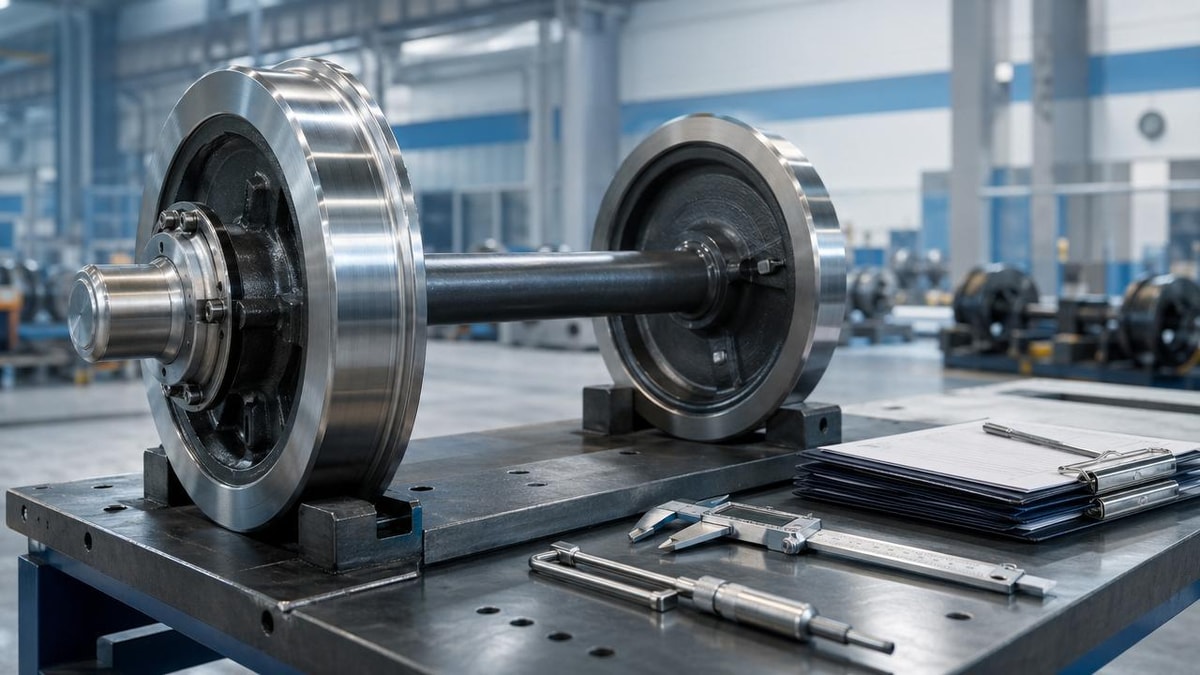
At a basic level, railway wheelset wholesale refers to bulk supply of assembled wheelsets for freight wagons, locomotives, maintenance vehicles, and other rolling stock. A wheelset is not just two wheels on an axle. It is a safety-critical rotating assembly whose performance affects load stability, braking behavior, track wear, noise, energy efficiency, and fleet availability. In freight corridors where axle loads are high and operating windows are tight, wheelset quality directly influences both asset life and operational continuity.
For finance approvers, this matters because wheelsets sit at the intersection of procurement price, maintenance cost, safety exposure, and compliance liability. A cheap quote can look attractive in a spreadsheet, yet fail under closer review when heat treatment traceability, ultrasonic test records, dimensional tolerance control, or bearing seat consistency are missing. In other words, railway wheelset wholesale should be evaluated as a lifecycle asset decision, not as a commodity metal purchase.
Why the market pays close attention to low quotes
The global rail sector is under pressure to expand freight capacity, decarbonize land transport, and improve corridor reliability. That has increased demand for qualified components across heavy-haul networks, intermodal systems, and industrial rail operations. At the same time, procurement teams face budget constraints, currency risk, and pressure to reduce upfront capex. This creates ideal conditions for aggressive pricing in railway wheelset wholesale.
However, wheelsets are governed by tight engineering and regulatory expectations. International references such as UIC, EN, and AAR are not marketing badges; they shape material selection, manufacturing discipline, inspection routines, and acceptance criteria. Suppliers that truly manufacture to these standards carry costs related to forging quality, machining precision, heat treatment control, nondestructive testing, balancing, and documentation. When a quote is dramatically lower than the qualified market range, the difference usually comes from somewhere concrete.
Where cheap railway wheelset wholesale quotes often go wrong
Low pricing is not automatically a red flag. Some suppliers benefit from scale, localized steel sourcing, or efficient production lines. The problem begins when low quotes are supported by incomplete technical scope or weak quality assurance. The most common failure points include the following.
Material and metallurgy shortcuts
Wheel and axle steel chemistry, cleanliness, grain structure, and heat treatment consistency are fundamental. If material certificates are generic, recycled across batches, or disconnected from actual serial numbers, fatigue performance becomes uncertain. This may not show up at delivery, but it can surface later as shelling, cracking, premature wear, or axle integrity concerns.
Incomplete certification packages
Some offers appear compliant but provide only partial documentation. Missing items may include mechanical test data, ultrasonic test reports, hardness mapping, wheel press-fit records, traceability logs, or witness inspection evidence. For a finance approver, absent documents increase the chance of delayed acceptance, dispute costs, and insurance or warranty complications.
Weak dimensional control
Railway wheelset wholesale depends on precision. Small deviations in wheel profile, back-to-back distance, axle journal dimensions, or bearing seat tolerances can trigger vibration, abnormal wear, braking issues, and fitment failures during assembly. Rework, return freight, and service interruption can erase any nominal savings quickly.
Misleading scope assumptions
A low quote may exclude coatings, balancing, packaging standards, corrosion protection, spare documentation, or destination inspection support. It may also assume lower load ratings, different duty cycles, or a non-equivalent standard. Unless the technical baseline is normalized, quote comparison is unreliable.
A practical overview for finance-led evaluation
Finance decision-makers do not need to become metallurgists, but they do need a disciplined framework. The most useful approach is to connect each technical item with its commercial consequence. The table below provides a high-level lens for reviewing railway wheelset wholesale proposals.
Business value across different rail applications
Not every wheelset serves the same duty profile. A finance approver reviewing railway wheelset wholesale should consider how operating context changes risk and value. Heavy-haul freight, cross-border wagons, industrial railcars, and maintenance fleets all impose different loading patterns, speed ranges, and maintenance expectations.
How total cost of ownership changes the sourcing decision
In railway wheelset wholesale, unit price is only one layer of cost. The fuller picture includes inspection effort, storage losses, installation delays, wheel reprofiling frequency, failure rates, inventory carrying cost, and service interruption. A wheelset that costs 8% less upfront but requires more frequent replacement or causes even a single major outage can become the more expensive choice over its service life.
This is especially relevant for organizations managing strategic freight corridors or large wagon fleets. The real question is not “Which quote is cheapest today?” but “Which supplier reduces financial volatility over time?” When finance teams model downtime probability, rejection risk, and residual life uncertainty, many low-price offers lose their apparent advantage.
What a stronger supplier review process looks like
A mature review process combines procurement discipline with technical validation. For railway wheelset wholesale, the strongest buyers usually align commercial, engineering, and quality teams before final approval. That does not slow decisions; it prevents expensive surprises after purchase order release.
A practical review sequence may include specification normalization, document checklist validation, sample report review, plant capability assessment, and clear warranty language. If the supplier claims compliance with international standards, ask whether those claims are supported by recent production references, not just historical certificates. If the quote includes custom wheel profiles or unusual axle loads, verify that the manufacturer has actual process experience with equivalent duty conditions.
For larger programs, independent inspection or third-party witnessing can be worth the added cost. It is often far cheaper than resolving disputes after shipment. Institutions involved in complex rail infrastructure and rolling stock decisions, including technical intelligence platforms such as G-RFE, increasingly emphasize benchmark-based evaluation because rail hardware performance cannot be separated from regulatory, safety, and lifecycle realities.
Key warning signs in railway wheelset wholesale offers
- Pricing far below market without a clear production or scale explanation.
- Certificates that do not match serial numbers, batches, or current drawings.
- Vague wording around UIC, EN, or AAR compliance.
- No clear statement of inspection methods or acceptance criteria.
- Limited response on fatigue life, wheel press-fit control, or machining tolerance capability.
- Warranty terms that exclude field removal, freight, or consequential service losses.
Practical guidance for finance approvers
If you are the final approver, focus on comparability and downside protection. Require all suppliers in a railway wheelset wholesale bid to quote against the same technical baseline, documentation package, inspection scope, and delivery definition. Ask for the cost impact of nonconformance, not just the initial discount. Confirm whether replacement stock, field support, and quality claims handling are contractually defined. These steps improve decision quality without forcing finance teams into unnecessary technical detail.
It also helps to separate “cheap” from “efficient.” Efficient suppliers can demonstrate process control, repeatability, and traceable performance. Cheap suppliers often rely on ambiguity. In a safety-critical sector such as rail, ambiguity is usually where hidden cost begins.
Conclusion and next-step perspective
Railway wheelset wholesale deserves a broader lens than unit price alone. The subject matters because wheelsets influence safety, compliance, operating reliability, and long-term asset economics across freight and engineering networks. For financial decision-makers, the best path is to connect technical credibility with commercial outcome: standards compliance, traceability, precision, inspection discipline, and support responsiveness all have measurable cost implications.
When reviewing future railway wheelset wholesale proposals, treat abnormally low quotes as a signal for deeper verification rather than instant savings. A supplier that can explain its quality controls, prove conformance, and support lifecycle performance will usually protect capital more effectively than one that wins only on price. In modern rail procurement, disciplined evaluation is not an administrative burden; it is a financial safeguard.
Industry Briefing
Get the top 5 industry headlines delivered to your inbox every morning.