

Environmental Equipment News: Sustainable Materials to Watch
As rail freight networks accelerate decarbonization, material selection is becoming a core engineering and procurement decision.
This environmental equipment news for sustainable materials highlights innovations that technical evaluators should track across locomotives, infrastructure, signaling assets, and intermodal terminals.
What Technical Evaluators Are Really Trying to Determine
The main search intent is not curiosity about green materials. Evaluators want to know which materials are technically credible, commercially available, and operationally safe.
For railway freight and engineering teams, sustainability claims only matter when they survive load cycles, vibration, weathering, electromagnetic constraints, and maintenance realities.
The strongest question is whether a material can lower lifecycle emissions without creating new risks in durability, certification, inspection, or replacement planning.
That makes material evaluation less about novelty and more about evidence, standards alignment, supplier maturity, and measurable performance across critical logistics corridors.
Why Sustainable Materials Now Matter in Rail Freight Engineering
Rail freight is already efficient compared with road transport, yet heavy-haul corridors still rely on carbon-intensive steel, concrete, polymers, coatings, and insulation.
Infrastructure owners are facing stricter procurement rules, embedded-carbon disclosure requirements, and investor pressure to document emissions across asset lifecycles.
At the same time, network capacity expansion demands materials that perform under heavier axle loads, higher train frequencies, and harsher climate conditions.
Sustainable material selection therefore becomes a technical risk-management tool, not a public-relations exercise or a minor purchasing preference.
The right materials can reduce embodied carbon, extend service intervals, improve corrosion resistance, and support circular maintenance programs across railway systems.
Low-Carbon Steel: The First Material Category to Benchmark
Steel remains the dominant material in rails, wheels, bogies, bridges, fasteners, couplers, wagons, and locomotive structures.
For evaluators, low-carbon steel deserves priority because even modest emission reductions can create meaningful impact at railway procurement scale.
Technical teams should distinguish between recycled-content steel, electric-arc furnace steel, hydrogen-reduced steel, and steel backed only by offsets.
Each route has different implications for metallurgical consistency, residual elements, fatigue behavior, weldability, cost, and supply reliability.
Rail applications require strict control of hardness, fracture toughness, rolling contact fatigue, and resistance to wear under high axle loads.
A credible supplier should provide product-specific environmental declarations, heat-level traceability, mechanical test data, and compatibility with UIC, EN, or AAR requirements.
Low-carbon steel is most attractive where performance specifications remain unchanged and emissions savings can be verified without redesigning the component.
Recycled and Hybrid Composites for Non-Primary Structures
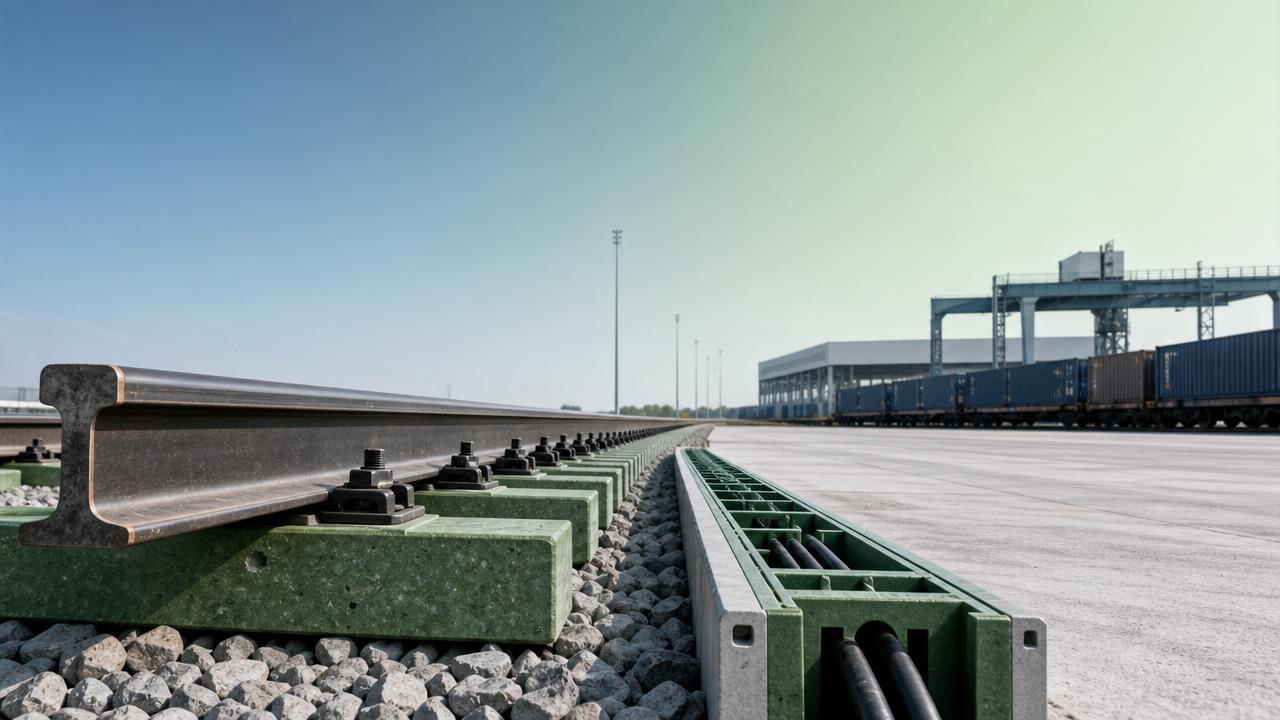
Recycled composites are gaining attention for cable troughs, covers, interior panels, equipment housings, walkway surfaces, and certain terminal components.
They can reduce weight, reuse industrial waste streams, and resist corrosion in environments where conventional metals require frequent coating maintenance.
However, technical evaluators should avoid treating composites as universal replacements for metallic or concrete railway components.
Key concerns include fire performance, smoke toxicity, UV stability, impact resistance, creep, repairability, and end-of-life recyclability.
For signaling and communication assets, dielectric properties and electromagnetic compatibility can be advantages when properly validated.
Composite adoption is most defensible in secondary structures where failure consequences are limited, inspection access is simple, and replacement logistics are manageable.
Procurement specifications should require accelerated aging data, fire classification evidence, mechanical testing, and documented field references in comparable climates.
Green Concrete and Cement Alternatives for Track and Terminal Works
Concrete appears throughout rail networks, including sleepers, foundations, retaining walls, drainage channels, platforms, bridges, and intermodal terminal pavements.
Because cement production is emissions-intensive, lower-carbon concrete mixes are central to environmental equipment news for sustainable materials.
Options include supplementary cementitious materials, geopolymer binders, recycled aggregates, carbon-cured concrete, and optimized mix designs using performance-based specifications.
The engineering challenge is to reduce embodied carbon while preserving compressive strength, freeze-thaw resistance, chloride resistance, dimensional stability, and fatigue performance.
Railway applications are unforgiving because premature cracking can accelerate water ingress, corrosion, settlement, and maintenance disruption.
Technical evaluators should request durability modeling, curing requirements, strength-development timelines, and compatibility with construction schedules.
Green concrete is particularly valuable in terminal expansions and civil works where large volumes make carbon savings measurable and commercially meaningful.
Bio-Based Insulation and Interior Materials for Rolling Stock
Bio-based insulation, natural-fiber panels, and renewable polymer blends are increasingly proposed for locomotive cabins and freight vehicle ancillary spaces.
They may reduce petroleum dependence, improve thermal comfort, and support lower embodied carbon targets in rolling stock procurement.
Yet railway interiors must satisfy fire, smoke, toxicity, vibration, moisture, and cleaning requirements across long service lives.
Materials derived from flax, hemp, cellulose, cork, or bio-resins need evidence beyond laboratory sustainability narratives.
Evaluators should examine fire performance under relevant standards, off-gassing behavior, fungal resistance, acoustic properties, and long-term dimensional stability.
Bio-based materials are most practical when they replace conventional insulation or panels without affecting crashworthiness, electrical safety, or maintainability.
For heavy-haul locomotives, benefits are likely incremental but useful when combined with cabin efficiency, operator comfort, and noise-control improvements.
Corrosion-Resistant Coatings with Lower Environmental Burden
Coatings are a high-impact material category because corrosion directly affects asset life, inspection frequency, structural integrity, and maintenance cost.
Sustainable coating innovation includes low-VOC systems, waterborne formulations, powder coatings, zinc alternatives, ceramic hybrids, and longer-life protective systems.
For rail infrastructure, the best environmental result often comes from extending repainting intervals and reducing surface-preparation waste.
Evaluators should compare total lifecycle impact rather than only the chemical profile of the coating at application.
Important criteria include salt-spray performance, abrasion resistance, edge retention, curing conditions, field repairability, and compatibility with existing substrates.
Bridge steel, terminal equipment, coastal trackside cabinets, and rolling stock underframes are practical candidates for advanced protective systems.
A lower-toxicity coating that fails early is not sustainable; a durable system with controlled application risks may deliver better lifecycle performance.
Circular Components for Maintenance-Intensive Railway Assets
Circularity becomes most valuable where components are replaced frequently, returned predictably, and traceable through maintenance systems.
Examples include brake components, polymer pads, insulation covers, cable management products, fastener assemblies, filters, and consumable maintenance parts.
For technical evaluators, circular materials should be judged by closed-loop feasibility rather than broad recycling claims.
A supplier should show collection mechanisms, reprocessing capacity, contamination controls, quality assurance, and warranty treatment for recovered material.
Digital asset tracking can improve circularity by linking material batches, installation dates, inspection results, and retirement pathways.
Railway operators benefit when circular programs reduce disposal cost, stabilize spare-parts supply, and support environmental reporting without disrupting maintenance windows.
The most credible programs start with standardized components and predictable replacement cycles, not complex bespoke assemblies.
How to Evaluate Claims Before Approving a Material
Technical evaluators should separate marketing claims from engineering evidence through a structured qualification process.
The first step is defining the functional requirement: load, environment, safety consequence, inspection method, and expected service life.
The second step is requesting comparable test data, field references, certification documents, and product-specific environmental declarations.
The third step is assessing integration risk, including installation equipment, workforce skills, storage requirements, repair procedures, and spare-parts availability.
The fourth step is calculating lifecycle cost, not just purchase price or headline carbon reduction.
Maintenance frequency, downtime exposure, disposal cost, warranty coverage, and failure consequences often decide whether a sustainable material creates real value.
For safety-critical railway assets, pilot deployment should be controlled, instrumented, and tied to predefined acceptance criteria.
Standards, Documentation, and Regulatory Readiness
Sustainable materials must still fit within railway certification regimes, procurement standards, and asset-management frameworks.
Evaluators should map each material to applicable UIC, EN, AAR, ISO, fire-safety, environmental, and national infrastructure requirements.
Documentation quality is a strong indicator of supplier maturity, especially when materials are proposed for cross-border freight corridors.
Useful documents include environmental product declarations, material safety data, mechanical test reports, fatigue data, fire certificates, and installation manuals.
Where standards do not yet address a new material directly, equivalency assessments and independent third-party testing become essential.
Regulatory readiness also includes end-of-life handling, hazardous substance restrictions, worker exposure limits, and waste classification.
Procurement teams should avoid approving materials whose compliance burden is unclear, even when their sustainability profile appears attractive.
Where These Materials Fit Across Railway Freight Systems
Heavy-haul locomotives are likely to adopt sustainable materials selectively, especially in coatings, insulation, non-structural panels, and service components.
Rolling stock may see broader adoption in wagon interiors, protective finishes, composite covers, friction-related components, and traceable recycled metals.
Track systems will prioritize low-carbon steel, durable concrete, recycled polymers, improved fastener materials, and longer-life corrosion protection.
Signaling and communication assets can benefit from weather-resistant composites, low-impact enclosures, cable protection systems, and modular repairable housings.
Intermodal rail-port systems may present the fastest business case because pavements, structures, barriers, and equipment supports consume large material volumes.
Specialized rail engineering machinery can use sustainable coatings, remanufacturable components, recycled hydraulic covers, and lower-impact operator environment materials.
The best adoption strategy is application-specific, beginning with low-risk assets and expanding after performance data confirms reliability.
Commercial Risks Technical Teams Should Not Ignore
Sustainable materials can introduce supply-chain risk when capacity is limited, feedstock quality varies, or production depends on emerging technologies.
Price volatility may also affect materials based on recycled metals, bio-based feedstocks, or specialized low-carbon processing routes.
Another risk is specification lock-in, where only one supplier can meet a novel sustainability requirement.
Technical evaluators should balance innovation with competitive sourcing, especially for assets needing long-term spare-parts support.
Warranty terms deserve careful review because some suppliers exclude field conditions that are common in railway operations.
There is also reputational risk if carbon claims depend on weak accounting, offsets, or unverifiable recycled-content declarations.
A strong procurement process requires both engineering validation and sustainability assurance, preferably reviewed by independent technical and environmental specialists.
Practical Selection Framework for 2026 Procurement Planning
For upcoming procurement cycles, evaluators can classify sustainable materials into three adoption categories.
The first category is ready-to-specify materials, including verified low-carbon steel, durable low-VOC coatings, and proven lower-carbon concrete mixes.
The second category is pilot-ready materials, such as recycled composites, circular maintenance components, and bio-based insulation in non-critical applications.
The third category is watch-list materials, including hydrogen-reduced specialty steels, advanced bio-polymers, and high-recycled-content structural composites.
Ready-to-specify materials should be incorporated into tenders with clear performance and documentation requirements.
Pilot-ready materials should be tested under controlled operating conditions with inspection intervals and failure thresholds defined before installation.
Watch-list materials should be monitored through supplier audits, standards development, field trials, and cost curves before large-scale commitment.
Final Takeaway for Railway Technical Evaluators
The most important sustainable materials are not always the newest or most publicized.
They are the materials that reduce lifecycle impact while preserving safety, reliability, maintainability, and regulatory confidence.
Low-carbon steel, green concrete, advanced coatings, recycled composites, bio-based interiors, and circular maintenance parts all deserve attention.
However, each category should be evaluated by application risk, evidence quality, lifecycle cost, and compatibility with railway standards.
For G-RFE’s audience, the practical conclusion is clear: sustainability must be engineered into specifications, not added as a late procurement label.
Technical teams that build disciplined material-evaluation frameworks will capture emissions benefits while protecting corridor reliability and long-term asset performance.