
Clean Air Equipment News: Compliance Trends

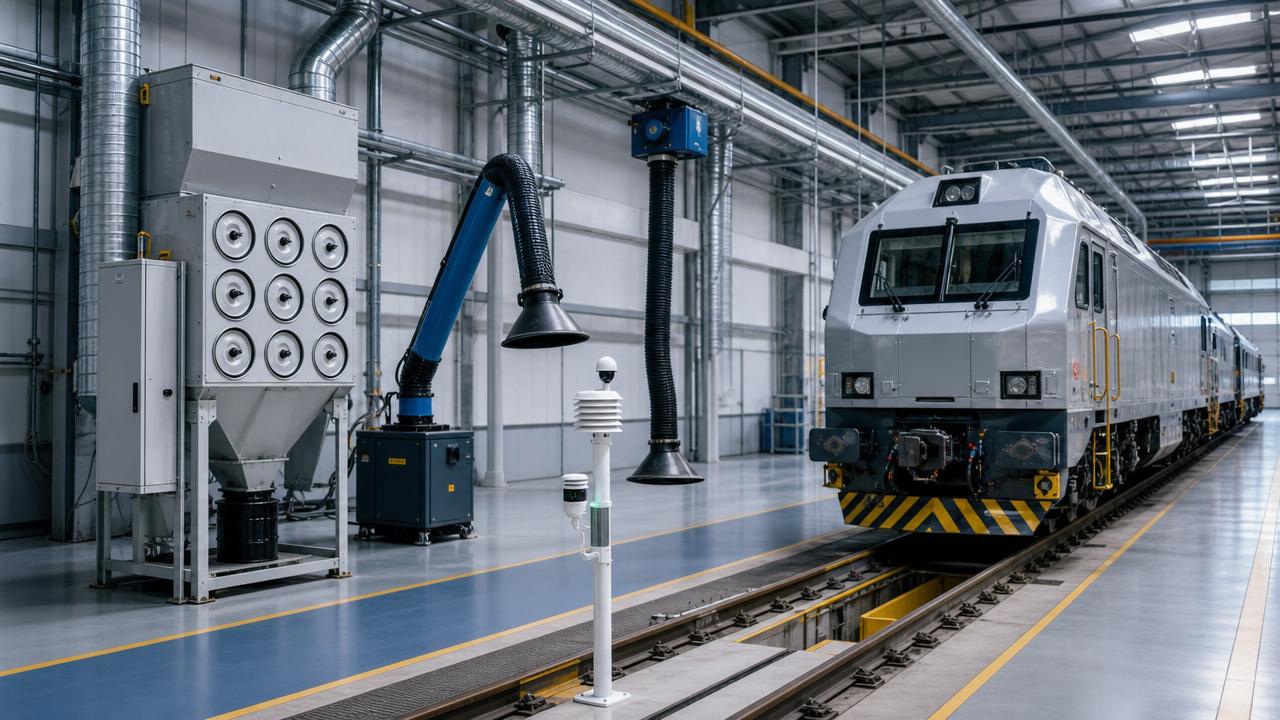
As emissions rules tighten across rail freight, engineering worksites, and industrial facilities, quality control and safety managers need reliable insight into technologies that protect both compliance and operational continuity. This clean air equipment news update examines the latest compliance trends shaping filtration, ventilation, monitoring, and emissions-control investments. By tracking environmental equipment news for clean air solutions, decision-makers can better align procurement, risk management, and workplace safety strategies with evolving regulatory expectations.
Why Compliance Trends Now Matter for Rail-Linked Industrial Operations
The compliance pressure is moving from permits to daily operating evidence
Clean air compliance is no longer limited to a stack test, a paper certificate, or a scheduled inspection. Regulators increasingly expect traceable operating records.
For rail freight depots, locomotive maintenance shops, port-rail transfer zones, and engineering machinery yards, this creates a practical challenge: equipment must control emissions and prove performance.
Quality control teams want stable parameters. Safety managers want exposure reduction. Procurement teams want defensible choices. Environmental equipment news for clean air solutions helps connect these priorities.
- Airborne particulate limits are being applied more closely to diesel maintenance, welding, abrasive cleaning, and material handling activities.
- Workplace exposure programs are demanding better capture efficiency, filter change records, alarm logic, and worker protection documentation.
- Cross-border freight corridors require equipment choices that can be explained against international practices, not only local habits.
- Energy consumption is becoming part of clean air decision-making because high-pressure ventilation can raise lifecycle cost.
G-RFE follows these developments through a railway-freight and engineering lens, where heavy-duty assets, safety protocols, and operational uptime must be evaluated together.
Which Clean Air Technologies Are Gaining Procurement Priority?
Procurement decisions are shifting from single devices toward integrated air quality systems. Buyers now compare capture, filtration, monitoring, maintenance, and data reporting as one package.
The following comparison summarizes technology categories frequently appearing in environmental equipment news for clean air solutions across rail workshops and industrial sites.
The strongest solutions are rarely chosen by catalog airflow alone. They match contaminant type, duty cycle, maintenance capability, and reporting expectations.
What buyers should not overlook
A low initial price can become expensive if filters blind quickly, alarms are ignored, or the system cannot produce useful compliance records.
Quality control and safety teams should review environmental equipment news for clean air solutions with one question: can this technology survive real operating conditions?
How Should Safety Managers Read New Standards and Certification Signals?
Compliance language must be translated into practical equipment requirements
Standards and certification references can be difficult to compare because they may address filtration efficiency, electrical safety, machinery guarding, or occupational exposure.
In railway-freight environments, G-RFE encourages buyers to align clean air equipment with wider engineering governance, including UIC, EN, AAR, and local safety rules.
The table below outlines common compliance checkpoints that appear in environmental equipment news for clean air solutions and procurement discussions.
Certification should not be treated as a decorative document. It must connect to the operating environment, the contaminant profile, and the audit questions likely to follow.
- Ask whether the cited standard applies to the full system or only a component such as a filter or fan.
- Confirm whether installation changes, local ductwork, or third-party controls affect the declared performance.
- Keep commissioning results in the same document trail as maintenance records and exposure assessments.
Application Scenarios: Where Clean Air Investments Deliver the Fastest Risk Reduction
Rail workshops and locomotive depots
Rail workshops combine welding fumes, grinding dust, oil mist, diesel exhaust, and cleaning vapors. A single ventilation approach rarely covers every exposure route.
In these areas, environmental equipment news for clean air solutions points toward modular extraction, zoned ventilation, and real-time monitoring around high-activity bays.
Intermodal rail-port systems
Rail-port terminals face short loading windows, diesel shunting, container handling dust, and changing wind conditions. Managers need flexible controls that avoid bottlenecks.
Portable monitoring units, local extraction at maintenance points, and low-emission handling strategies help reduce compliance exposure without disrupting throughput.
Engineering machinery and track maintenance bases
Automated track-laying machines, tamping equipment, and support vehicles create maintenance tasks involving hydraulic fluids, dust, exhaust, and metal fabrication.
For safety managers, the priority is to map task frequency, contaminant type, and worker proximity before selecting extraction or filtration capacity.
- Identify the top three emission-generating tasks by frequency, intensity, and number of exposed workers.
- Measure baseline conditions using credible monitoring methods before requesting supplier proposals.
- Separate continuous background ventilation needs from short-duration high-intensity source capture requirements.
- Define the evidence needed for internal audits, regulator visits, and contractor safety reviews.
Procurement Guide: What Should Quality Control Teams Evaluate Before Buying?
The best purchasing process begins before a quotation. It starts with a clear contaminant profile, space layout, operating schedule, and acceptable maintenance burden.
Environmental equipment news for clean air solutions is useful only when translated into a selection matrix that reflects site reality and compliance exposure.
Practical selection checklist
- Define contaminants precisely, such as respirable dust, welding fume, diesel particulate matter, volatile compounds, or oil mist.
- Confirm airflow requirements at the capture point, not only total fan capacity listed in the supplier brochure.
- Review filter replacement access, waste handling, and whether maintenance can occur without shutting down critical operations.
- Ask suppliers how alarms, pressure drop data, and sensor readings can be exported for internal records.
- Check noise, heat load, and air balance impacts, especially in enclosed maintenance bays or tunnel support facilities.
G-RFE’s technical intelligence approach helps buyers avoid comparing unrelated systems. A dust collector, a dilution ventilation system, and a source capture arm solve different problems.
A decision rule for tight budgets
When budgets are limited, prioritize controls closest to the emission source and areas where exposure duration is highest. This usually improves risk reduction per dollar.
Secondary upgrades, such as dashboard integration or expanded sensor networks, can follow once core capture and filtration performance has been verified.
Cost and Implementation: How to Avoid Expensive Misalignment
Clean air projects fail most often because the purchased equipment does not match the workflow. The result is bypassed hoods, overloaded filters, or ignored alarms.
Cost evaluation should include engineering time, installation disruption, spare filters, calibration, energy use, and documentation support, not only the equipment invoice.
The following implementation flow reflects common lessons from environmental equipment news for clean air solutions and railway engineering procurement practice.
This staged approach reduces rework. It also helps procurement defend decisions when finance, operations, and safety teams have different priorities.
Common cost traps
- Buying oversized fans that increase noise and energy use without improving capture at the source.
- Ignoring filter availability, which can create long shutdowns during supply chain disruptions.
- Selecting monitoring devices without a calibration plan or responsibility assignment.
- Treating installation as a minor detail when duct design determines real-world performance.
FAQ: Environmental Equipment News for Clean Air Solutions
How should a safety manager choose between filtration and ventilation?
Choose source capture and filtration when contaminants are generated at identifiable points, such as welding, grinding, or diesel testing. Use ventilation to manage background dilution.
Many sites need both. Environmental equipment news for clean air solutions increasingly shows hybrid strategies because rail workshops rarely have only one emission source.
What procurement documents should be requested before ordering?
Request technical specifications, filter data, electrical information, installation requirements, maintenance intervals, commissioning procedures, and any applicable declaration or test documentation.
For monitored systems, ask for calibration guidance, data export formats, alarm configuration details, and examples of routine inspection records.
Are portable units suitable for rail maintenance environments?
Portable units can be suitable for changing tasks, temporary repairs, or contractor work. They are less suitable when emissions are continuous or widely distributed.
Check mobility, power supply, filter capacity, hose durability, and whether operators will position the unit correctly during high-pressure maintenance schedules.
What is the most common misconception in clean air equipment buying?
The most common misconception is that higher airflow always means better control. Capture geometry, hood position, contaminant behavior, and maintenance condition matter just as much.
Quality control teams should verify measurable results after commissioning rather than relying only on rated specifications from the proposal stage.
Why Choose G-RFE for Clean Air Compliance Intelligence?
A railway-freight perspective for complex industrial decisions
G-RFE connects environmental equipment news for clean air solutions with the realities of heavy-haul locomotives, rolling stock maintenance, intermodal terminals, and engineering machinery.
Our value is not a generic product list. We help decision-makers interpret clean air technologies against operational risk, safety governance, and international railway standards.
- Consult us to clarify technical parameters, including airflow, filtration class, monitoring points, duty cycle, and maintenance access.
- Request support for product selection when comparing fixed extraction, mobile filtration, diesel exhaust capture, or sensor-based monitoring.
- Discuss certification expectations, commissioning records, supplier documentation, and alignment with UIC, EN, AAR, or local compliance frameworks.
- Engage G-RFE early when delivery windows are tight and installation must avoid disruption to freight, depot, or engineering operations.
If your team is reviewing environmental equipment news for clean air solutions and needs a defensible procurement path, G-RFE can help structure the next step.
Contact us to discuss parameter confirmation, solution comparison, delivery timing, customization needs, certification questions, sample evaluation, or quotation preparation for rail-linked facilities.
Industry Briefing
Get the top 5 industry headlines delivered to your inbox every morning.