
Future of Autonomous Freight Trains: What Deployment Still Requires

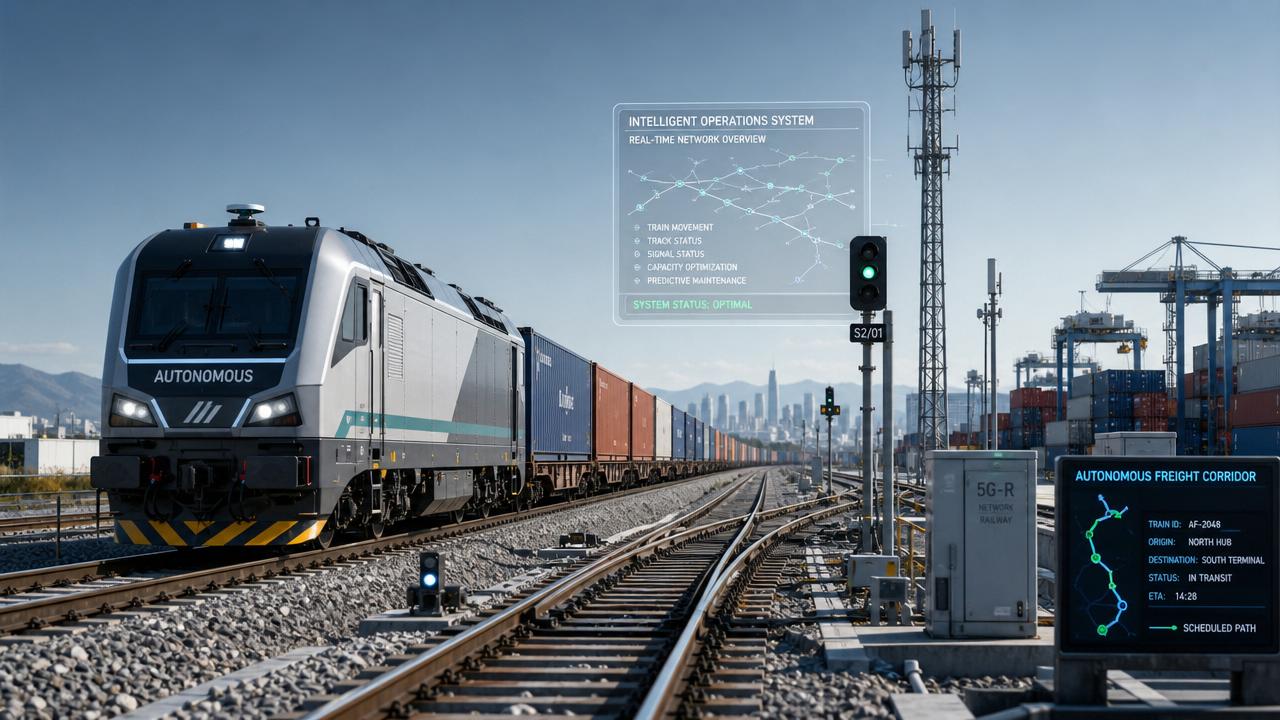
The future of autonomous freight trains promises safer, greener, and more efficient rail logistics, but large-scale deployment still depends on more than advanced locomotives alone. For project managers and engineering leaders, the real challenge lies in aligning signaling systems, infrastructure readiness, cross-border standards, and operational safety into one workable framework. Understanding these remaining requirements is essential for turning autonomous rail ambitions into reliable corridor-level execution.
Why deployment is still a systems challenge, not a locomotive challenge
For most project leaders, the key question is not whether autonomous freight trains are technically possible. It is whether an entire freight corridor can support them safely, consistently, and at commercial scale.
That distinction matters. A successful autonomous trial with one trainset on a controlled route does not automatically translate into network-wide deployment across mixed traffic, aging infrastructure, and cross-border operations.
The future of autonomous freight trains will therefore be decided less by onboard intelligence alone and more by how well rail operators integrate infrastructure, digital signaling, operations governance, and regulatory acceptance.
For engineering managers, this shifts the conversation from innovation showcase to delivery readiness. The real task is building a dependable operating environment where automation can perform under real freight conditions.
What project managers actually need to evaluate first
Before investing in autonomous freight programs, decision-makers need a clear readiness view. That starts with identifying whether the target route is a closed industrial line, a dedicated freight corridor, or a mixed-use public network.
Each environment changes the complexity level. Closed mining and port logistics lines usually offer the fastest path because train movements, interfaces, and safety boundaries are easier to control.
Dedicated freight corridors come next. They can support higher automation maturity if signaling, dispatching, and right-of-way protection are already standardized and access by third parties is tightly managed.
Mixed passenger-freight networks are the hardest environment. They introduce timetable conflicts, more variable operating rules, higher safety assurance requirements, and a larger number of exceptions that automation must handle.
Project managers should also assess traffic density, route length, communication coverage, grade crossings, yard complexity, and manual override procedures. These factors often determine deployment feasibility more than locomotive capability itself.
Signaling and train control remain the foundation
If there is one requirement that still defines the future of autonomous freight trains, it is signaling maturity. Autonomous operation depends on precise train separation, route authority, speed enforcement, and constant status visibility.
Legacy signaling systems may support partial automation, but they often lack the interoperability, data granularity, or reliability needed for higher levels of unattended or remotely supervised operation.
That is why modern train control architectures matter. Systems aligned with ETCS, CBTC in appropriate environments, ATP, ATO overlays, and robust interlocking logic provide the structured control layer automation depends on.
For freight corridors, the challenge is not just installing new signaling equipment. It is proving that onboard systems, wayside assets, dispatch platforms, and communication links operate as one verified safety ecosystem.
Managers should ask practical questions early. Can the signaling system support movement authority updates in real time? Can train position be validated continuously? Can degraded modes be handled without unsafe improvisation?
Without strong answers to those questions, autonomy remains fragile. In rail freight, fragile automation is operationally worse than disciplined human-led operation because uncertainty directly affects safety, throughput, and customer confidence.
Communications infrastructure is not optional support, it is mission-critical
Autonomous freight trains rely on dependable communications for train control, remote monitoring, diagnostics, dispatching, and incident response. Weak communications turn otherwise capable automation into a high-risk operating model.
GSM-R has played a major role across many rail systems, but future deployments increasingly require migration planning toward FRMCS and broader IP-based architectures with stronger capacity and resilience.
For project teams, the issue is not simply bandwidth. It is deterministic performance, low latency where required, handover reliability, cybersecurity hardening, and stable coverage across tunnels, mountains, remote terrain, and border zones.
Communication blind spots can disrupt command flows, monitoring continuity, and emergency intervention capability. That makes network mapping, redundancy design, and fail-safe behavior planning central parts of deployment preparation.
In many cases, communications upgrades should be treated as core infrastructure investment rather than an add-on for the autonomy package. Without corridor-grade connectivity, autonomous freight operations cannot scale responsibly.
Infrastructure readiness goes far beyond track condition
It is easy to assume that if a line already carries heavy freight, it is automatically suitable for autonomous trains. In practice, infrastructure readiness is broader than rail geometry, axle load, and track quality.
Autonomous operations require accurate digital mapping of the corridor, reliable detection systems, protected interfaces at switches and crossings, and strong asset health visibility across critical infrastructure components.
Turnouts, level crossings, bridges, tunnels, and yards become especially important because they introduce operational uncertainty. Automation performs best where those assets are observable, diagnosable, and governed by clear control logic.
Trackside sensing can also become more valuable. Hotbox detectors, wheel impact load detectors, obstacle detection, weather monitoring, and condition-based maintenance systems all improve the operating confidence autonomous systems need.
Project leaders should therefore define readiness at corridor level. A technically advanced train running on inconsistent infrastructure creates a mismatch that delays approvals, raises operating risk, and weakens expected productivity gains.
Yards, terminals, and last-mile operations are often the real bottleneck
Mainline automation attracts attention, but many deployment programs slow down in yards, terminals, and intermodal interfaces. These environments are less predictable and involve more human interaction, switching moves, and equipment variability.
An autonomous train may operate efficiently between terminals, yet still depend on manual crews for coupling, brake checks, loading coordination, marshalling, and last-mile access. That limits the business case if not addressed early.
For freight operators, the question is where automation creates the most value across the entire chain. In some corridors, assisted automation on the mainline may deliver returns sooner than full autonomy end to end.
Engineering teams should map operational handoff points carefully. Every transfer between automated and manual domains introduces complexity, training needs, procedural risk, and potential throughput loss.
This is why deployment planning must include port interfaces, depot workflows, shunting logic, and maintenance access. Corridor automation cannot be evaluated only from the cab or control center perspective.
Safety assurance and regulation will decide deployment speed
Even where the technology works, autonomous freight trains cannot scale without accepted safety cases. Regulators, infrastructure managers, insurers, and customers all need evidence that automation performs safely in normal and degraded conditions.
That means formal hazard analysis, verification and validation, software assurance, cyber risk controls, human factors assessment, and well-defined fallback modes. Demonstration runs alone are not enough.
The regulatory burden becomes heavier in cross-border corridors. Different national approval frameworks, interoperability rules, labor policies, and signaling standards can slow deployment even when the engineering concept is sound.
Project managers should expect certification to be a phased journey. Starting with driver assistance, then supervised automation, and later higher autonomy levels is often more realistic than targeting immediate full driverless freight service.
Strong governance matters here. Programs need documented responsibilities across operators, rolling stock suppliers, signaling vendors, telecom providers, and infrastructure authorities to avoid safety gaps at system boundaries.
Cybersecurity is now part of operational safety
As autonomy increases, rail freight becomes more dependent on connected control systems, cloud-linked analytics, remote diagnostics, and software-defined functions. That expands the attack surface significantly.
For autonomous operations, cybersecurity is not just an IT concern. A compromised communication link, corrupted positioning stream, or manipulated maintenance data set can directly affect train movement authority and operational decisions.
Project teams should therefore integrate cybersecurity architecture from the beginning. Network segmentation, secure authentication, encrypted communications, patch governance, intrusion detection, and incident response all need operational alignment.
It is also important to evaluate supplier risk. Autonomous freight programs usually involve multiple vendors across onboard electronics, signaling, telecom, software, and infrastructure systems. Weakness in one layer can affect the whole corridor.
For executives approving investment, cybersecurity maturity should be treated as a deployment gate, not a post-installation enhancement. In autonomous rail, digital resilience is inseparable from safety resilience.
Human roles will change, not disappear
A common mistake in discussing the future of autonomous freight trains is assuming that people become irrelevant. In reality, automation shifts labor requirements rather than eliminating operational responsibility.
Remote supervisors, dispatchers, cybersecurity teams, maintenance technicians, control room operators, and incident managers all become more important as automation expands. Their tools and training must evolve accordingly.
Human-machine interface design is especially critical in degraded modes. When a system requests intervention, the operator must understand the situation quickly and act within clearly defined authority limits.
Change management is therefore a deployment requirement, not a communications exercise. Resistance from operations teams often reflects valid concerns about accountability, exception handling, and practical workflow impacts.
Programs that involve frontline stakeholders early usually perform better because operating knowledge helps expose edge cases that design teams may overlook during concept development.
What a realistic deployment roadmap looks like
For most rail freight organizations, the best path is progressive automation rather than immediate full autonomy. This reduces risk, builds internal capability, and creates measurable milestones for investment decisions.
Phase one often focuses on digital foundations: signaling modernization, communications upgrades, asset monitoring, centralized traffic visibility, and interoperable data platforms. These investments create value even before autonomy is introduced.
Phase two may add driver advisory systems, automatic train protection enhancement, and supervised automatic train operation on carefully selected segments. This helps validate performance in live service conditions.
Phase three can expand into higher autonomy on dedicated freight corridors, heavy-haul routes, or industrial networks where access control and operating rules are easier to standardize.
Only after those phases are stable should organizations push toward broader corridor-scale autonomous operations across complex multi-actor networks. By then, the business case and safety case are both easier to defend.
How to judge whether the business case is truly credible
Autonomous freight projects are often justified through labor optimization, fuel or energy efficiency, improved punctuality, higher line capacity, and reduced incident rates. Those benefits are real, but they depend on corridor conditions.
Managers should test whether expected gains come from autonomy itself or from enabling investments such as signaling upgrades, dispatch optimization, predictive maintenance, and terminal coordination improvements.
That distinction is important because some benefits may be achievable earlier through targeted modernization without full autonomous deployment. A credible business case compares those options honestly.
It should also include hidden costs: certification effort, telecom redundancy, cyber controls, training, systems integration, lifecycle software support, and operational fallback arrangements during outages or transition periods.
The strongest investment cases usually come from high-volume, repetitive freight operations where schedule discipline, route control, and network design support automation economically over many years.
Where autonomous freight trains are most likely to scale first
The earliest large-scale successes are most likely on heavy-haul mining railways, port-rail shuttles, industrial logistics lines, and dedicated long-distance freight corridors with limited operational variability.
These environments reduce external interference and simplify the assurance case. They also provide high utilization rates, which improve return on investment for the digital and infrastructure upgrades autonomy requires.
Public mixed-traffic networks will still adopt automation, but usually in staged forms. Assisted and supervised operations are likely to expand faster there than fully unattended freight service in the near term.
For project leaders, this means deployment strategy should reflect route reality, not technology ambition. The best autonomous program is the one matched to corridor constraints, governance capacity, and measurable operational value.
Conclusion: the future is promising, but execution will favor prepared corridors
The future of autonomous freight trains is strong, but widespread deployment still requires much more than intelligent locomotives. Signaling maturity, communications resilience, infrastructure readiness, terminal integration, safety assurance, and cyber resilience remain decisive.
For project managers and engineering leaders, the most useful question is not whether autonomy is coming. It is whether a specific corridor is operationally, digitally, and regulatorily ready to support it.
Organizations that treat autonomy as a corridor transformation program rather than a rolling stock upgrade will make better decisions, avoid unrealistic timelines, and build stronger long-term freight performance.
In short, autonomous freight rail is no longer a distant concept. But only networks that align technology, infrastructure, standards, and governance will convert promise into dependable commercial deployment.
Industry Briefing
Get the top 5 industry headlines delivered to your inbox every morning.