
How Power Density Changes Traction Inverter Cooling Choices

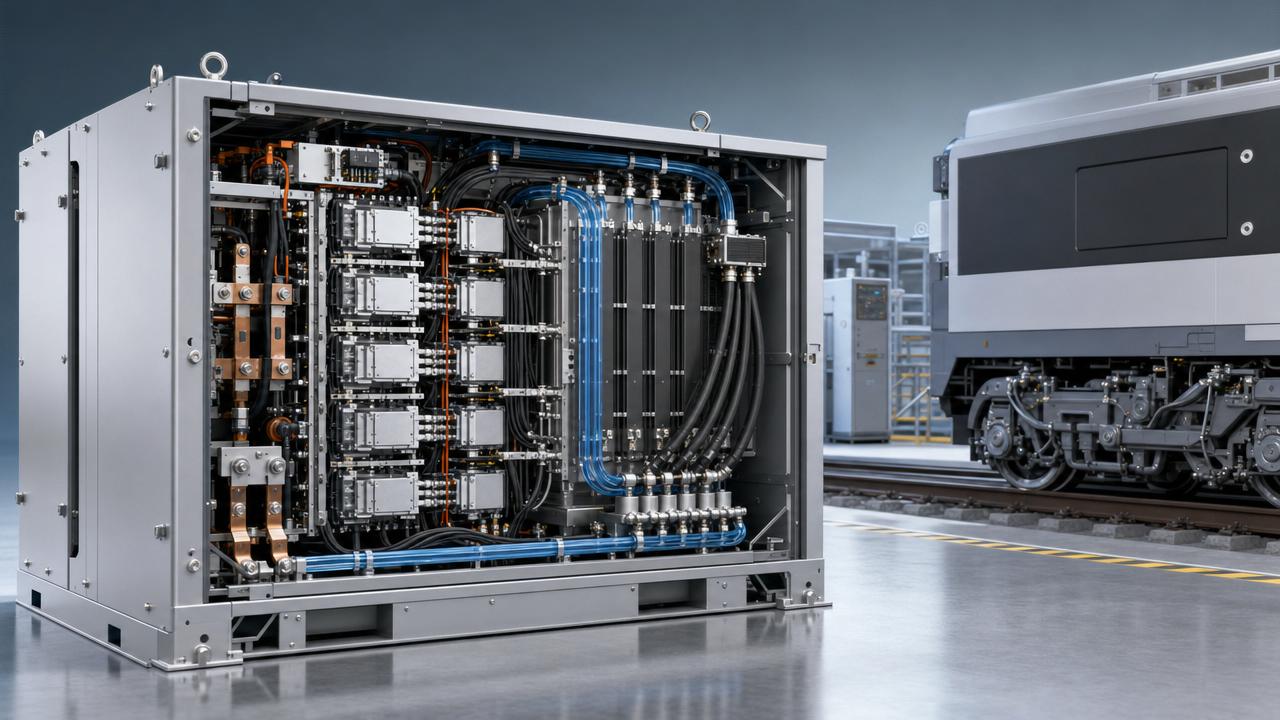
As traction packages shrink and output rises, traction inverter power density becomes more than a headline specification. It changes how heat is generated, where it accumulates, and which cooling architecture remains dependable over years of freight service.
In railway rolling stock, that shift matters because thermal decisions influence reliability, enclosure size, axle load distribution, maintenance access, and lifecycle cost. For programs judged against UIC, EN, and AAR expectations, cooling is now a strategic design choice.
Why power density has become a system-level issue
Traction inverter power density describes how much power an inverter delivers within a given volume or mass. Higher values usually reflect tighter packaging, better semiconductor performance, and stronger pressure to save space onboard.
That looks positive at first. Smaller equipment cabinets can free room for batteries, auxiliary systems, or easier routing in locomotive and multiple-unit platforms.
The tradeoff is thermal concentration. Losses may fall in percentage terms, yet the remaining heat is packed into smaller surfaces. The local temperature gradient rises, and cooling margins narrow quickly.
This is why traction inverter power density now affects not just component design, but vehicle integration, duty-cycle planning, and maintenance strategy across heavy-haul and intermodal fleets.
What actually changes inside the inverter
As switching devices become more capable, thermal behavior becomes less forgiving. IGBT and SiC-based topologies can support compact assemblies, but junction temperatures respond faster to load swings.
Busbars, capacitors, gate drivers, and magnetic elements also sit closer together. Heat no longer spreads evenly through the cabinet. Instead, hotspots emerge around semiconductor modules and high-current paths.
The practical effect is simple. A cooling method that worked well at moderate traction inverter power density may underperform once the same platform targets higher continuous power or tighter packaging.
Thermal limits appear earlier during real duty cycles
Rail applications rarely operate at smooth laboratory conditions. Freight acceleration, gradients, regenerative braking, ambient dust, and tunnel heat all create uneven thermal loading.
Higher traction inverter power density means those peaks matter more. Short bursts can drive repeated thermal cycling, which often becomes a larger reliability concern than average temperature alone.
How cooling choices shift as density increases
At lower densities, forced-air cooling may remain viable. It is simpler, easier to inspect, and often cheaper at the equipment level.
Once traction inverter power density climbs, air systems face limits. The heat transfer coefficient is lower, airflow paths become restrictive, and filters add maintenance burden in dusty rail environments.
Liquid cooling then becomes more attractive. Water-glycol loops, cold plates, and integrated heat exchangers can remove concentrated heat more efficiently and keep device temperatures more stable.
Some programs also assess hybrid approaches. These may use liquid cooling for power modules and controlled air circulation for passive components and enclosure balance.
Railway-specific factors that change the decision
Cooling in rail traction is never selected in isolation. Vehicle mission profile and corridor conditions heavily influence what traction inverter power density can be supported safely.
A heavy-haul locomotive pulling long consists on steep grades produces different thermal stress than an intermodal unit with frequent stop-start cycles and regeneration events.
Ambient conditions also matter. Desert dust, coastal corrosion, high-altitude air thinning, and depot washdown procedures all change cooling performance and sealing requirements.
For this reason, technical benchmarking platforms such as G-RFE are increasingly valuable. They connect hardware decisions with corridor realities, regulatory frameworks, and the operational constraints of international freight networks.
Space and maintainability are often in tension
Higher traction inverter power density can reduce cabinet volume, but denser layouts may complicate service access. Replacing a pump, flushing a loop, or cleaning blocked channels takes planning.
When fleets operate far from major depots, maintainability can outweigh small gains in compactness. The correct cooling choice is not always the one with the highest thermal performance on paper.
Where lifecycle cost usually shifts
A common mistake is comparing cooling options only through initial equipment price. Higher traction inverter power density changes the cost curve across the full service life.
Air cooling may cost less upfront, yet filters, fan wear, contamination risk, and derating during heat waves can increase operational losses. Liquid cooling may cost more initially but preserve performance margins longer.
Thermal instability also drives hidden expenses. Repeated overheating can shorten capacitor life, accelerate solder fatigue, and reduce module lifetime, causing disruptions that are expensive in freight corridors.
When service reliability affects network throughput, cooling selection becomes tied to dispatch performance, spare strategy, and asset availability rather than component cost alone.
A practical framework for evaluating cooling options
The most useful way to assess traction inverter power density is to link thermal data with actual operating context. Nameplate output by itself is not enough.
- Map continuous and peak duty cycles, including gradients, braking frequency, and low-speed high-torque periods.
- Check thermal margins at the hottest corridor conditions, not just nominal ambient temperatures.
- Review contamination exposure, especially dust, oil mist, moisture, and cleaning procedures.
- Estimate service access time for fans, filters, pumps, hoses, and heat exchangers.
- Model failure impact on train availability, not only component replacement cost.
- Align design assumptions with UIC, EN, and AAR compliance expectations where relevant.
This approach prevents overvaluing compactness while missing downstream thermal risk. It also helps compare suppliers that present different cooling concepts for similar traction inverter power density targets.
What to watch in upcoming traction programs
The move toward SiC devices, modular propulsion packages, and higher onboard energy efficiency will continue pushing traction inverter power density upward. Cooling architectures will therefore become more integrated with overall vehicle design.
Expect more emphasis on digital thermal monitoring as well. Temperature sensing, predictive diagnostics, and condition-based maintenance can offset some risks created by compact, high-output assemblies.
At the same time, not every platform should chase the highest density available. Freight programs with harsh environments, long maintenance intervals, or mixed infrastructure may benefit from conservative thermal headroom.
That is often the most important takeaway. Better performance comes from matching traction inverter power density to route conditions, service philosophy, and asset life targets, not from maximizing one metric in isolation.
Turning analysis into a sound decision
A useful next step is to review propulsion specifications with thermal scenarios side by side. Compare cabinet space, environmental exposure, maintenance intervals, and expected duty peaks before locking the cooling concept.
Where uncertainty remains, benchmark against comparable locomotive and rolling stock programs, especially those operating under similar corridor and compliance conditions. In traction systems, cooling performance is rarely a secondary detail once power density rises.
Industry Briefing
Get the top 5 industry headlines delivered to your inbox every morning.