
Agricultural Equipment Selection: Matching Tractor Power to Implements

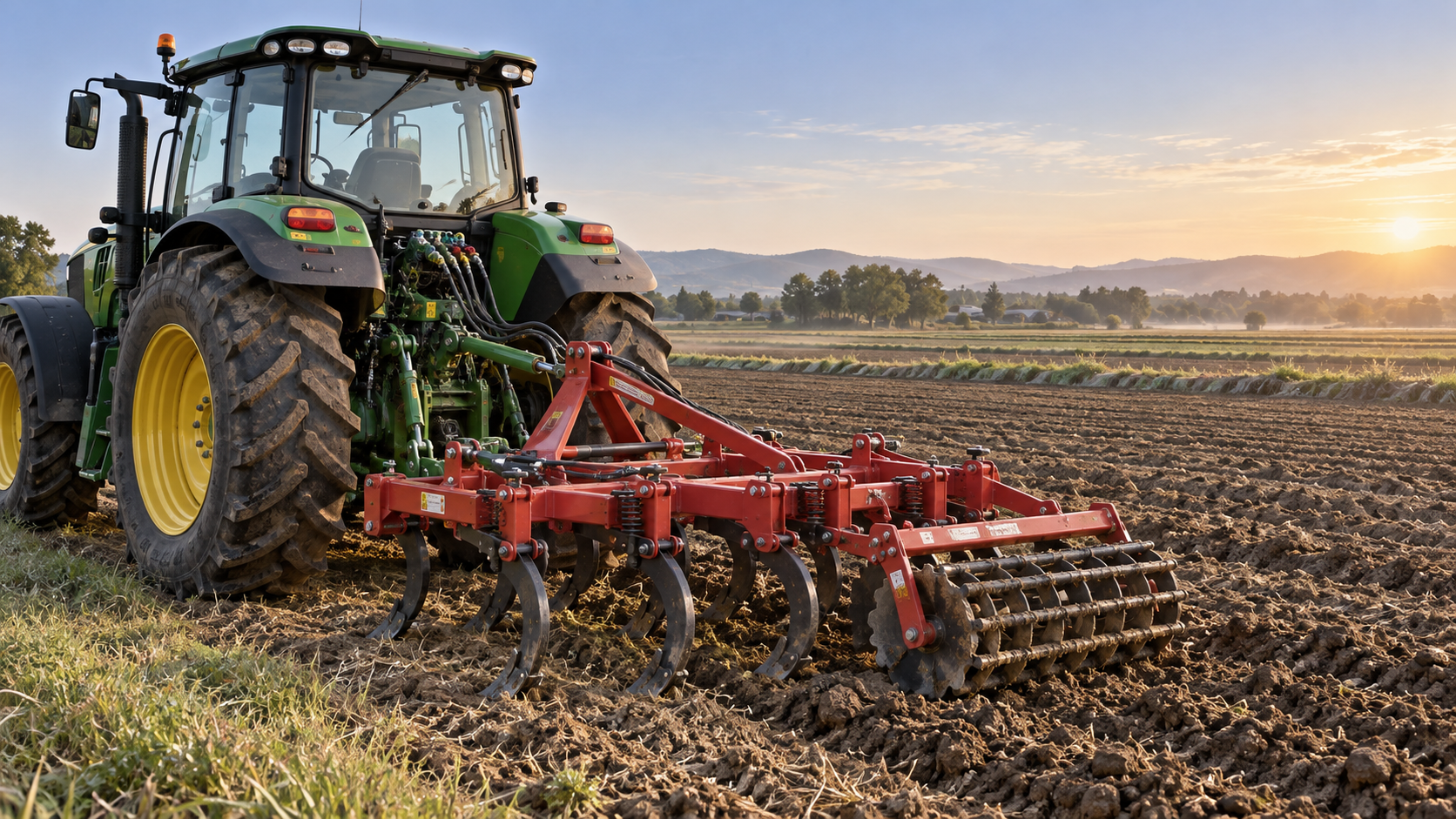
A tractor may sit comfortably within an implement’s advertised horsepower range and still struggle to hold working depth, maintain PTO speed, or lift the machine safely at a headland. Selecting agricultural equipment means checking the complete power-and-load relationship—not simply comparing two numbers in a brochure.
For technical evaluators, the decision rests on usable PTO and drawbar power, hydraulic capacity, hitch geometry, traction, and the conditions in which those resources must work together. The objective is not to buy the largest tractor available. It is to specify a combination that delivers the required field output without operating continuously at its limits or carrying unnecessary ownership costs.
Start with the job, not the tractor rating
Before reviewing tractor models, define what the implement must accomplish. Working width alone is insufficient: a cultivator operating shallowly in light soil presents a different demand from the same machine working deeper in compacted ground.
A useful duty specification records:
- Operation and implement configuration: tillage, mowing, planting, baling, spreading, or transport; mounted, semi-mounted, or trailed.
- Required output: hectares per hour and the available seasonal working window.
- Operating conditions: soil texture, moisture, residue, slopes, and expected working depth.
- Working speed: the range needed for acceptable implement performance, not merely the tractor’s available travel speeds.
- Concurrent loads: draft, PTO demand, hydraulic motors, electrical systems, and cooling requirements.
This prevents a common procurement error: selecting power around average conditions when the critical requirement is finishing a time-sensitive operation during a short weather window. Conversely, sizing every machine for a rare extreme can leave expensive capacity idle throughout most of the season.
Understand which horsepower the implement actually needs
Engine horsepower, PTO horsepower, and drawbar horsepower describe different points in the energy path. They are not interchangeable, and there is no universal conversion factor that remains accurate across tractors and field conditions.
Check whether quoted engine output is rated, maximum, or boosted power. Boost may be available only during specified PTO, transport, or hydraulic operating conditions. It should not be treated as continuously available power for every field task.
For comparisons, use figures measured to consistent standards. OECD tractor test reports and Nebraska Tractor Test Laboratory reports, where available for the relevant model, can provide evidence beyond sales literature. Confirm the tested transmission, equipment configuration, and operating conditions before applying those results.
For draft implements, calculate the pull at working speed
The basic relationship is straightforward:
Drawbar power (kW) = draft force (kN) × travel speed (km/h) ÷ 3.6
Suppose a proposed implement requires an estimated 30 kN of draft at 8 km/h. Its useful drawbar requirement is approximately 66.7 kW. That is power delivered as pull, not the engine rating required to produce it. Transmission losses, tire slip, rolling resistance, and field conditions separate the two.
The quality of the draft estimate matters more than the arithmetic. Obtain implement-manufacturer data, use relevant engineering estimates, or measure a comparable machine in representative ground. Generic horsepower-per-meter guidance can support an initial shortlist, but it is too coarse for final approval.
Width, depth, and speed do not carry equal uncertainty
Increasing width generally increases draft when other conditions remain similar. Depth can have a much less forgiving effect, particularly when tools enter a compacted layer. Higher speed also raises power demand through both increased travel speed and, often, increased soil resistance.
Evaluate at least a normal operating case and a credible high-load case. Where resistance is uncertain, a field trial is more defensible than an arbitrary increase in tractor size. Record depth, speed, soil condition, fuel use, and wheel slip so the trial produces reusable evidence rather than a favorable demonstration.
PTO-driven agricultural equipment needs speed stability
For PTO implements, compare the manufacturer’s requirement with available PTO output at the required shaft speed. Confirm whether the machine needs 540 or 1,000 rpm, together with the correct shaft size, spline arrangement, and driveline specification. Physical connection does not establish compatibility.
Average power can conceal the loads that matter. A baler entering a dense windrow or a mower reaching heavy crop may impose short-duration peaks. Consider measured PTO performance, engine response, and the implement manufacturer’s guidance on reserve capacity.
An economy PTO setting can reduce engine speed during lighter work, but it is not automatically suitable for demanding operations. Check available power, cooling capability, and the tractor manufacturer’s restrictions. Lower engine speed offers little benefit if it causes repeated lugging or poor implement performance.
Also verify driveline length through the full hitch movement, operating angles, guarding, and overload protection. Too much tractor power can damage an implement if its torque limits are ignored; horsepower is not a substitute for a correctly specified slip clutch or shear-bolt system.
Hydraulics can disqualify an otherwise suitable tractor
A tractor may have adequate engine power yet fail to operate a planter fan, air seeder, or conveyor reliably. Compare the implement’s simultaneous hydraulic requirements with usable tractor capacity at the intended engine speed—not simply the pump’s maximum advertised output.
Hydraulic output can be estimated using:
Hydraulic power (kW) = pressure (bar) × flow (L/min) ÷ 600
A circuit supplying 60 L/min at a 180-bar pressure difference delivers approximately 18 kW of hydraulic power. Engine input will be higher because the system is not perfectly efficient. Avoid double-counting this load if the tractor performance data already reflect the same hydraulic demand.
Check the system architecture, remote-valve flow limits, couplers, return-line restrictions, and any case-drain requirement. A machine designed for a load-sensing system may need specific connections or controls. Continuous motor operation also creates a cooling duty that intermittent cylinder operation does not.
The practical test is whether the tractor can sustain required flow and pressure while steering, lifting, and performing other concurrent functions. Confirm usable hydraulic oil capacity where large cylinders draw significant oil from the tractor reservoir.
Lift capacity and traction are separate approval gates
Neither lifting ability nor pulling ability follows automatically from horsepower. A compatible combination must pass both checks independently.
Check the complete mounted load
Three-point hitch category establishes connection dimensions, not sufficient lift capacity. Compare the implement’s loaded mass and center-of-gravity position with the tractor’s lift specification at the stated measurement point. Capacity at the linkage ends may substantially exceed capacity farther behind the tractor.
Include seed, fertilizer, attachments, and accessories. Assess the least favorable configuration during lifting, turning, and transport. Rear-mounted equipment can unload the front axle enough to affect steering even when the hitch raises it without difficulty.
For trailed implements, check drawbar vertical load, coupling suitability, axle and tire limits, and braking requirements. Folding and road transport introduce load cases that a field-only assessment can miss.
Use ballast to transmit power, not disguise a mismatch
If the tires cannot transmit available torque, additional engine power will not increase useful work. Review drive configuration, tire dimensions, inflation pressure, axle loading, and permitted ballast arrangements.
Set inflation pressure from tire load-and-speed data rather than habit. Insufficient ballast can increase slip; excessive ballast increases rolling resistance, compaction risk, and axle loads. Target slip depends on tire or track type and ground conditions, so use manufacturer guidance rather than a single universal percentage.
On slopes, include grade resistance and stability in the assessment. A combination acceptable on level ground may require lower speed, different ballast, or a narrower implement elsewhere.
Work backward from the required field capacity
A power match is useful only if it completes the work on time. Estimate effective field capacity as:
Effective capacity (ha/h) = width (m) × speed (km/h) × field efficiency ÷ 10
A 6 m implement traveling at 8 km/h with an assumed field efficiency of 0.75 achieves approximately 3.6 ha/h. That efficiency is an illustrative planning assumption, not a guaranteed result. Field shape, headland turns, filling stops, overlap, and operating practices all affect actual output.
If that output misses the working window, compare wider equipment, longer operating hours, or additional capacity. Simply increasing speed may exceed the implement’s agronomic limits or raise power demand beyond the tractor’s capability. A tractor that pulls steadily at the correct speed can be a better choice than one that achieves high speed only in favorable patches.
Turn the comparison into a defensible purchase specification
Use a compatibility matrix rather than a single horsepower threshold. Mark each criterion as verified, conditional, or unresolved, and identify the evidence required to close each uncertainty.
- Power: adequate PTO or drawbar output under the specified concurrent loads.
- Interfaces: suitable PTO, hitch, drawbar, hydraulic connections, and implement-control compatibility.
- Load limits: acceptable lift geometry, axle loads, tire loads, coupling loads, and transport mass.
- Field performance: required speed, depth, work quality, and effective capacity.
- Operating support: service access, wear-part availability, diagnostics, and maintenance requirements.
- Economics: ownership and operating costs evaluated against expected annual utilization.
Allow an operating margin where resistance or crop loading varies, but explain its basis. A universal reserve percentage can encourage oversizing or provide false confidence. Separate continuous demand, short-duration peaks, and exceptional conditions that can reasonably be managed by reducing speed or depth.
For shortlisted combinations, agree on acceptance criteria before the demonstration. Test with realistic implement loading and representative terrain. Record sustained speed, PTO stability, hydraulic behavior, temperatures, slip, and work quality. Where conditions differ from the intended application, document that limitation explicitly.
The final choice should be the smallest practical tractor-and-implement combination that meets the duty specification with justified operating margin—not merely the lowest engine rating or the largest available machine. When power, traction, hydraulics, stability, and seasonal capacity are assessed together, agricultural equipment selection becomes a traceable engineering decision rather than a horsepower guess.
- Sizing a Narrow-Gauge Locomotive for Tunnel Muck Haulage CyclesTime : Oct 31, 2026
- Battery vs Diesel Tunnel Locomotives: Ventilation and Operating Trade-OffsTime : Oct 31, 2026
- Choosing a Narrow-Gauge Tunnel Locomotive: Clearance, Grade and PayloadTime : Oct 31, 2026
Industry Briefing
Get the top 5 industry headlines delivered to your inbox every morning.