
When Should Brake Shoes Be Replaced on Freight Wagons?

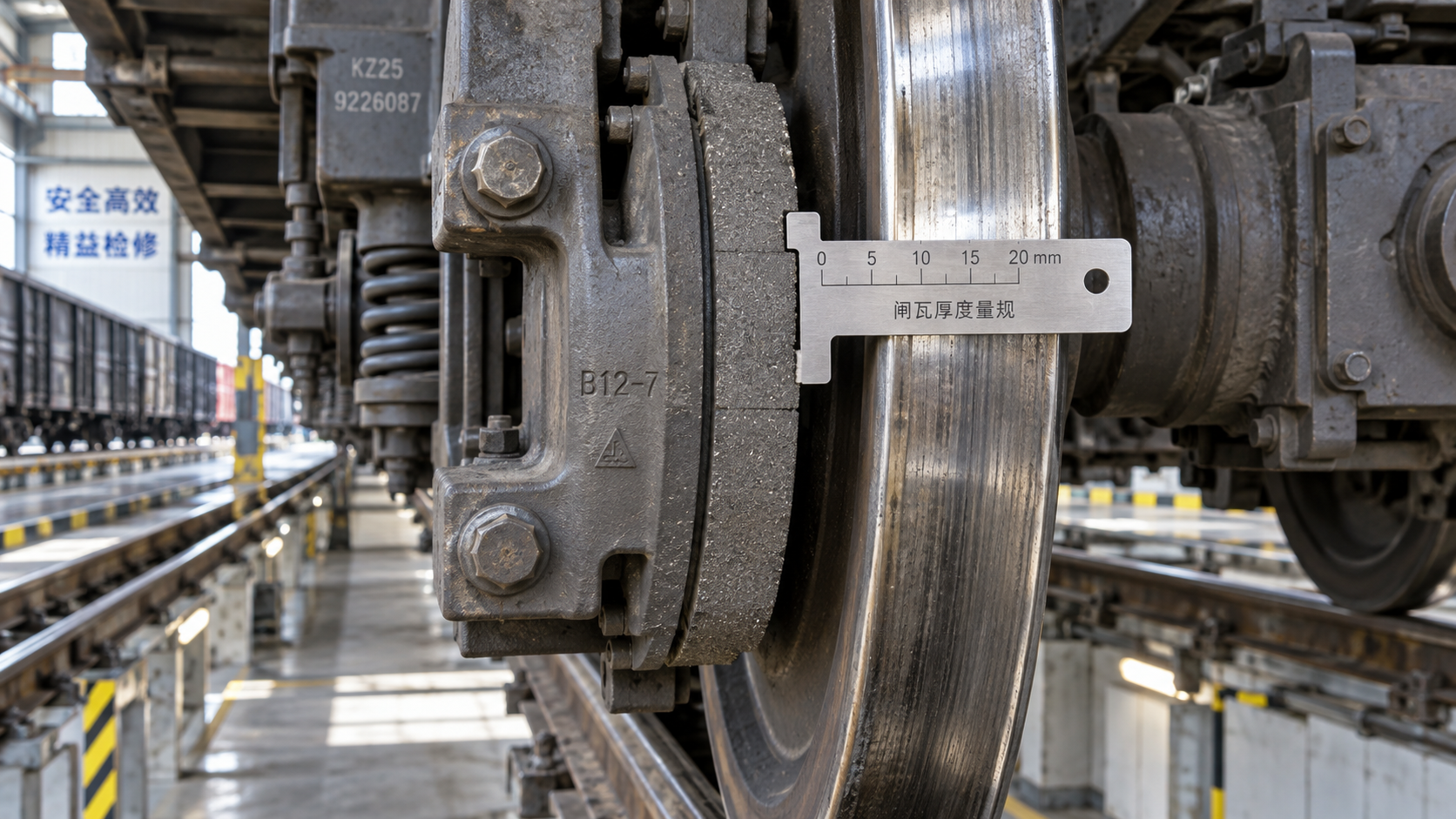
When Should Brake Shoes Be Replaced on Freight Wagons?
When should brake shoes be replaced on freight wagons? For fleet operators and maintenance engineers, the answer depends on more than visible wear. Brake shoe material, remaining thickness, damage, operating conditions, and applicable maintenance limits all influence replacement decisions. Delaying action can compromise braking performance and increase the risk of wheel damage, while premature replacement adds unnecessary cost.
The practical answer is to replace a brake shoe when it reaches its applicable condemnation limit, develops a rejectable defect, or cannot reasonably remain serviceable until the next planned inspection. The first two conditions are governed by approved technical requirements. The third is a maintenance-planning judgment—not permission to extend an established limit.
This guide concerns tread-braked freight wagons, where shoes or blocks press against the wheel tread. Disc-braked equipment uses different components and inspection criteria. Even within tread-braked fleets, one replacement rule cannot safely cover every shoe design, braking system, and operating network.
Start with the correct limit, not a remembered number
A universal minimum thickness is an attractive shortcut, but it can be misleading. Cast-iron and composite brake shoes have different construction and service characteristics. Their acceptance criteria may also depend on the shoe holder, backing arrangement, wheel application, and approved vehicle configuration.
The controlling information should come from the applicable wagon maintenance documentation, brake shoe manufacturer’s instructions, and railway or interchange requirements. In North American interchange service, relevant AAR requirements need to be checked. For European operations, the applicable vehicle maintenance file, entity in charge of maintenance arrangements, and relevant national or contractual requirements matter. References to UIC or EN documents are useful only when the specific document applies to that equipment and task.
Do not confuse a product qualification standard with an in-service rejection rule. A document establishing friction material performance does not necessarily tell an inspector where to measure a worn shoe or whether a particular crack is acceptable.
Where instructions appear inconsistent, the discrepancy should be resolved through the responsible maintenance authority before release. Selecting whichever limit leaves more material in service is not a defensible approach.
Thickness matters—but the measurement must capture actual wear
Brake shoes rarely wear into perfectly uniform shapes. A central reading can look acceptable while an end or edge has already reached its rejection condition. Inspection therefore needs to follow the specified measurement locations and consider the whole friction face, not just the easiest accessible point.
Use the prescribed gauge or measurement method, distinguish friction material from any backing structure, and record the relevant readings. Wear indicators can assist inspection where provided, but they should be interpreted according to the manufacturer’s instructions rather than treated as a universal pass-or-fail feature.
Tapered wear deserves particular attention. It may reflect misalignment, a shoe that is not sitting correctly, worn brake rigging, or uneven contact with the wheel. Replacing the shoe without investigating the cause can put the replacement straight back into the same wear pattern.
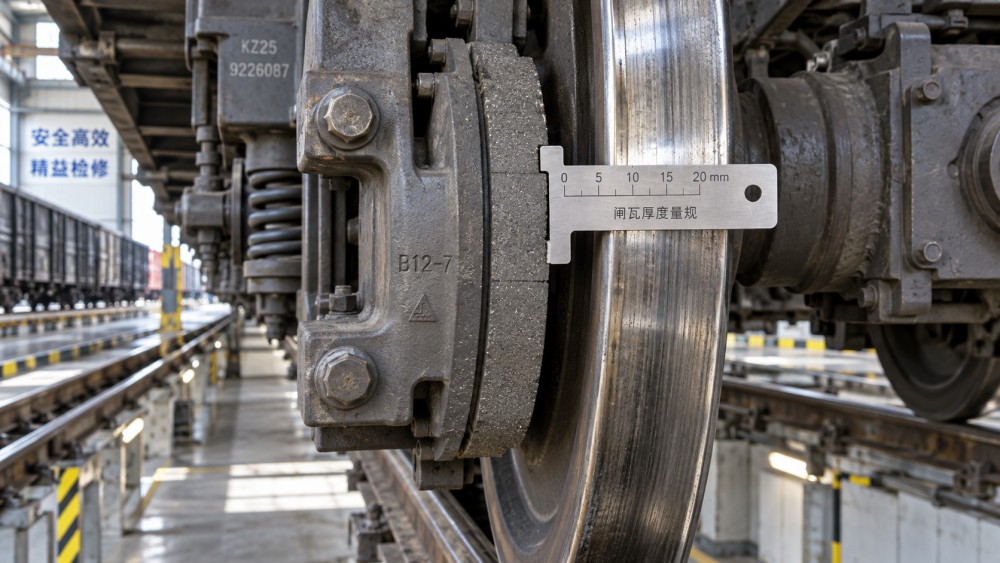
A useful inspection view shows the shoe’s full profile, its position in the holder, and the wheel contact area. A close-up of the friction face alone may miss loose retention or an incorrect fit. Inspection must take place with the wagon secured under the operator’s approved safety procedures.
Damage can require replacement before the wear limit
Remaining thickness does not override a rejectable defect. A relatively thick shoe may still be unserviceable if its structure, attachment, or friction surface cannot perform as intended. Inspectors should distinguish minor surface features permitted by the applicable criteria from defects that require replacement or further assessment.
- Cracking or broken sections: assess the location, extent, and effect on integrity against the approved rejection criteria. Do not assume every surface crack is equivalent, or that every crack is harmless.
- Separation of friction material from its backing: loss of attachment can make a shoe unsafe even when considerable material remains.
- Damaged retention features: a defective key, holder, or attachment arrangement may prevent secure seating. The associated hardware requires attention, not just the shoe.
- Contamination: oil or grease can affect friction behavior. Determine the source and follow the approved disposition; cleaning is not automatically sufficient.
- Evidence of abnormal heating: unusual surface deterioration or other heat-related signs warrant investigation of both the shoe and the brake system.
Where an inspection identifies a potentially safety-critical defect, the wagon’s disposition must follow the operator’s rules. A maintenance planner should not convert an unresolved defect into a routine future work order simply because a workshop slot is inconvenient.
Look beyond the shoe when wear accelerates
A shoe that wears much faster than comparable components is a diagnostic clue. Possible causes include incomplete brake release, incorrect adjustment, restricted rigging movement, poor alignment, or a problem affecting brake force distribution. These are possibilities to investigate, not conclusions that can be drawn from wear alone.
The wheel also needs examination under its own inspection criteria. Tread damage, thermal distress, or an abnormal contact pattern may require action separate from brake shoe replacement. New shoes do not repair a damaged wheel, and changing friction material is not a substitute for correcting a dragging brake.
Repeated replacement at the same position should trigger a review of the maintenance history. Compare wear across the wagon, note whether the pattern follows a particular brake assembly, and check relevant adjustment and release functions. The aim is to stop the recurring fault, not merely improve the replacement rate.
Operating duty changes the replacement window
Mileage alone is a weak basis for deciding when to replace freight wagon brake shoes. Two wagons covering similar distances can experience very different braking demands. Long descents, frequent stops, yard movements, loading conditions, and train handling all influence friction work and thermal exposure.
Route context matters most when a shoe is still acceptable but approaching its limit. A wagon heading into demanding service or a long interval without suitable maintenance access may justify planned replacement earlier than a comparable wagon operating near a repair facility. That decision should be documented within the approved maintenance framework.
For condition-based planning, compare measured wear across successive inspections and similar duty cycles. A simple estimate of remaining life can support scheduling, but it should not assume that wear remains linear after a route change, material change, or braking fault. Uncertainty calls for a suitable inspection interval, not an optimistic extrapolation.
Calendar-based replacement still has a role where required or where condition information is insufficient. However, replacing every shoe at the same age without considering condition can waste usable material while missing components that deteriorate early.
Replacement material must match the approved brake configuration
A brake shoe is not interchangeable merely because it fits the holder. Friction characteristics influence braking force, thermal behavior, and wheel interaction. Substituting composite material for cast iron—or changing between composite formulations—may require engineering assessment, configuration changes, and formal approval.
European references to K-blocks and LL-blocks, for example, describe different composite brake block categories, not unrestricted substitutes for one another. Likewise, a shoe approved for one freight application should not be assumed suitable for another network or vehicle solely because its dimensions match.
Before installation, verify the approved part identification, material category, dimensions, attachment compatibility, and any position-specific restrictions. Follow the maintenance instructions on whether associated shoes must be replaced together. There is no universal rule that every replacement must cover the entire wagon, nor that isolated replacement is always acceptable.
Procurement should preserve these distinctions. A purchase description such as “freight wagon brake shoe” is too broad to control substitution. Traceable product identification and the applicable approval basis are more useful than a supplier’s general claim of standards compliance.
Make the inspection record useful for the next decision
A record that says only “brakes checked” provides little help when a wagon returns with accelerated wear. Useful records link the shoe position, material identification, measured condition, observed defects, inspection date, and resulting action. Photographs can clarify unusual damage, but they do not replace measurements or acceptance criteria.
For mixed fleets, the maintenance system should make the correct limits easy to retrieve. Inspectors should not have to infer the material category from appearance or rely on a threshold remembered from another wagon type.
This is where the technical intelligence approach of Global Railway-Freight & Engineering (G-RFE) is relevant: connecting rolling-stock specifications, operating conditions, and applicable UIC, EN, or AAR references rather than treating them as separate subjects. Such benchmarking supports informed comparison, but it does not replace the vehicle-specific maintenance authority or approved release process.
Close the job with a release decision, not just a new shoe
After replacement, confirm correct installation and retention, then complete the adjustment, clearance checks, and functional brake tests required by the applicable procedure. Verify that the brake applies and releases correctly and that any underlying defect has been addressed. A component change alone is not evidence that the wagon is ready for service.
The next step for a fleet reviewing its replacement policy is specific: verify the approved shoe types, obtain the current rejection criteria, and compare inspection intervals with actual duty and maintenance access. Replace at the established limit, act on rejectable damage immediately under the relevant rules, and plan earlier intervention where the remaining service margin is inadequate. That is a more reliable basis than either a universal thickness figure or a fixed mileage promise.
- Why Do Wet Rails Increase Train Stopping Distance, and What Can Operators Do?Time : Oct 31, 2026
- What Determines Rail Brake Stopping Distance on Grades and Curves?Time : Oct 31, 2026
- Uneven Railway Brake Shoe Wear: Causes, Checks, and Corrective ActionsTime : Oct 29, 2026
Industry Briefing
Get the top 5 industry headlines delivered to your inbox every morning.