
Wagon Body Material Selection: How Steel, Aluminum, and Composites Compare

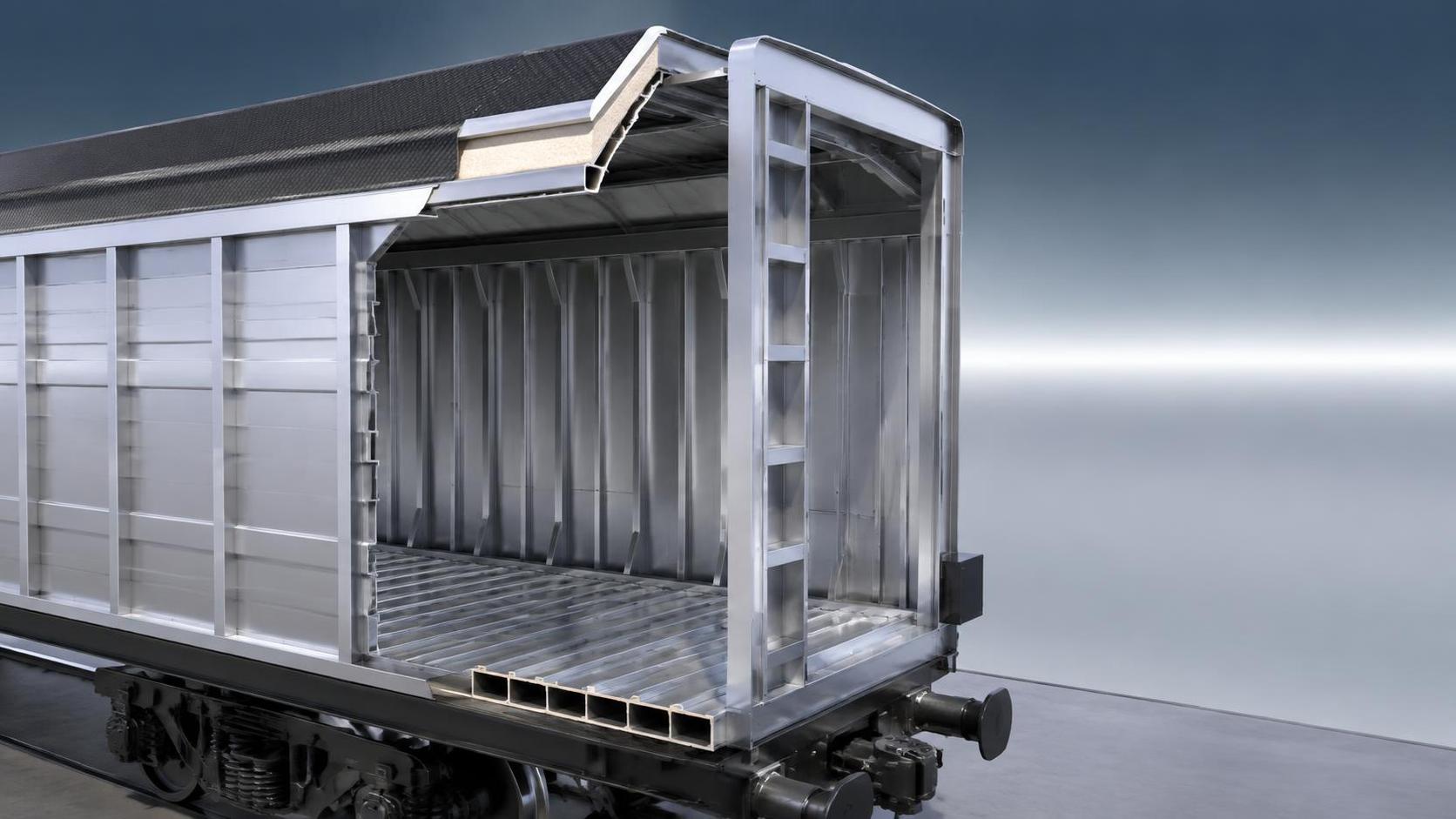
For most freight wagon programs, steel remains the baseline choice when the body must absorb high local loads, tolerate repeated impacts, and be repaired in dispersed workshops. Aluminum earns its place when tare mass limits revenue payload or route economics, while composites are strongest when corrosion, thermal performance, or modular panels matter more than concentrated structural abuse. The correct choice follows the load path, cargo behavior, duty cycle, repair network, and approved joining methods; material density alone is a poor starting point.
A wagon body is not a uniform shell. Side walls, end walls, floor sheets, doors, hopper slopes, roof members, top chords, stakes, discharge equipment, and underframe interfaces see very different stresses. Bulk cargo can create abrasion and impact at the floor and lower side wall. Coil, timber, containers, and steel products transfer concentrated loads through restraint points. Moisture and residues collect in seams, drain paths, door pockets, and interfaces between dissimilar materials. A material that performs well in one zone can be unsuitable in another, which is why hybrid construction is often more defensible than selecting a single material for every component.
Start with the governing duty, not nominal strength
The first question is whether the wagon body is primarily a load-carrying structure, a cargo enclosure, or both. Open gondolas, high-sided bulk wagons, and certain hopper bodies rely heavily on the shell and stiffeners to manage service loads. Covered wagons may permit more separation between the underframe and the body, but roof frames, door openings, and end walls still require stiffness to avoid fatigue damage and loss of weather sealing.
Static payload is only one input. Longitudinal train forces, buff and draft events, torsion on uneven track, vibration, unloading shocks, and repeated door operation all influence the design. A body that has ample calculated static capacity can still suffer cracking where a stiff longitudinal member terminates, where a gusset concentrates strain, or where thin sheet is restrained by a much heavier frame. Material selection therefore needs to be paired with a fatigue-detail review. Weld geometry, fastener spacing, drainage, access for inspection, and the transition between body and underframe often control service life more than the headline tensile strength of the base material.
Steel: durable, adaptable, and sensitive to corrosion detail
Steel is often selected because it combines structural capacity, impact tolerance, predictable fabrication, and practical field repair. It is especially appropriate for bodies exposed to rough loading, ballast-like materials, scrap, aggregates, mineral products, or operations where dents and abrasion are expected rather than exceptional. Thicker wear plates, replaceable liners, and reinforced lower-body areas can be integrated without creating radically different thermal expansion behavior or unfamiliar repair procedures.
Its mass penalty should not be judged from density alone. A steel body can become unnecessarily heavy when designers add thickness to compensate for uncertain loading, omit efficient formed sections, or use a uniform plate thickness in zones with very different demands. Conversely, attempts to minimize thickness without controlling panel buckling and fatigue can create a body that meets initial weight targets but needs recurring structural work. Stiffeners should be placed to maintain load paths without creating water traps or inaccessible corrosion pockets.
Corrosion is the central steel tradeoff. Exterior atmospheric exposure is manageable with an appropriate coating system and maintainable surface preparation, but internal service conditions are more demanding. Wet coal, fertilizer residues, salt-bearing cargo, chemicals, trapped wash water, and prolonged contact with damp debris can attack floor seams and lower-side details. Drain holes only work when their location, size, protection, and cleaning access are considered together. A narrow slot hidden behind a reinforcement can retain contamination while appearing to provide drainage on a drawing.
Repairability is a substantial operational advantage, but it should not be treated as permission for poor design. Repeated weld repairs in the same fatigue-prone location can alter stiffness, introduce residual stress, and move cracking to the next geometric discontinuity. A repair plan should distinguish between sacrificial wear components, patchable sheet areas, and primary structural members that require controlled replacement or engineering review after damage.
Aluminum: payload opportunity with stricter structural discipline
Aluminum can lower tare mass and therefore improve the payload available within gross rail-load limits. This benefit is most relevant when the cargo is dense enough to reach the wagon’s weight limit before it fills the volume, and when the route, axle-load regime, and operating pattern allow the mass reduction to be used productively. For low-density cargo that fills the wagon before reaching the load limit, a lighter body may provide little payload gain. The evaluation must therefore compare cubic capacity, cargo bulk density, loading tolerance, and legal or route-specific mass limits rather than assuming every kilogram removed produces additional carried product.
Aluminum structures require attention to stiffness because elastic modulus is lower than that of steel. A direct substitution of thinner aluminum sheet for steel plate often produces excessive deflection, oil-canning, door misalignment, or local buckling. Efficient aluminum bodies commonly use deeper extrusions, closely designed stiffeners, formed profiles, or sandwich-like arrangements. These features can preserve stiffness while retaining a mass advantage, but they affect tooling, joining sequence, inspection access, and replacement-part logistics.
Impact loading deserves a separate review. Aluminum can perform well in properly designed freight structures, yet thin unprotected panels are less forgiving of forklift contact, dropped tooling, concentrated cargo edges, or abrasive loading. Local reinforcements, sacrificial liners, wear strips, and robust interfaces at door thresholds may be necessary. The added mass of these protections must be included in the comparison; an idealized bare-shell calculation can overstate the finished wagon advantage.
Joining choices also shape lifecycle performance. Welding, bolting, bonding, and mixed joints each affect fatigue behavior and repair options. Heat from welding changes the properties of some aluminum alloys near the joint, so joint efficiency cannot be assumed from parent-material values. Distortion control matters on long side sheets, roof assemblies, and door frames. Where aluminum joins steel hardware or an underframe interface, electrical isolation, sealing, fastener selection, and water management are needed to reduce galvanic corrosion risk. A coating can supplement this strategy, but it cannot compensate for a joint that traps electrolyte and keeps dissimilar metals electrically connected.
Field repair capacity should be examined before adopting aluminum for heavily exposed body zones. A workshop accustomed to steel patching may need different cleaning practices, consumables, welding qualification, straightening limits, and inspection methods. Contamination from steel particles, incorrect filler selection, or uncontrolled heating can create corrosion and fatigue concerns that are not obvious immediately after repair.
Composites: targeted value, limited tolerance for poorly defined damage
Composite materials are rarely a blanket replacement for steel in severe freight-body structures. Their strongest applications are corrosion-resistant panels, roofs, interior linings, doors, access covers, insulated enclosures, aerodynamic fairings, and components where low mass and low thermal conductivity offer direct functional value. Fiber orientation, resin system, core material, edge treatment, inserts, and bonding details determine performance far more than the word “composite” suggests.
A composite panel can be stiff and light, but stiffness does not automatically equal resistance to point impact. A hard object striking a sandwich panel can crush a core, separate skins from the core, or create delamination beyond the visible mark. A steel dent is often easy to locate and assess; composite damage may require tap testing, ultrasonic methods, or removal of interior trim to establish its extent. This inspection burden is especially relevant where loading equipment, loose cargo, or trackside debris can strike the body repeatedly.
Moisture control remains necessary. Composite skins do not rust, yet exposed cut edges, penetrations, fastener holes, damaged coatings, and poorly sealed inserts can allow water into a core or bond line. Freeze-thaw exposure, cleaning chemicals, ultraviolet exposure, and sustained heat should be considered against the selected resin and protective finish. A panel that stays dry and lightly loaded on a roof has a very different risk profile from a floor module exposed to standing water and abrasion.
Repair is also less straightforward than replacing a damaged panel. Structural composite repairs require a defined damage boundary, controlled surface preparation, compatible materials, cure conditions, and verification that the restored laminate transmits load as intended. A depot can handle cosmetic repairs without necessarily being equipped for structural restoration. Where rapid wagon availability is essential, modular bolted panels may be preferable to a bonded structural skin, even if the latter has a cleaner theoretical mass result.
Where hybrid bodies make sense
A mixed-material body often aligns better with real loading conditions. Steel can carry concentrated loads at the underframe connection, floor edge, coupler-adjacent structure, door sill, and lower impact zones. Aluminum may form large upper side-wall or roof sections where corrosion exposure and tare mass matter but direct cargo contact is limited. Composites can serve as roof, lining, or insulated panel systems where their specific properties are useful.
Hybrid construction adds interface complexity. Differential thermal movement can stress sealants and joints. Dissimilar-metal contact requires corrosion isolation. A repair that is routine on one side of an interface may damage the adjoining material. Drawings should identify approved fasteners, sealants, electrical isolation layers, torque requirements, coating restoration, and replacement sequences. Without this information, maintenance personnel may solve an immediate defect while compromising the original interface design.
Parameters that often distort the comparison
- Payload gain calculated from body mass alone: the actual gain can be capped by volume, route limits, axle loads, or loading variability.
- Material yield strength used as the sole structural measure: panel buckling, stiffness, fatigue detail, and localized contact loads can govern first.
- Corrosion resistance treated as freedom from maintenance: aluminum and composites still require sealing, drainage, inspection, and protection of joints or penetrations.
- Repair cost estimated from workshop labor only: downtime, access equipment, qualified procedures, parts availability, post-repair inspection, and repeat damage patterns belong in the calculation.
- Uniform cargo assumptions: loading method, drop height, moisture content, residue behavior, and unloading equipment can change the required floor and side-wall construction substantially.
Turning the comparison into a defensible specification
Define the cargo envelope first: density range, particle size, abrasive behavior, moisture, temperature, chemical residues, loading device, unloading method, and expected misuse events. Then map these conditions to body zones rather than assigning a single material requirement to the entire wagon. The floor may need wear resistance and impact tolerance; the upper body may be governed by corrosion, stiffness, or mass; doors may be driven by cycling and dimensional stability.
Next, require a structural concept that states the assumed load paths and the treatment of transitions. Material certificates and nominal thicknesses are insufficient without details for corner joints, stiffener endings, openings, lifting points, liner attachments, and body-to-underframe connections. For aluminum and composite proposals, require the joining and repair philosophy at the same stage as the structural layout. These subjects cannot be left to workshop documentation after the body geometry is fixed.
Finally, compare lifecycle exposure honestly. Steel is often the resilient choice where mechanical damage is frequent and local repairs must be fast. Aluminum is compelling when lighter tare produces usable payload and the body can be protected from severe local abuse. Composites are best reserved for components whose loading, inspection, and repair conditions suit laminate construction. The strongest wagon body selection is often the one that assigns each material to the area where its limitations are visible, manageable, and economically justified.
Industry Briefing
Get the top 5 industry headlines delivered to your inbox every morning.