
Reducing Freight Rail Bottlenecks at Passing Loops and Terminals

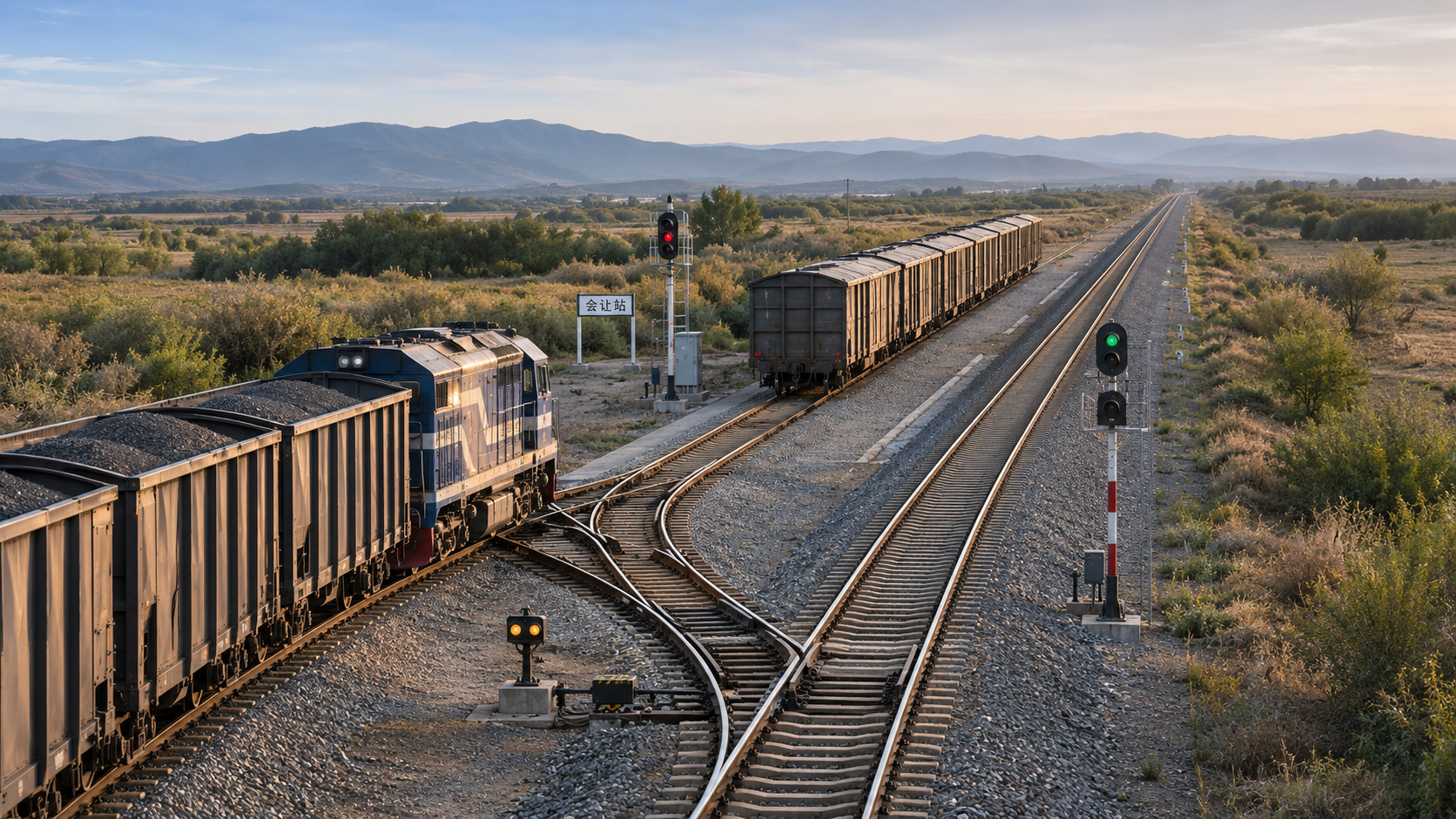
A passing loop or terminal becomes a bottleneck when trains arrive faster than the location can process them, or when the timetable leaves too little room to recover from disruption. The most effective remedy depends on what is occupying the constrained track: an opposing train, a slow turnout, a conflicting yard movement, unavailable terminal equipment, or a maintenance possession.
Improving high-capacity rail efficiency therefore starts with identifying where time is lost and why. A longer loop may solve a train-length restriction, but it will not fix unreliable terminal release times. Similarly, faster signaling can help trains approach more closely, yet deliver little benefit if the receiving track remains occupied. The task is to find the constraint that controls the whole movement, then check where the pressure will move after it is relieved.
Find the constraint before choosing the project
Begin with a corridor view, not a list of assets that appear congested. Map the route from the approaches to the loop or terminal through to the next location where a train can be held, received, or dispatched. Include junctions, block sections, yard entrances, loading tracks, and connections to ports or industrial facilities. A delay recorded at one point may originate somewhere else.
For a representative operating period, compare the working timetable with actual train movements. Record arrival and departure times, time spent waiting outside signals, track occupancy, train length, and the stated reason for delay. Separate routine patterns from unusual disruptions, and examine busy periods as well as daily totals. A terminal can appear to have spare daily capacity while its entrance is saturated during a short arrival peak.
Three questions help distinguish symptoms from causes:
- Where does the queue begin? Trains waiting outside a terminal may be held by an occupied receiving track, but they may also be constrained by a junction shared with departures.
- What releases the occupied resource? At a loop, it may be the opposing train clearing a section. At a terminal, it may be the completion of unloading, inspection, shunting, or a crew change.
- What prevents recovery? A small delay can spread when there are no usable alternative tracks, crews are unavailable, or the next train occupies the only route out.
Use dispatch records alongside input from signallers, terminal staff, train operators, and maintenance teams. Their explanations can reveal practices that are not obvious from timestamps, such as holding an early train to avoid blocking a yard throat. Treat each explanation as a hypothesis to compare with the movement data, rather than assuming the most visible delay code identifies the root cause.
Passing loops: match the infrastructure to the train plan
On a single-track corridor, a passing loop allows trains traveling in opposite directions to cross. Its usefulness depends not just on its physical length, but on whether the trains that need to meet can enter, stop, and depart without fouling points, signals, or adjacent routes.
Compare the planned maximum train length with the loop’s usable standing length under the applicable operating rules. The relevant dimension is not simply the distance between two turnouts. Signal positions, clearance points, gradients, and operational allowances affect where a train can stand. A loop that accommodates most services but excludes the longest freight trains can force dispatchers to arrange crossings farther apart, making the timetable less flexible.
Extending a loop is attractive when long trains regularly pass through and the current layout prevents otherwise practical meets. It is less compelling when the loop is rarely the controlling location, or when the next junction or terminal cannot accept those longer trains. The assessment should follow the complete train path, including reception tracks and any locations where trains must be divided.
Loop spacing matters too. If a late-running train must travel a long distance before it reaches the next crossing opportunity, an opposing train may have to wait even when a nearby loop is available. A new loop can reduce that exposure, but its value depends on the timetable, running times, terrain, and expected traffic mix. Test its location against delayed as well as scheduled train movements; a loop placed only for a perfect timetable may offer limited recovery value.
Look at the time spent entering and clearing
Two loops of similar length can have different operating capacity. Turnout speed, braking distance, signal placement, route setting, and the time required for a train to clear the main line all affect how long a crossing occupies the corridor. Slow entry or exit can turn a short meet into a prolonged blockage.
Upgrading turnouts or changing signal arrangements may reduce that occupation time without a major extension. The benefit is greatest where crossings are frequent and the approach and departure sections can make use of the improvement. If the train must still wait for a distant block section to clear, work at the loop alone may simply shift the waiting point.
Gradient and train handling also deserve attention. A heavy train stopped on an unfavorable grade may need more time or additional traction to restart. Scheduling it to keep moving through the main line while the opposing train waits in the loop can be useful, provided the layout and operating rules support that arrangement.
Terminal bottlenecks often start at the throat
A terminal may have several tracks but only one practical route into or out of them. The throat, where those routes converge, can become the limiting resource when arrivals, departures, and shunting movements conflict. Adding storage tracks behind the throat will not necessarily increase throughput if trains cannot reach them at the required times.
Trace a complete train cycle: approach, reception, securing and inspection, loading or unloading, any necessary shunting, train preparation, and departure. Measure both the time each activity takes and the time between activities. A track can remain occupied after unloading is complete because the departure crew, locomotive, paperwork, or onward path is not ready.
For an intermodal terminal or rail-port interface, include the transfer operation in that cycle. A train arriving on time cannot be released quickly if containers, handling equipment, road access, or the ship-side schedule are not aligned with the rail plan. Conversely, faster handling has limited value if the finished train has no available departure path.
Possible responses depend on the conflict:
- Separate opposing movements where arrivals, departures, and shunting repeatedly block one another and the available land and track geometry permit it.
- Resequence arrivals or departures when the same track is contested at predictable times but capacity is available elsewhere in the operating window.
- Reduce occupation time by coordinating inspections, equipment, crews, and documentation with the expected arrival, rather than starting preparation only after the train reaches the terminal.
- Add receiving or departure capacity when tracks remain occupied by essential work and a throat analysis shows that trains can access the additional tracks.
Track additions need particular care where trains are longer than existing terminal tracks. Splitting a train may make it physically possible to receive it, but the extra shunting can consume the very throat capacity the project was intended to free.
Choose operational and signaling changes for the constraint they address
Before committing to major civil works, test whether changes to the operating plan can make better use of existing capacity. Adjusting meet locations, spreading terminal arrivals, protecting departure paths, or coordinating crew changes may reduce recurring conflicts. These measures need agreement across the organizations controlling the train, infrastructure, and terminal; a timetable improvement on paper is of little use if the terminal cannot receive the revised arrival.
Signaling and communications upgrades can support more flexible operation, but their contribution depends on the existing system and the traffic pattern. Shorter signaling sections or more efficient route setting may reduce the separation between movements where track occupancy is the limiting factor. Remote control or improved communications may also reduce delays associated with arranging movements, depending on the current operating method.
Such changes do not create a second track, eliminate conflicting routes, or make a terminal process a train faster. Assess compatibility with onboard equipment, control systems, operating rules, and the existing safety case. Technologies such as ETCS or CBTC should be considered against the corridor’s operational need and interfaces, not selected solely because they are associated with automation or modern signaling.
Where an upgrade requires altered procedures, include training, degraded-mode operation, and transition arrangements in the project scope. A system that works well in normal operation but has no practical response to equipment failure can weaken corridor resilience.
Protect maintenance access while increasing traffic
A timetable that uses every available path can make maintenance harder to deliver and leave little room for recovery. Track inspections, turnout work, signaling maintenance, and renewal activities all need access. Removing or repeatedly overrunning maintenance windows may produce short-term train paths at the expense of asset condition and future reliability.
Include planned possessions in capacity studies rather than treating them as exceptions. Test how traffic will be rerouted, held, or rescheduled during work, and identify the effect on terminal receiving capacity. For major construction, model the temporary layout as carefully as the final one: a loop extension or throat reconstruction may reduce capacity while it is being built.
Compare options by corridor performance, not asset count
A practical option assessment should compare an operating change, a targeted infrastructure intervention, and a combined package where each is credible. Use the same forecast train plan, terminal assumptions, and maintenance access for each. Show which trains benefit, which movements still conflict, and whether the proposed solution introduces a new constraint downstream.
Useful measures include trains handled in the busy period, waiting time at the constraint, terminal dwell time, and the ability to recover after a late arrival or temporary track closure. Report the distribution of delays as well as averages: a small improvement in average time may conceal severe delays to a particular service or direction.
Stress-test the preferred option with longer trains, uneven arrivals, and the planned maintenance regime. A simulation can help compare interactions across a corridor, but its output is only as useful as its assumptions about running times, handling rates, dispatch rules, and infrastructure availability. Review those assumptions with the people responsible for delivering the service.
For the project decision, connect expected benefits to the investment and its dependencies. A loop extension that requires a terminal track extension, revised rolling stock plans, and a signaling change should be evaluated as a connected package. Also consider staged delivery: an operating change may provide useful relief while design and approvals proceed, and the first construction phase should remain useful if a later phase is delayed.
Finish by defining a baseline and an operating owner for each measure. Track occupancy, queue duration, train length, and departure reliability provide a practical starting point. After commissioning, compare results with the same operating conditions used in the assessment, investigate any new queues, and adjust the timetable or terminal procedures before treating the project as complete.
- Reducing Freight Rail Bottlenecks at Passing Loops and TerminalsTime : Nov 03, 2026
- Selecting Rail Infrastructure Components for Heavy-Axle-Load TracksTime : Nov 02, 2026
- Rail Infrastructure Components: A Guide to Track Equipment and UsesTime : Nov 02, 2026
Industry Briefing
Get the top 5 industry headlines delivered to your inbox every morning.