
Railway Electrification Compliance: Key Standards, Tests, and Approval Risks

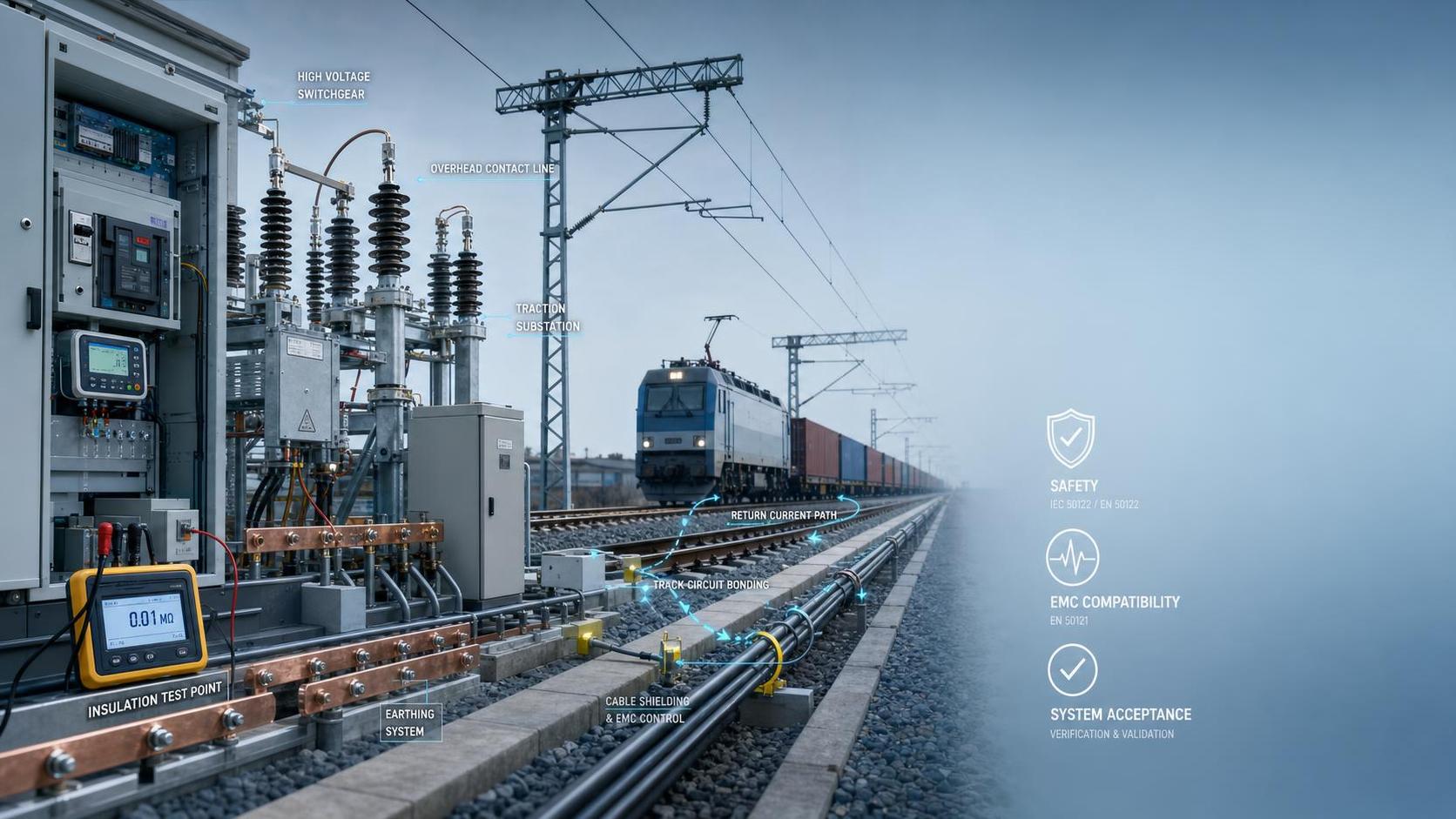
Railway Electrification Compliance Is Broader Than Electrical Safety
In railway projects, electrification compliance is often misunderstood as a matter of voltage ratings, insulation checks, and whether the overhead contact system energizes correctly. That is only the visible layer. In practice, railway regulatory compliance in electrification is the discipline of proving that the traction power system, its interfaces, and its operating environment meet the technical, safety, and approval conditions required for a line to enter service without creating unacceptable risk.
For quality and safety teams, the real difficulty is not the existence of standards. It is the overlap between them. A modern freight corridor may be shaped by EN requirements, referenced IEC methods, national railway rules, infrastructure manager specifications, signaling constraints, EMC limits, earthing philosophy, and asset acceptance procedures that were written for a specific network rather than for a generic railway. Compliance therefore has to be read as a system question, not a component question.
That distinction matters because many approval delays do not come from obvious failures. They come from interfaces that were left underspecified: return current paths that affect signaling, bonding arrangements that do not match local practice, surge protection that is adequate on paper but not accepted by the authority, or test evidence that exists at component level but does not support system-level authorization.
What “Compliance” Usually Covers on an Electrified Railway
In industry use, electrification compliance usually spans four layers at once.
The first is fixed traction power infrastructure: substations, feeder stations, autotransformer arrangements where used, switching equipment, sectioning, and the overhead contact line or conductor rail system. The second is protection of people and assets: clearances, touch voltage control, earthing and bonding, fire behavior of installed materials where relevant, and safe maintenance isolation. The third is compatibility with the railway around it: signaling, telecommunications, rolling stock current collection, bridges, tunnels, stations, and maintenance depots. The fourth is evidence: design dossiers, calculations, type-test certificates, installation records, commissioning results, and the format in which the approving body expects them.
This is why the same overhead line equipment can be technically sound in one corridor and still face non-acceptance in another. Approval is tied not only to engineering quality, but to whether the submitted design proves conformity to the specific operating envelope of that route.
The Standards That Usually Set the Frame
There is no single universal code that settles every electrification question. In Europe and in projects influenced by European practice, a large part of the framework sits around the EN 50119 family for overhead contact lines, EN 50122 for protective provisions relating to electrical safety and earthing, EN 50121 for electromagnetic compatibility, and EN 50388 for technical criteria coordinating traction power supply and rolling stock. Depending on scope, IEC standards may be referenced for switchgear, insulation coordination, protection concepts, and test methods. UIC documents remain relevant as technical references in some international railway environments, while freight programs outside Europe may also need to reconcile local authority rules or AAR-influenced operating expectations.
What matters is not memorizing standard numbers. It is understanding which standards are normative for approval, which are advisory, and which have been contractually elevated into acceptance criteria. That hierarchy changes project behavior. A requirement written into the employer’s specification or the infrastructure manager’s standard can become just as decisive as a formal national rule.
Teams sometimes assume that compliance with a product standard automatically proves route approval. It does not. A contact wire, insulator, circuit breaker, or protection relay may be certified to its product standard and still require additional evidence for system integration, environmental conditions, or operational interfaces on the target railway.
Tests That Carry Real Approval Weight
Not every test has the same regulatory value. Factory tests are essential, but they mainly show that equipment was built to the approved design. They do not replace installation verification or prove interaction with the live railway.
The tests that usually influence acceptance most are the ones that close the gap between design intent and operational reality:
- Insulation and dielectric verification, including the adequacy of clearances and creepage under the actual contamination and climate assumptions of the route.
- Earthing and bonding continuity checks, because protective bonding errors are common, hard to spot visually, and critical to touch voltage control.
- Return current and stray current assessment, especially where signaling circuits, buried metallic structures, or urban interfaces create sensitivity.
- Electromagnetic compatibility testing, including evidence that traction power operation does not degrade signaling, telecommunications, axle counters, or train detection performance.
- Pantograph–catenary interaction and dynamic performance checks for overhead systems, particularly at the intended operating speed and loading profile.
- Protection system functional testing, including fault detection, tripping logic, interlocking dependencies, and safe isolation sequences.
- Commissioning and energization tests that verify the installed railway behaves as the approved calculations predicted.
For freight-heavy networks, current demand, regenerative braking behavior where applicable, harmonic effects, and voltage stability under long-distance loading can become approval issues rather than purely performance issues. A system may pass static checks and still reveal unacceptable operational margins once realistic train formations are considered.
Where Approval Risk Usually Hides
Approval problems in electrification rarely begin with a dramatic technical collapse. More often, they accumulate in ordinary project decisions.
One common risk is treating national or network-specific requirements as minor local deviations to be handled late. That is a mistake. Earthing philosophy, bridge bonding, tunnel interfaces, maintenance access, and immunization of signaling systems are often governed by local railway practice, and authorities usually expect these decisions to appear early in design submissions.
Another risk is fragmented evidence. Mechanical design, electrical protection, EMC analysis, and operational safety may each be prepared competently by different teams, but approval can still stall if the documents do not speak to one another. A safety assessor or infrastructure manager will ask a basic question: does the complete package show that the railway can be energized and operated safely under fault, maintenance, and degraded modes? If the answer has to be reconstructed across inconsistent reports, confidence drops quickly.
There is also a recurring misconception around “equivalent” equipment. Substituting a component with similar ratings is not necessarily harmless. In electrified railways, equivalence may depend on EMC behavior, failure mode, mechanical endurance, fire properties, maintainability, software revision control, or accepted type-test lineage. Procurement substitutions that look efficient can trigger fresh validation work.
How Quality and Safety Managers Usually Judge Readiness
A practical review does not start with whether every test report exists. It starts with whether the compliance story is coherent.
That last point is worth stressing. Electrification approval is not finished when equipment energizes. If staff cannot isolate sections reliably, if return paths during fault conditions remain ambiguous, or if maintenance procedures depend on undocumented field judgment, the railway is not truly compliant in operational terms.
A Freight-Corridor Perspective
On high-capacity freight railways, electrification compliance becomes more exacting because the load profile is less forgiving. Long, heavy trains place sustained demand on substations and feeder arrangements. Mixed traffic can introduce different pantograph behaviors and current signatures. Cross-border routes may require alignment between differing legacy practices. In those settings, a narrow interpretation of railway regulatory compliance electrification is risky. The technical file must show not only that the assets were built correctly, but that the corridor can operate at the intended duty cycle without undermining signaling integrity, power quality, or maintenance safety.
That is also why engineering platforms that benchmark locomotives, rolling stock interfaces, signaling frameworks, and infrastructure standards in one place are useful to decision-makers. Electrification does not sit alone. Its approval path is tied to the wider railway system.
What Good Compliance Work Looks Like in Practice
The strongest projects treat compliance as a design input from day one, not as a final documentation exercise. They identify the approving authority early, freeze the applicable standards hierarchy, define electrical and signaling interfaces before procurement hardens, and build test plans around the evidence that the authority will actually require. They also keep a live compliance matrix tied to design revisions, site changes, and supplier substitutions.
For quality and safety managers, that leads to a simple working rule: when reviewing an electrification package, do not ask only whether the equipment meets specification. Ask whether the project can demonstrate, in an auditable and route-specific way, that the electrified railway will behave safely and predictably in service. That is the threshold approval bodies tend to care about, and it is where costly surprises are either prevented or discovered too late.
- Track Maintenance Solutions in North America for Freight, Climate, and Network ScaleTime : Aug 28, 2026
- What Does Railway Compliance Standards EN Cover in Modern Rail Projects?Time : Aug 16, 2026
- What Railway Engineering Platforms Must Prove for Compliance in Safety-Critical ProjectsTime : Aug 15, 2026
Industry Briefing
Get the top 5 industry headlines delivered to your inbox every morning.