
Non Pressure Tank Wagon Applications and Common Specification Mistakes

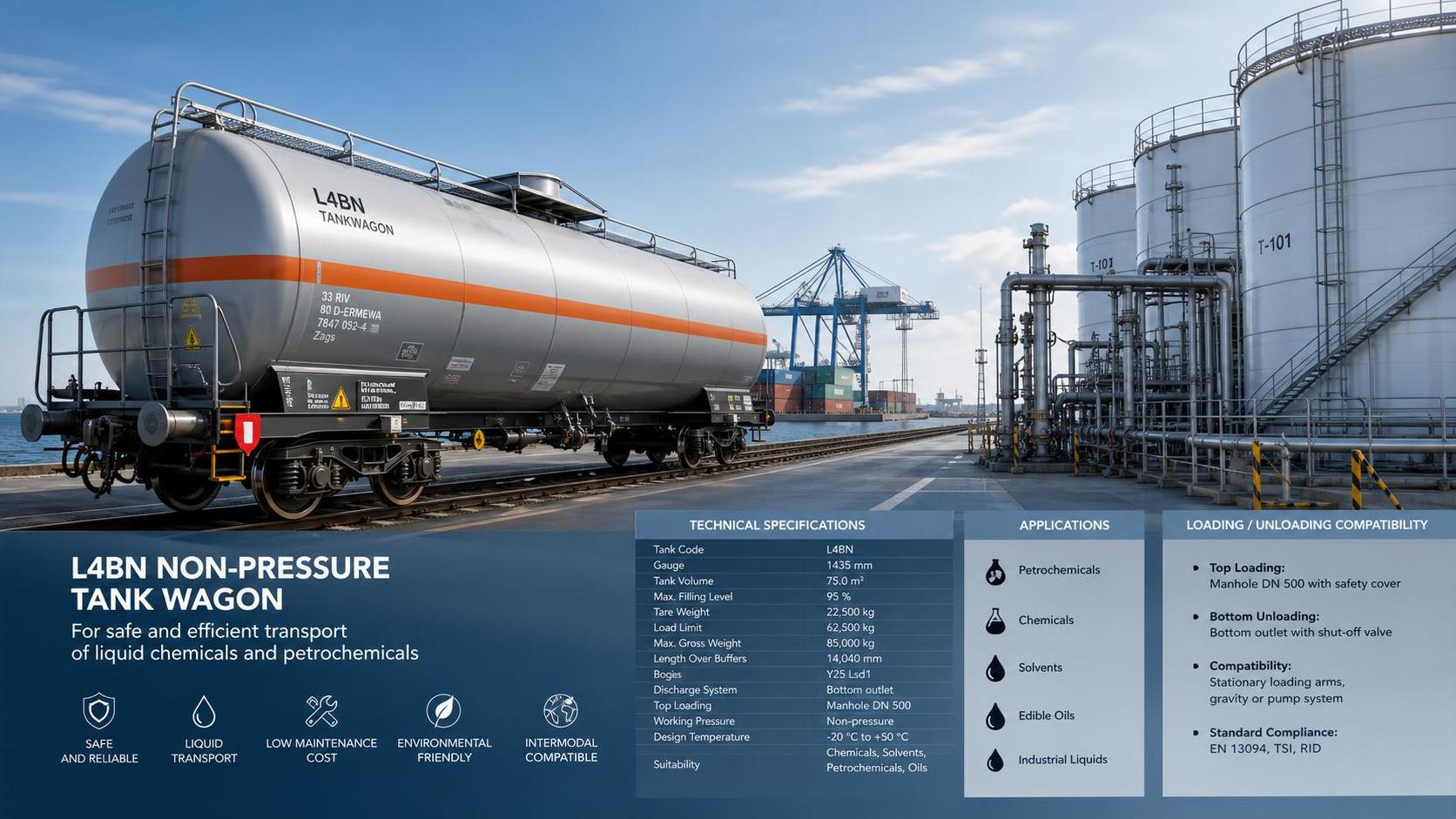
Why application context matters before choosing a non pressure tank wagon
A non pressure tank wagon often looks straightforward on paper. It carries liquids or bulk cargo without pressurized containment, so selection seems simple until operating conditions start to differ.
In railway freight, that assumption creates avoidable risk. Small specification mistakes can affect route availability, loading efficiency, cleaning cycles, regulatory acceptance, and long-term fleet utilization.
That is why the non pressure tank wagon is rarely judged by capacity alone. Real performance depends on cargo behavior, terminal design, axle load rules, climate, and maintenance capability.
Within the G-RFE perspective, rolling stock decisions are tied to broader corridor logic. A wagon that fits one industrial loop may perform poorly in an intermodal rail-port chain or cross-border heavy-haul network.
The more common evaluation mistake is treating similar cargoes as identical. A non pressure tank wagon for edible liquids, mineral slurry, and bitumen substitute feedstock can require very different material, discharge, and cleaning choices.
Different operating environments change the specification baseline
In actual use, demand shifts with the corridor and terminal pattern. Closed industrial circuits usually prioritize turnaround speed, while long international routes place more weight on standard compliance and maintenance predictability.
Cargo stability also changes the baseline. Low-viscosity liquids are sensitive to surge and braking behavior, while dense bulk slurries place more pressure on lining durability and discharge geometry.
Another variable is handling equipment. Some sites fill from top loading gantries, others rely on bottom discharge systems, vacuum unloading, or simple gravity-assisted transfer.
These differences explain why one non pressure tank wagon specification does not scale cleanly across every route. The useful question is not whether a wagon can carry the product, but whether it can do so repeatedly without hidden friction.
Where the judgment points usually shift
High-frequency liquid movements need more than simple tank volume
One common application for a non pressure tank wagon is regular transport of water, molasses, liquid fertilizers, oils, or other non-hazardous fluids between fixed points.
In these cases, procurement teams often compare tank volume first. That matters, but volume without fill ratio control can create surge behavior that affects braking stability and unloading consistency.
A more reliable judgment starts with density range, loading temperature, and permitted axle load. The apparent “larger” wagon may deliver less usable payload on a restricted corridor.
Top fittings deserve equal attention. If the route serves multiple terminals, hatch arrangement, inspection access, and valve protection can shape real operating speed more than tank size does.
Cleaning is another dividing line. A non pressure tank wagon carrying one stable commodity can tolerate a simpler interior finish than a wagon rotating across food-grade or contamination-sensitive liquid streams.
Bulk slurry and dense materials create a different set of risks
Another frequent use case involves slurry, tailings byproducts, industrial residues, or semi-fluid mineral materials. These cargoes do not need pressure vessels, yet they challenge the wagon in other ways.
Here, discharge design becomes central. Viscosity, sedimentation, and solids concentration can turn a theoretically compatible non pressure tank wagon into a slow, maintenance-heavy asset.
Wall thickness alone does not solve that problem. Internal geometry, slope angles, anti-abrasion lining, and outlet positioning often determine whether unloading finishes cleanly or leaves residue buildup.
A common mistake is specifying the wagon around fresh product data. In service, dense material behavior changes after dwell time, weather exposure, and repeated loading cycles.
For that reason, a non pressure tank wagon used in mining or heavy process industries should be evaluated with worst-case discharge conditions, not best-case laboratory values.
What usually separates a workable specification from a costly one
- Confirm product density across the full temperature range, not at one reference point.
- Check whether the non pressure tank wagon needs internal coating, stainless sections, or abrasion-resistant treatment.
- Match outlet design to actual unloading equipment, not assumed terminal capability.
- Review residue tolerance, wash cycle time, and contamination consequences between cargo changes.
- Model usable payload against route axle limits and tare weight, not tank volume alone.
Rail-port and intercontinental corridors raise compliance questions early
When a non pressure tank wagon enters longer corridors, the technical discussion broadens. Wagon design now interacts with signaling rules, train formation limits, port dwell time, and regional documentation requirements.
That wider view is consistent with G-RFE’s infrastructure-to-rolling-stock approach. A wagon can be structurally sound and still create problems if brake system compatibility or inspection practice does not fit the corridor.
This is where specification shortcuts become expensive. Some buyers assume that a domestic non pressure tank wagon can be exported into broader service with minimal adjustment.
In practice, coupler arrangement, bogie standard, gauge environment, and maintenance documentation may need rework. Even ladder layout or valve guarding can become an acceptance issue.
The better approach is to map the wagon against corridor rules from the start. That includes loading gauge, brake performance, maintenance intervals, and interoperability expectations under UIC, EN, or AAR frameworks.
The most common specification mistakes are usually avoidable
Several errors repeat across projects because the non pressure tank wagon is treated as a standard commodity wagon. It is not. Its value depends on fit between product, route, and handling process.
Mistakes seen most often
- Selecting maximum nominal capacity without checking tare weight and route load restrictions.
- Assuming all non-corrosive cargoes are also material-compatible with the same seals, lining, and valve components.
- Copying an existing non pressure tank wagon specification from another line without reviewing terminal interfaces.
- Underestimating cleaning downtime in multi-product operations.
- Treating climate as secondary, even when temperature changes alter viscosity, residue formation, or seal life.
- Checking compliance at the end instead of using standards as an early screening filter.
More subtle mistakes also matter. For example, an optimized non pressure tank wagon for one liquid may become inefficient once cargo turnover changes or the route adds intermediate unloading points.
A practical way to compare non pressure tank wagon options
Before finalizing a specification, it helps to score each non pressure tank wagon option against actual operating conditions instead of catalog values alone.
What to confirm before moving from concept to procurement
A sound non pressure tank wagon decision starts with a narrow but disciplined checklist. Define the product range, route envelope, loading method, discharge method, and cleaning expectation in one working document.
Then test whether the proposed wagon still works when conditions drift. The critical question is how the non pressure tank wagon performs under heavier density, slower discharge, lower temperatures, or tighter route restrictions.
That process usually reveals the real tradeoff. Sometimes a slightly smaller tank, better lining system, or more compatible outlet arrangement produces better annual utilization than a larger nominal design.
For projects moving across industrial sites, ports, and continental rail corridors, the most useful next step is to establish a scenario-based specification matrix. It should compare cargo behavior, compliance rules, maintenance demands, and lifecycle cost together.
Used this way, the non pressure tank wagon becomes easier to evaluate with fewer assumptions. The result is a specification built around operating reality, not just a familiar drawing or a convenient payload number.
Industry Briefing
Get the top 5 industry headlines delivered to your inbox every morning.