
Choosing a Covered Wagon Supplier: Payload, Weatherproofing, and Delivery

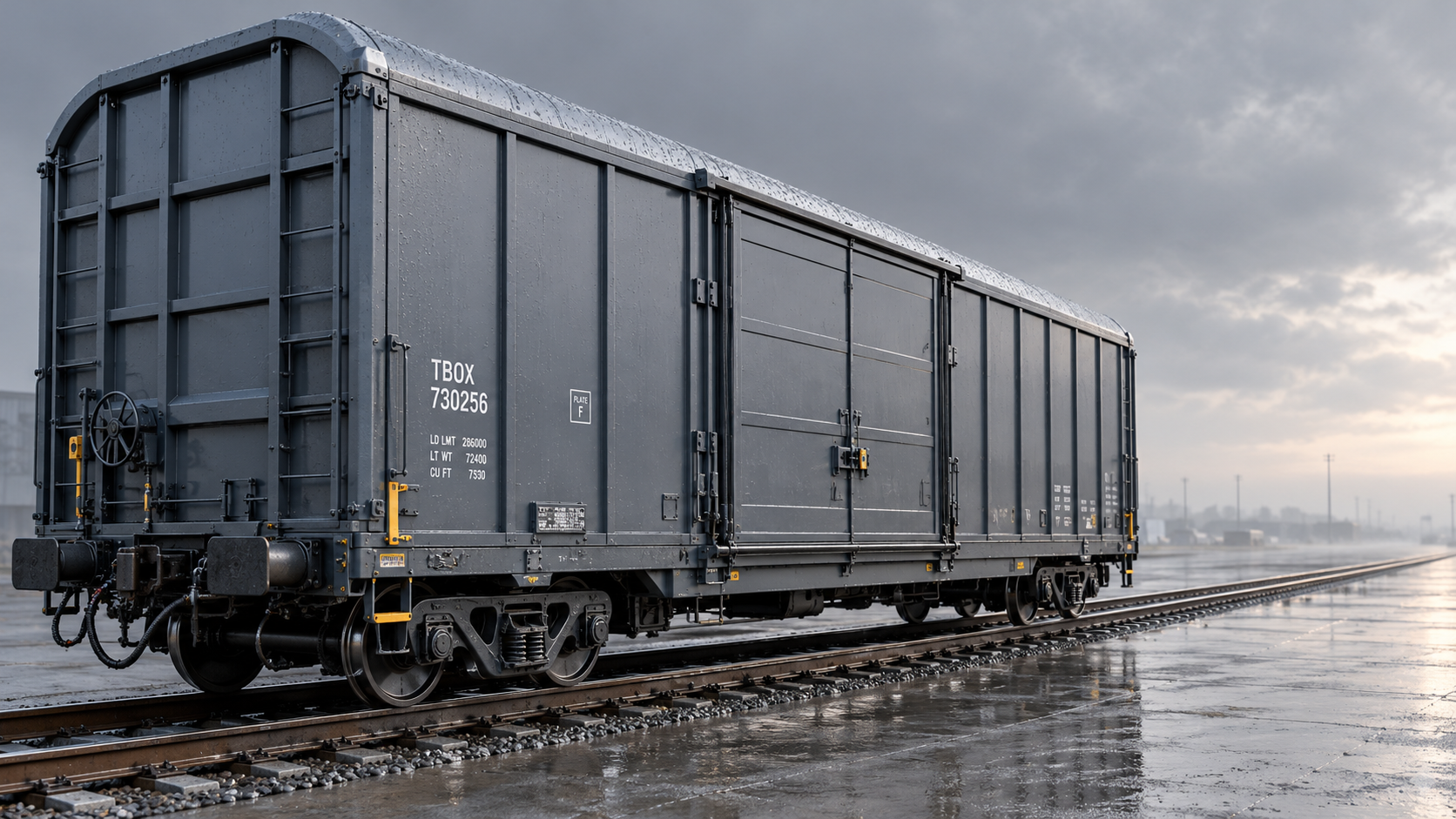
Choosing a Covered Wagon Supplier: Payload, Weatherproofing, and Delivery
Choosing a covered wagon supplier means looking beyond purchase price to verify payload capacity, weather protection, and delivery commitments against your freight requirements. A mismatch in axle load, loading gauge, or door sealing can leave you with restricted routes, damaged cargo, or wagons that arrive but cannot enter service.
The buying decision is not simply which manufacturer offers the strongest wagon. It is which proposal gives you a usable transport asset at a defensible whole-life cost. That requires checking the relationship between the vehicle, the cargo, the route, and the receiving terminal—and making those checks before the commercial terms are settled.
Define the freight duty before comparing quotations
“Covered wagon” is not a sufficiently precise purchase description. An enclosed sliding-wall wagon for palletized products, a conventional box wagon, and a covered hopper for bulk commodities solve different handling problems. Their loading arrangements, contamination risks, and maintenance requirements are not interchangeable. This guide focuses primarily on enclosed general-freight wagons; bulk discharge equipment needs a separate specification.
Give bidders a duty profile rather than a cargo name alone. Paper reels, for example, require attention to concentrated floor loads, restraint arrangements, and moisture exposure. Palletized goods may be constrained by door clearance and usable floor layout before reaching the wagon’s weight limit. Bagged products introduce their own concerns around packaging damage, cleanliness, and forklift access.
Specify the operating routes, track gauge, loading gauge, permitted axle loads, intended speed, braking requirements, coupling interfaces, temperature conditions, and terminal practices. Where these are not yet confirmed, identify them as open items. An attractive quotation based on a supplier’s default assumptions is not a reliable budget.
Payload: distinguish the rated figure from usable capacity
Rated payload is meaningful only alongside tare mass, permitted gross mass, and route restrictions. A wagon may be structurally capable of carrying a load that the intended railway cannot accept. Conversely, lightweight cargo may fill the available space while leaving much of the nominal payload unused.
As a screening calculation, subtract the delivered tare mass from the permissible gross mass for the intended operation. Then check axle-load distribution, loading conditions, speed-related restrictions, and any operator-specific limits. Do not assume that an evenly distributed load rating also permits heavy reels, machinery, or stacked pallets in a small floor area.
Ask for the loading diagram and floor-load limits, including concentrated loads and forklift wheel loads where onboard forklift operation is intended. The floor structure, door threshold, and loading interface all need to suit the handling method. “Forklift compatible” without a defined truck mass, wheel arrangement, and loaded operating condition leaves too much unresolved.
Internal volume deserves the same scrutiny. Compare clear door openings, usable dimensions, obstructions, securing points, and the space needed to position cargo safely. A larger nominal volume does not necessarily accommodate more saleable freight if the pallet pattern or reel arrangement is inefficient.
Make tare mass a contractual parameter. Ask what equipment the quoted figure includes, what tolerance applies, and how delivered mass will be verified. Added linings, reinforced floors, or different running gear can change the payload economics after the initial offer.
Weatherproofing needs an agreed test—not an adjective
A supplier’s description of a wagon as “weatherproof” is not an acceptance criterion. Translate it into defined exposure conditions, test methods, and permissible outcomes. Roof joints, door seals, thresholds, wall interfaces, and penetrations all deserve attention. The appropriate inspection points depend on the design.
Request the proposed water-ingress test procedure before placing the order. It should identify the wagon configuration, water application method, duration, inspection locations, and pass/fail criteria. Clarify whether testing applies to a prototype, the first production unit, every wagon, or an agreed sample. A report from a different design is supporting information, not proof that the offered wagon meets your requirement.
Seal performance also depends on how the doors behave in service. Ask how alignment is adjusted, how compression is maintained, and how seals are replaced. If the loading process involves frequent door operation, inspect tracks, rollers, locks, and sealing surfaces for damage exposure. A design that is watertight when carefully adjusted may be expensive to keep that way.
Rain protection does not resolve condensation
Water can enter with the cargo, remain after cleaning, or condense when temperatures change. A successful external spray test does not establish humidity control during transport.
For moisture-sensitive products, discuss loading moisture, transit duration, temperature changes, packaging, and the required internal environment. Ventilation, insulation, and absorbent materials each have trade-offs; none should be specified as a universal cure. Ventilation may help under some conditions while introducing humid air under others.
Separate the wagon supplier’s obligations from the shipper’s loading and packaging responsibilities. Otherwise, a later damage claim can become a dispute over whether the cause was leakage, condensation, wet packaging, or unsuitable loading practice.
Check standards against the actual operating network
“UIC compliant,” “built to EN standards,” and “AAR design” are too broad to establish suitability. These references relate to different technical frameworks, and applicability depends on the network, vehicle configuration, operating arrangements, and jurisdiction. They are not interchangeable approval labels.
Require a compliance matrix identifying applicable requirements, editions, evidence, exclusions, and responsibility for acceptance. Depending on the project, evidence may include calculations, material records, welding documentation, braking assessments, test reports, and vehicle authorization documents. Confirm the required scope with the relevant railway operator or approval body rather than relying solely on the supplier’s interpretation.
Keep manufacturing capability separate from permission to operate. A factory’s quality-management certification does not, by itself, establish route compatibility or vehicle authorization.
The engineering-and-network perspective used by Global Railway-Freight & Engineering (G-RFE) is useful here: assess rolling stock alongside infrastructure limits, terminal interfaces, and applicable safety requirements. A wagon can meet its manufacturing specification yet still be unsuitable for the corridor where it is expected to earn revenue.
Turn the delivery promise into inspectable milestones
Ask every covered wagon supplier what “delivery” means in its quotation. Factory completion, readiness for dispatch, arrival at a port, arrival at the receiving depot, and release into service are different milestones. Compare offers only after putting them on the same basis.
The schedule should show design approval, procurement of critical components, fabrication, assembly, testing, documentation, and transport. Ask which activities depend on buyer decisions and which depend on outside approvals. For a new or substantially modified design, early validation can affect the production sequence; that uncertainty should be visible rather than buried in a promised dispatch date.
Check the status of wheelsets, bearings, brake equipment, couplers, and other project-critical items. “Available” may mean physically in stock, ordered, or merely obtainable. Ask whether substitutions are permitted and who approves their technical consequences.
An inspection and test plan should identify hold points, witness points, records, and release authority. Typical checks may cover dimensions, tare verification, door operation, water ingress, braking functions, markings, and documentation, subject to the agreed design and acceptance regime. State how defects are classified and which prevent shipment.
Do not leave transport engineering until the wagons are complete. Transit routes, gauge differences, shipping restraints, lifting arrangements, customs documentation, and receiving-site access may all affect cost and timing. Where Incoterms are used, specify the rule, version, and named place, then address technical acceptance separately.
Compare the cost of usable service, not the invoice alone
Normalize bids before negotiating discounts. Include delivery, testing, approval support, initial spares, training, specialist tools, and exclusions. Then examine the operating consequences: effective payload, loading time, inspection access, repairability, and expected downtime under your maintenance arrangements.
A lower-tare design may improve carrying capacity, but not if it compromises the duty you actually need. Additional weather protection may be justified for sensitive cargo but unnecessary for a less demanding service. There is no universally best specification; there is a better-supported trade-off for a defined operation.
Before selecting the preferred bidder, resolve four commercial questions:
- When does warranty coverage begin: dispatch, receipt, acceptance, or another agreed event?
- Who pays for diagnosis, transport, labor, and replacement parts when a covered defect occurs?
- What drawings, maintenance instructions, and parts references will the buyer receive?
- What remedies apply if delivered mass, test results, or completion dates fall outside the contract?
Keep unresolved assumptions in a visible bid-deviation register. If a supplier cannot confirm a route limit, sealing test, component specification, or delivery responsibility, price that uncertainty explicitly or close it before award. The strongest proposal is the one that makes payload, cargo protection, and entry into service verifiable—not merely persuasive.
- Fleet Management Data Gaps: Why Rolling Stock Alerts FailTime : Nov 01, 2026
- Rolling Stock Performance Data: Which Fleet KPIs Matter Most?Time : Nov 01, 2026
- Reducing Freight Wagon Downtime with Condition Monitoring AlertsTime : Oct 31, 2026
Industry Briefing
Get the top 5 industry headlines delivered to your inbox every morning.