
Railway Bogie Price Breakdown: Specifications, Volumes, and Lifecycle Costs

Railway Bogie Price Breakdown: Specifications, Volumes, and Lifecycle Costs
Understanding railway bogie price is less about finding the lowest unit quotation and more about defining what is actually being bought. Two bogies may look broadly similar in a supplier catalogue, yet differ materially in axle-load capability, wheelset arrangement, suspension tuning, brake integration, machining quality, inspection scope, documentation, and approval status. Those differences usually become visible only after a procurement team compares technical schedules line by line.
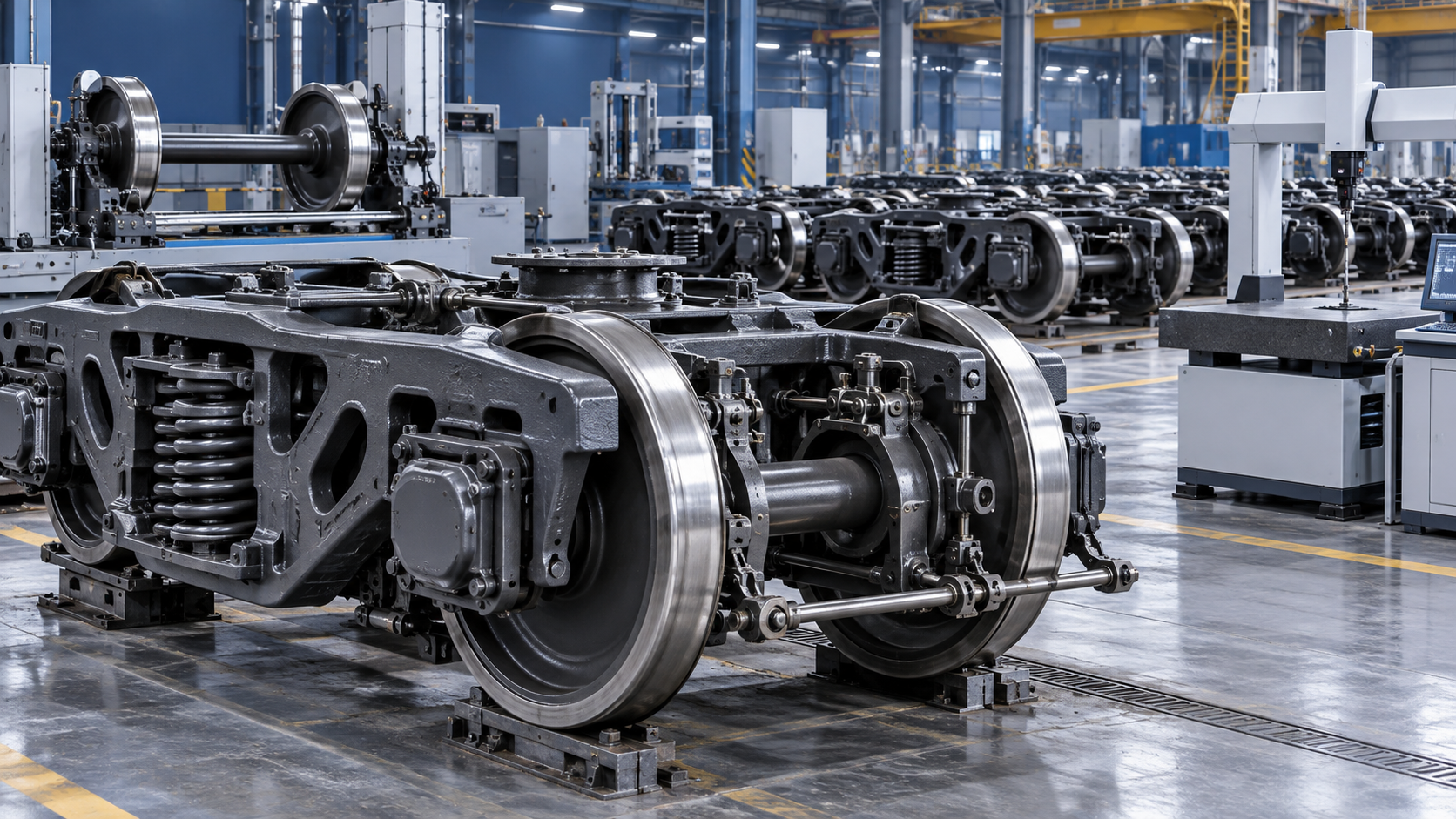
For freight rolling stock projects, the bogie is not a peripheral assembly. It sits at the intersection of payload, track forces, vehicle stability, braking behavior, maintenance access, and route compliance. A cheap bogie that causes accelerated wheel wear, difficult bearing replacement, or repeated downtime can be a far more expensive decision than a higher-priced design with predictable parts support.
This is particularly relevant on cross-border and heavy-haul corridors, where equipment may need to align with UIC, EN, AAR, national railway authority requirements, or project-specific interface rules. Procurement teams should therefore treat a railway bogie price as a structured commercial result of technical scope—not as a single commodity benchmark.
Why Bogie Quotations Vary So Widely
The starting point is bogie architecture. A conventional two-axle freight bogie for general bulk or container service is priced differently from a heavy-haul design intended for higher axle loads, severe curving, extended haul distances, or demanding brake duty. The same is true when comparing three-piece bogies, fabricated-frame bogies, bolsterless designs, radial or steering arrangements, and specialized bogies for tank wagons, intermodal platforms, hopper cars, or maintenance vehicles.
Frame construction is one of the largest drivers. Cast steel frames, welded fabricated frames, and designs with extensive machined interfaces each have different material, tooling, welding qualification, heat-treatment, non-destructive testing, and dimensional-control requirements. A supplier’s offer may include a robust frame but a simplified inspection package; another may include more traceability and testing at a higher initial price. Neither is automatically better. The correct choice depends on the operating environment and contractual risk allocation.
Wheelsets and axleboxes also need careful treatment in a price comparison. Buyers sometimes receive a bogie quotation that excludes wheelsets, bearings, axleboxes, brake rigging, or shock absorbers. Others receive a “complete bogie” price that includes these items but leaves the exact bearing class, wheel profile, axle finish, or component manufacturer undefined. That creates an apparent price gap which is not really a price gap at all—it is a scope gap.
Suspension choices matter for both procurement cost and operating behavior. Primary suspension arrangements, spring packs, rubber-metal elements, hydraulic dampers, side bearers, friction wedges, and load-proportional features all affect the bill of materials. They also affect ride quality, hunting stability, wagon dynamics, and maintenance workload. On a route with uneven track condition or frequent empty-to-loaded transitions, saving money by simplifying the suspension may create operating problems that were not obvious during tender evaluation.
The Specification Details That Change the Real Price
A useful way to assess railway bogie price is to ask suppliers to price against a controlled configuration sheet. Without one, quotations often combine assumptions that are difficult to uncover later. At minimum, the commercial package should clarify whether the offer includes the components and services below.
The phrase “compliant with UIC, EN, or AAR” should be treated carefully. These standards and industry frameworks do not function as a simple interchangeable label. The relevant requirement depends on the vehicle, network, country, approval route, and operating conditions. A supplier should identify the specific design inputs and verification evidence applicable to the supplied configuration, rather than relying on a broad statement of familiarity with a standard family.
One practical warning: do not assume a previous design is acceptable merely because it has operated elsewhere. Track gauge, loading gauge, coupler system, brake arrangement, climate, wheel profile, maintenance practice, and local authority expectations may all differ. Reusing a proven platform can reduce engineering cost and lead time, but only if the gaps are explicitly assessed.
Order Volume, Tooling, and the “Cheap Unit Price” Trap
Volume has an obvious impact on unit pricing, but the relationship is not linear. A pilot batch or small fleet may absorb non-recurring engineering, fixture preparation, first-article inspection, prototype testing, documentation setup, and supplier qualification work. A larger series order can spread some of those costs across more units. Yet volume discounts are only credible when production capacity, raw material availability, inspection throughput, and delivery sequencing are all realistic.
For a procurement team, the better question is not simply “What discount applies above a certain quantity?” It is “Which costs are fixed, which are variable, and which assumptions support the reduction?” Request a cost structure at a sensible level of detail: engineering and tooling, frames, wheelsets, suspension, braking interfaces, inspection, packing, spares, and logistics. Suppliers may not disclose every internal cost, but they should be able to explain commercial changes between a sample order, a first production lot, and a long-term call-off arrangement.
Delivery phasing deserves equal attention. A supplier may quote an attractive price based on consolidated production, while the project requires staggered deliveries over a long period. Holding finished bogies, securing components for later batches, or accommodating changes in steel and bearing supply can alter the commercial picture. Where the wagon builder, bogie supplier, brake supplier, and wheelset supplier are all separate parties, schedule risk can quickly become an interface-cost problem.
Lifecycle Cost Is Where the Procurement Decision Is Usually Won or Lost
The purchase price is visible on day one. Lifecycle cost arrives in smaller, less convenient invoices: wheel reprofiling, bearing-related work, spring replacement, damper failures, brake component wear, inspection labor, unscheduled workshop visits, and stock held for hard-to-source parts. On long freight corridors, availability losses can be more disruptive than the direct repair invoice because wagons are tied to loading windows, port slots, train paths, or customer commitments.
A credible total-cost review should consider expected maintenance intervals, accessibility of wear parts, interchangeability with existing fleet components, recommended spare holdings, local workshop capability, and the supplier’s process for technical support. Procurement should ask for maintenance manuals and illustrated parts lists early, not after contract award. The way a bogie is designed to be inspected and serviced often reveals more about future cost than a polished sales presentation.
Wheel and rail interaction is another area where the cheapest assembly may not remain cheap. Bogie steering characteristics, suspension condition, wheel profile management, axle alignment, and damping all influence vehicle-track behavior. The exact outcome depends on route geometry and operating practice, so it should not be reduced to a generic promise of “lower wear.” Still, a buyer should evaluate whether the design has suitable technical evidence for the intended service, especially where tight curves, heavy loads, or mixed track quality are expected.
Corrosion protection should also be priced as an operating decision. Standard coatings may be adequate for ordinary inland service, while coastal terminals, fertilizer traffic, mining environments, or aggressive wash-down routines can justify a more demanding paint system or material treatment. The initial increment may be modest compared with the disruption caused by premature corrosion repairs, but the specification must be tied to actual exposure conditions rather than copied from a previous project.
How to Compare Supplier Proposals Without Losing the Technical Thread
A disciplined bid comparison normally begins with technical normalization before commercial ranking. Put every proposal against one baseline configuration and mark each deviation as accepted, rejected, priced separately, or pending clarification. This avoids a familiar outcome: the lowest bid is selected, then the missing wheelsets, brake interfaces, tests, documentation, packaging, or warranty provisions appear as variations.
It is worth separating “included” from “capable of being supplied.” A supplier may be capable of fitting a certain axlebox, monitoring provision, or brake arrangement, but unless it is included in the quoted configuration, the price does not yet cover it. The same distinction applies to digital condition-monitoring interfaces. Sensor mounts, cable routing, power arrangements, and communication equipment can be highly project-specific, particularly where rolling stock interfaces with broader signaling, yard, or freight-visibility systems.
Buyers managing international fleets should also examine spare-parts continuity. A technically strong bogie with proprietary components may be a sensible choice when the supplier has reliable regional support and the fleet is sufficiently large. It may be less attractive for a small, remote fleet with limited stockholding capacity. Standardized components can reduce dependency, but standardization should never override suitability for load, speed, braking, and route conditions.
A Better Procurement Brief for Railway Bogies
The strongest sourcing process brings engineering, operations, maintenance, quality, and commercial teams together before the request for quotation is released. For rail freight projects, that coordination is especially important because the bogie connects decisions made across the wagon body, brake system, coupler arrangement, loading profile, track environment, and workshop model.
Technical intelligence platforms such as G-RFE are useful in this stage because the procurement question is rarely limited to a component price. It may involve heavy-haul rolling stock practice, track-maintenance constraints, intermodal terminal conditions, or compatibility with broader safety and communications requirements. Benchmarking against the relevant UIC, EN, AAR, and local project framework helps teams distinguish genuine engineering value from a quotation that is simply incomplete.
Before issuing a purchase order, make sure the final commercial schedule states the exact bogie configuration, interfaces, inspection plan, documentation deliverables, warranty boundaries, spares recommendation, acceptance criteria, delivery terms, and responsibilities for changes. A railway bogie price becomes meaningful only when those details are fixed. If they remain vague, the apparent saving is usually just cost that has been moved somewhere else in the project.
Industry Briefing
Get the top 5 industry headlines delivered to your inbox every morning.