
Middle East Locomotive Noise Benchmarks: Which Test Conditions Matter?

Middle East Locomotive Noise Benchmarks: Which Test Conditions Matter?
A locomotive can meet a noise limit in one test and exceed it in another—but the difference may lie in the conditions, not the machine. For quality control and safety teams, interpreting Middle East locomotive noise benchmarks requires more than comparing decibel readings. Operating load, cooling fan duty, microphone placement, track condition, and background noise all affect whether results are comparable and useful for acceptance decisions.
The practical question is not simply, “How loud is this locomotive?” It is, “Under which defined conditions was that level measured, and do those conditions answer our acceptance or safety question?” Drawing on Global Railway-Freight & Engineering’s engineering perspective, the following framework separates repeatable vehicle testing from the additional checks needed for regional service conditions.
Start with the requirement, not the decibel value
There is no single noise limit that can safely be treated as a universal Middle East locomotive requirement. Applicable obligations depend on the country, railway authority, project specification, operating location, and assessment purpose. A contractual vehicle emission limit is not interchangeable with a boundary noise limit or an employee exposure criterion.
ISO 3095 provides measurement methods for noise emitted by railbound vehicles. ISO 3381 addresses noise inside railbound vehicles. Occupational exposure assessment may draw on ISO 9612, while environmental assessments may use the ISO 1996 series alongside local requirements. These references serve different purposes; citing one does not establish compliance with the others.
Likewise, an EN, UIC, or AAR reference should identify the relevant document, edition, and provision—not merely the organization’s name. European regulatory limits do not automatically apply to a Middle Eastern project, although a contract may adopt them explicitly. Measurement methods and acceptance limits must be traced separately.
Before comparing supplier reports, establish the acoustic quantity being assessed. An A-weighted equivalent level over a defined interval, a maximum level with specified time weighting, and a sound exposure level describe different aspects of an event. A report stating only “dB(A)” leaves too much unresolved.
Operating state is often the decisive difference
Stationary idle, loaded stationary operation, acceleration, and constant-speed pass-by are separate acoustic conditions. A favorable idle result says little about a locomotive hauling freight under sustained traction demand. Conversely, a high-load stationary measurement should not be presented as though it represents every operating hour.
For diesel-electric locomotives, record engine speed, control setting, actual power or load indication, and the means used to apply load. A throttle notch alone may not establish equivalent conditions between locomotive designs. Traction loading, load-bank operation, and other arrangements can produce different combinations of engine, generator, cooling, and auxiliary noise.
Auxiliary equipment deserves explicit attention. Cooling fans, compressors, ventilation systems, and cab air conditioning can change the measured level, particularly during stationary testing. A short measurement taken between compressor cycles may be repeatable but unrepresentative of the duty being evaluated.
Dynamic braking also needs consideration where relevant to the operating route. Resistance-grid cooling equipment can create a distinct noise condition that a traction-only test programme misses. The acceptance plan should identify which operating modes require contractual measurement and which require supplementary operational assessment.
Hot-weather cooling duty cannot be inferred from a cool test
High ambient temperature can increase cooling demand, but the acoustic outcome depends on the locomotive’s control strategy, fan arrangement, thermal condition, and any power derating. It is not defensible to apply a generic “Middle East temperature correction” to a cool-weather result.
Distinguish between testing under the reference conditions required by the selected method and verifying representative hot-weather operation. Both can be useful, but they answer different questions. Record ambient temperature, relevant coolant or equipment temperatures, fan command or speed, and the stabilization procedure.
A brief run immediately after startup may miss sustained fan operation. Where hot-weather performance matters, agree the thermal operating condition before testing rather than debating it after an unfavorable result. Any supplementary procedure should remain clearly separated from the formal standardized result.
Measurement geometry and the site can change the comparison
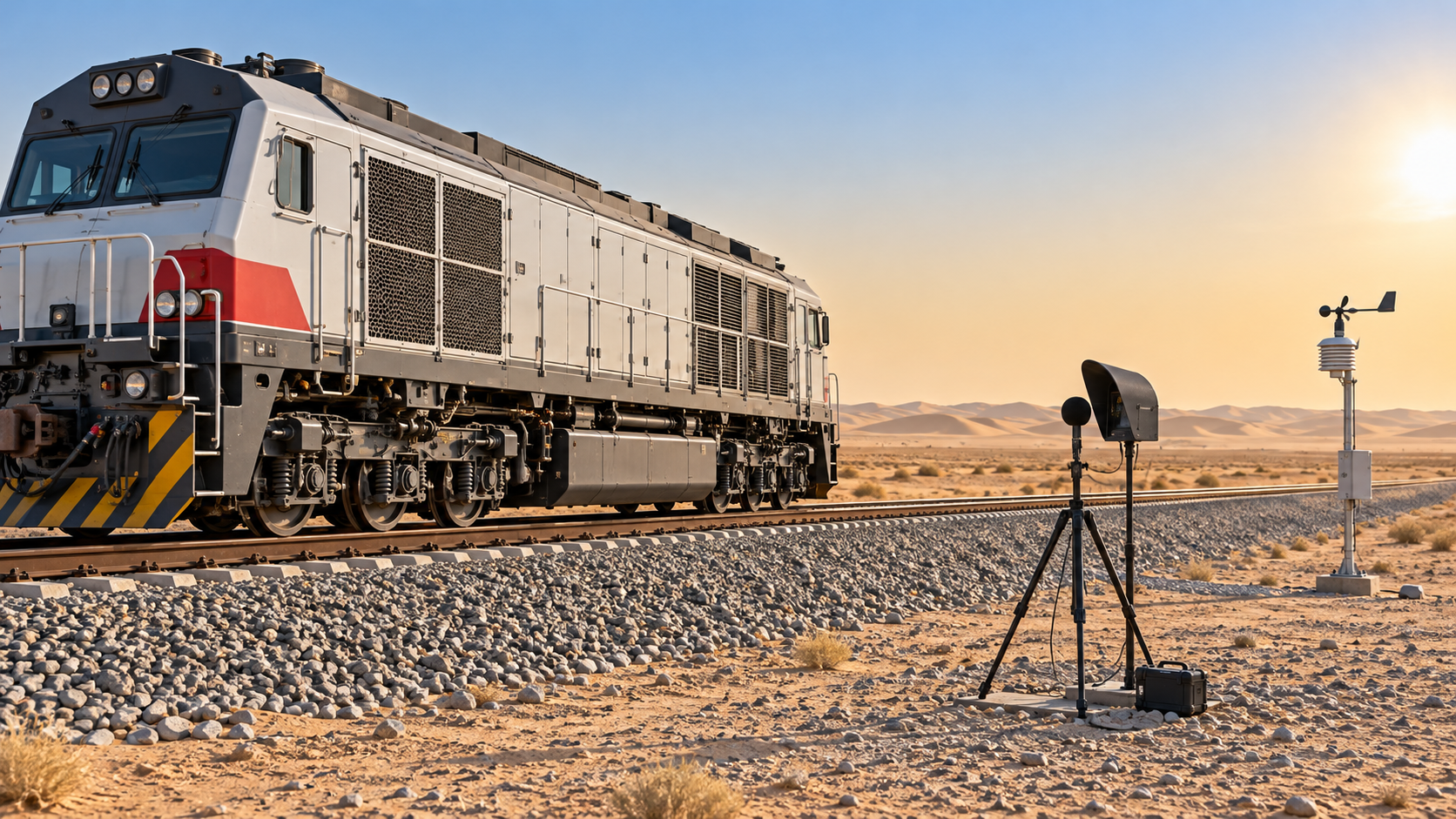
Microphone distance, height, longitudinal position, and side of the locomotive affect the result. Exhaust outlets, radiator openings, and equipment enclosures are not acoustically symmetrical. A measurement on the quieter side cannot automatically represent the louder side.
Use the geometry required by the adopted method and document it with dimensions and site photographs. If access restrictions force a deviation, report it explicitly. Moving a microphone and applying a simple distance correction is not necessarily valid near an extended source, reflecting surfaces, or acoustically uneven ground.
Depots and rail-port terminals introduce additional complications: workshop walls, parked wagons, barriers, paved surfaces, and nearby machinery. A convenient maintenance siding may be unsuitable for a standardized emission test. It may still support a useful operational investigation, provided the result is not mislabeled as a directly comparable reference measurement.
Pass-by results need track and speed evidence
During moving tests, wheel–rail interaction becomes part of the acoustic picture. Rail roughness, wheel condition, track construction, and local defects can influence the measured level. A locomotive tested on a rough or jointed section should not be ranked against another tested on a different track without examining those differences.
Where the adopted method specifies rail roughness or track acoustic characteristics, request the supporting measurements. “Good track condition” is not equivalent to documented compliance. Wheel flats, recent wheel reprofiling, and rail grinding should also be recorded when relevant.
Speed must be measured rather than described as nominal. The report should identify actual speed for each accepted pass, travel direction, operating mode, and the selected measurement interval. Acceleration runs also need a defined operating sequence; two drivers reaching the same final speed may have used different power histories.
Background noise and weather determine whether a run is usable
Industrial corridors can contain road traffic, cargo-handling equipment, other trains, and construction activity. Background sound must be measured and assessed against the selected method’s requirements. If the separation from locomotive noise is inadequate, the run may require a permitted correction or rejection. Arbitrary subtraction of decibel values is not valid.
Retain time histories and event notes, not just final averages. They help distinguish locomotive noise from a passing truck, horn, or other unrelated event. Exclusion rules should be established beforehand so that data selection does not become a way to obtain a preferred result.
Wind can generate microphone noise and affect sound propagation. Record wind speed and direction, temperature, humidity, and precipitation as required by the procedure. A windscreen does not make every wind condition acceptable. Instrument operation must also remain within the manufacturer’s environmental limits, including during very hot fieldwork.
Emission compliance does not settle every safety question
A compliant exterior noise result does not demonstrate acceptable cab conditions or worker exposure. Cab sealing, glazing, ventilation settings, and structure-borne vibration affect interior sound. Maintenance personnel may work close to cooling outlets or compressors, where a distant reference microphone does not describe their exposure.
Occupational assessment must account for tasks and exposure duration under applicable requirements. Likewise, a vehicle emission test alone cannot establish noise at a residential receptor. Train frequency, nighttime operation, horns, propagation, and local environmental criteria require a separate assessment. Keep these decisions connected, but do not collapse them into one pass/fail number.
What a defensible supplier report should contain
For acceptance, the report needs a traceable chain from requirement to result. At minimum, request:
- The governing specification, measurement standard and edition, acoustic descriptor, and acceptance limit.
- Vehicle identity and configuration, including relevant exhaust, cooling, software, and acoustic treatment details.
- Operating records, site geometry, track information, weather, and background measurements.
- Instrumentation details, calibration traceability, and field calibration checks before and after measurement.
- Individual valid results, rejected runs with reasons, permitted corrections, uncertainty, and procedural deviations.
Measurement uncertainty needs an agreed decision rule. A result close to the limit should not trigger an improvised argument about whether uncertainty is added, subtracted, or ignored. State the conformity rule in the test plan, together with repeat-test and invalid-run provisions.
G-RFE’s cross-disciplinary remit—covering rolling stock, infrastructure, intermodal terminals, and railway engineering—supports this system-level reading of noise evidence. A locomotive benchmark becomes more useful when its vehicle configuration, track interface, operating duty, and regulatory purpose remain visible together.
Before accepting Middle East locomotive noise benchmarks, ask whether another competent team could reproduce the test from the report. If fan duty, thermal state, microphone geometry, or track conditions remain unclear, resolve those gaps before declaring equivalence. The next step may be a targeted supplementary test, not rejection of the locomotive—and not unconditional acceptance either.
- Sizing a Narrow-Gauge Locomotive for Tunnel Muck Haulage CyclesTime : Oct 31, 2026
- Battery vs Diesel Tunnel Locomotives: Ventilation and Operating Trade-OffsTime : Oct 31, 2026
- Choosing a Narrow-Gauge Tunnel Locomotive: Clearance, Grade and PayloadTime : Oct 31, 2026
Industry Briefing
Get the top 5 industry headlines delivered to your inbox every morning.