
Locomotive Cab Equipment Cost: What Drives Budget Overruns Most

Locomotive Cab Equipment Cost: What Drives Budget Overruns Most
Why do locomotive programs exceed budget even when core specifications look settled?
In many freight projects, locomotive cab equipment cost becomes the quiet source of variance.
The chassis, traction package, and power rating may stay stable.
But cab systems keep moving.
Safety interfaces evolve, standards tighten, operator requirements shift, and supplier lead times change pricing behavior.
That makes locomotive cab equipment cost harder to freeze than many approval teams expect.
For capital-intensive railway procurement, the issue is not only unit price.
It is the combined effect of redesign, revalidation, integration, logistics, and schedule pressure.
Understanding these drivers helps improve forecast accuracy and protect total program value.
Why Locomotive Cab Equipment Cost Is So Prone to Overruns
Cab equipment sits at the intersection of hardware, software, regulation, and human use.
That alone makes locomotive cab equipment cost more exposed than static mechanical components.
A display panel change may trigger rewiring, software revisions, ergonomic checks, and EMC retesting.
A new vigilance system may require protocol updates with braking and signaling functions.
On paper, each change looks manageable.
In practice, these linked effects are exactly where locomotive cab equipment cost starts drifting.
The Biggest Cost Drivers Behind Budget Overruns
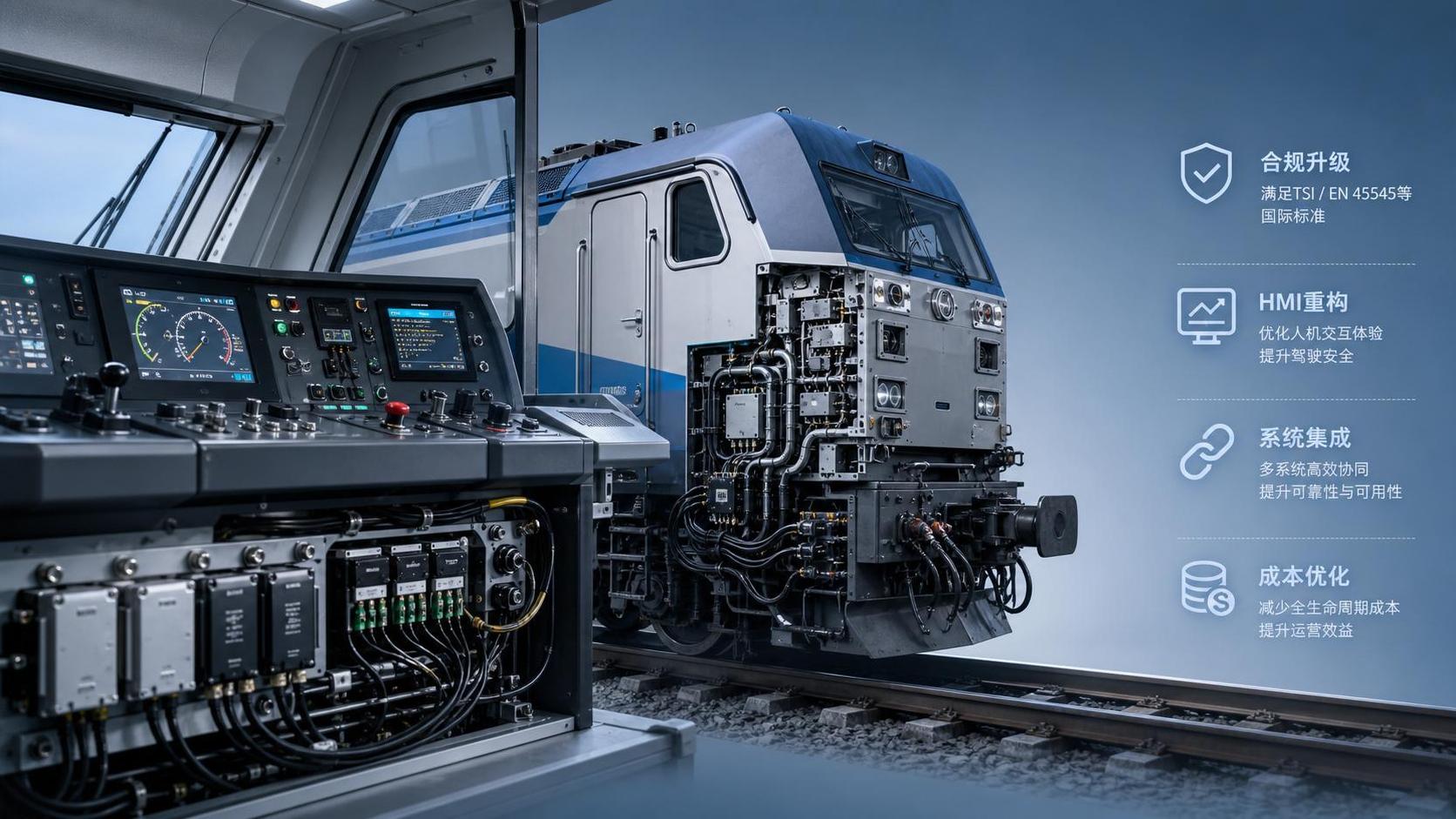
1. Compliance upgrades introduced after baseline approval
This is one of the most common causes of locomotive cab equipment cost escalation.
A project may begin with one safety or interoperability assumption.
Later, the authority requests updated compliance against UIC, EN, AAR, ETCS, or operator-specific rules.
That change often reaches deeper than the visible cab layout.
It can affect event recording, alert management, onboard communications, and diagnostic logic.
When compliance enters late, locomotive cab equipment cost rises through both parts and engineering hours.
2. Human-machine interface redesigns
HMI revisions are frequently underestimated during procurement review.
A revised touchscreen, control stand, seat geometry, or instrument cluster may seem cosmetic.
Yet ergonomic changes can alter brackets, harness lengths, panel cutouts, software pages, and training materials.
This matters even more in cross-border freight fleets.
Different operators often want different alert priorities, labeling conventions, and workflow logic, increasing locomotive cab equipment cost without changing locomotive power output.
3. Safety system integration complexity
Modern cabs are not isolated equipment boxes.
They interface with braking, propulsion, diagnostics, radio, cameras, event recorders, and signaling networks.
The more integrated the safety architecture, the higher the risk of hidden engineering effort.
One protocol mismatch can delay factory acceptance testing and force rework across several subsystems.
This is a major reason locomotive cab equipment cost can overrun even when supplier quotations initially look competitive.
4. Supplier concentration and long lead-time components
Certain cab items come from a narrow supplier base.
Examples include rugged displays, certified recorders, radio modules, driver vigilance units, and specialized control electronics.
When schedules tighten, buyers often pay expediting premiums.
When supply chains weaken, alternates need qualification.
Both paths increase locomotive cab equipment cost and create knock-on schedule exposure.
5. Low-volume customization across fleet variants
Budget overruns become more likely when each locomotive batch carries unique cab features.
The issue is not only materials.
Variant management raises documentation, validation, spare parts planning, and configuration control costs.
If the business case depends on economies of scale, fragmented specifications will push locomotive cab equipment cost higher than the approved model assumed.
Where Finance Reviews Often Miss the Real Exposure
Many approval reviews focus on quoted line items.
That is useful, but incomplete.
The real exposure usually sits in change interfaces and approval timing.
Three blind spots show up repeatedly:
- Quoted equipment excludes downstream integration, testing, and certification effort.
- Optional features are treated as low-risk, even when they alter safety logic.
- Schedule assumptions ignore supplier capacity and approval cycle delays.
When these blind spots remain unpriced, locomotive cab equipment cost looks stable until late-stage commitments expose the gap.
A Practical Framework to Control Locomotive Cab Equipment Cost
A better approach is to separate visible purchase cost from change-sensitive cost.
That makes procurement decisions more realistic from the start.
Use four review gates before final approval
- Freeze mandatory standards and operator requirements before commercial comparison.
- Separate base cab scope from variant-specific options and software modifications.
- Require an integration matrix covering signaling, braking, diagnostics, and communication links.
- Stress-test lead times for single-source items and include realistic delivery buffers.
This process does not eliminate locomotive cab equipment cost risk, but it makes the risk measurable earlier.
Compare suppliers on total delivered impact
Lowest unit pricing can be misleading.
A stronger comparison model should include the factors below.
This view is especially relevant for institutions managing long-haul freight corridors and multi-country technical obligations.
How to Build a More Defensible Budget
A defensible budget for locomotive cab equipment cost should include three layers.
- Base equipment pricing tied to a frozen technical baseline.
- Integration and validation allowances linked to system complexity.
- Contingency for compliance changes, sourcing shocks, and program acceleration.
From recent market behavior, the stronger signal is not inflation alone.
It is volatility in specialized electronics, certification pathways, and interface approval cycles.
That means locomotive cab equipment cost should be budgeted as a controlled risk package, not a static shopping list.
Final Takeaway
The biggest overruns in locomotive cab equipment cost usually come from late compliance shifts, HMI redesigns, safety integration issues, supplier constraints, and excessive customization.
None of these drivers are unusual.
What matters is whether they are exposed early enough to influence procurement structure.
For railway programs shaped by complex standards and long service lives, disciplined scope control is the most reliable cost defense.
The next approval decision should test not only price, but also how resilient that locomotive cab equipment cost really is under operational change.
Industry Briefing
Get the top 5 industry headlines delivered to your inbox every morning.