
European Railway Wheelset Suppliers: Standards and Testing to Verify

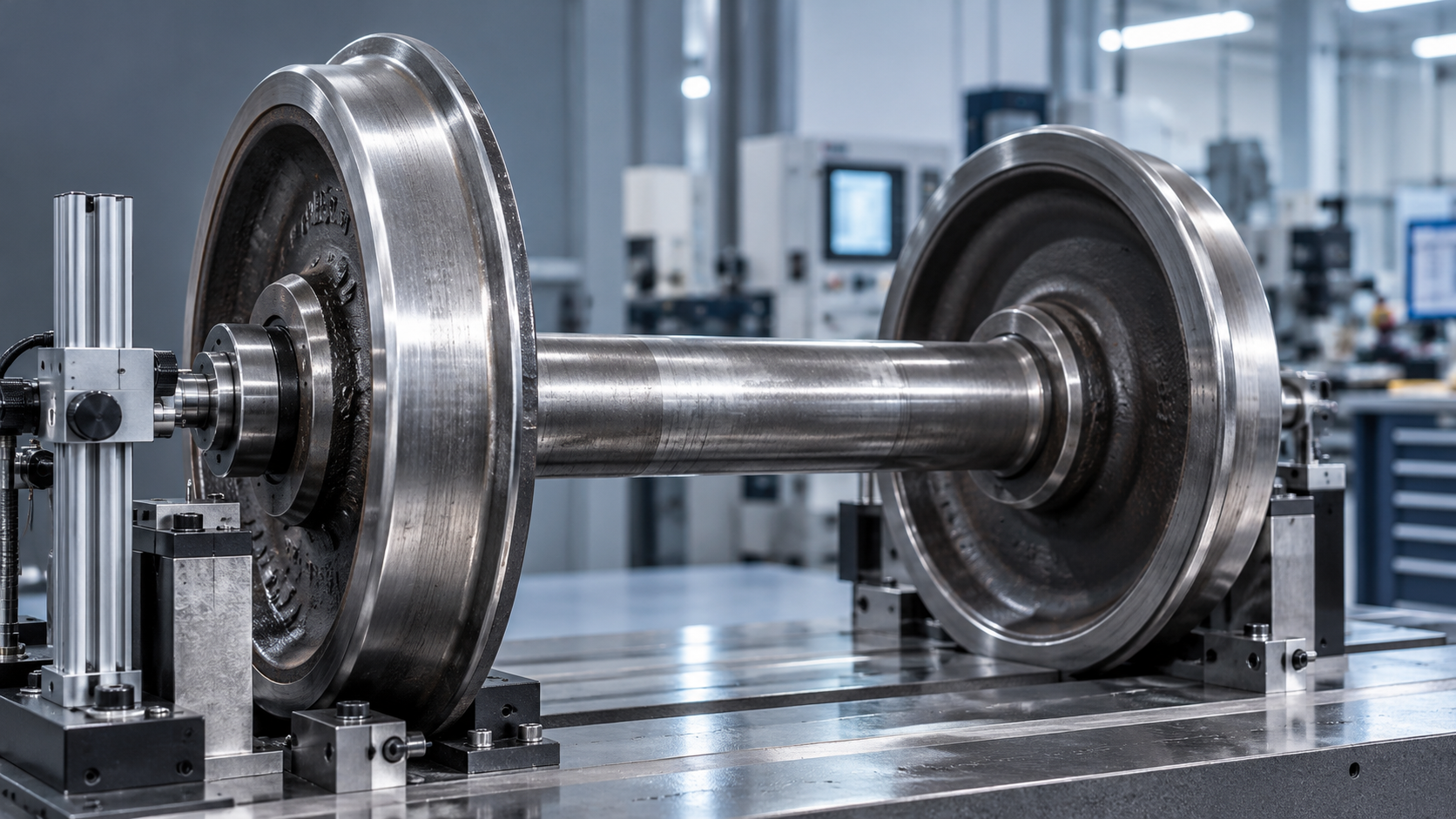
Selecting a railway wheelset supplier in Europe requires evidence for three separate questions: whether the wheels and axles meet their applicable product specifications, whether the assembled wheelset meets its requirements, and whether the complete design is suitable for the intended vehicle and duty. A supplier’s statement that it works to European standards is a starting point, not proof that a particular delivery conforms.
In a technical review, the difficulty often appears when component certificates look complete but do not connect clearly to the assembled wheelset, its drawing revision or its inspection results. Resolve that gap by agreeing the applicable standards and acceptance plan before manufacture, then tracing material, tests and assembly records to each delivered unit.
Establish the compliance basis before comparing suppliers
Start with the vehicle and operating envelope: axle load, maximum speed, wheel diameter and wear limits, braking arrangement, route conditions, expected mileage and maintenance regime. Identify whether the purchase is for a new design, a qualified replacement or a repair. These distinctions affect which design evidence can be reused and which manufacturing and acceptance checks must be repeated.
The principal European product standards to examine are EN 13260 for wheelsets, EN 13261 for axles and EN 13262 for wheels. Their applicability depends on the product, scope and contractual specification. Ask the supplier to identify the edition and amendments used, including any national adoption or project-specific requirements. Do not assume that a document referencing an older edition automatically satisfies a contract calling for a later one.
These standards are not interchangeable. A compliant wheel and axle do not, by themselves, demonstrate a compliant assembly or an adequate axle design. Design assessment may involve standards such as EN 13103 for non-powered axles or EN 13104 for powered axles, where applicable. Confirm the relevant scope, edition and any superseding documents against the project’s controlled standards register.
Separate product conformity from authorization
European technical specifications for interoperability, or TSIs, can be relevant to a vehicle or subsystem placed on the applicable rail system. Their requirements depend on the vehicle type, intended area of use and the applicable regulatory framework. Do not treat a component manufacturer’s certificate as automatic authorization to place a vehicle in service, or assume that every wheelset is independently certified in the same way.
Ask which requirements flow down from the vehicle specification and who is responsible for demonstrating conformity. Where a notified body, designated body or other assessor is involved, establish the scope of its assessment and request the relevant certificate or report. Check the product description, variants, manufacturing sites, conditions and validity against the item being purchased. A quality-system certificate can support confidence in process control, but it is not a substitute for product-specific conformity evidence.
Trace the material to the finished wheelset
Request a sample documentation package before placing the order. It should show how a finished wheelset serial number connects to the wheel and axle identifiers, material heat or batch, relevant process records and final inspection. For a replacement wheelset, also check that the drawing identifies interfaces for bearings, brake discs, gears or other fitted equipment as applicable.
Material documentation should identify the specified grade and the actual results required by the purchase specification. Review chemical composition, mechanical properties and heat-treatment condition against the correct acceptance criteria. Where inspection documents under EN 10204 are specified, agree the required document type and issuing responsibility; the document type alone does not establish that every necessary test was performed.
Traceability becomes less useful when identifiers change during machining or assembly. Ask how markings are preserved or transferred, how records are linked after components are fitted, and what happens if a marking becomes unreadable. The supplier should also be able to identify affected stock or deliveries if a material batch or process is later found nonconforming.
Testing evidence: distinguish design qualification from routine acceptance
A credible inspection and test plan identifies the characteristic, test method, applicable acceptance criterion, sampling frequency, responsible organization and record produced. It should distinguish evidence that qualifies a design or manufacturing process from checks carried out on each item or production batch. A historical test report may support an established design, but it does not replace the agreed acceptance records for a new delivery.
Axle strength and fatigue
Review the design calculations against the actual duty rather than accepting a generic fatigue claim. The calculation basis should identify loads, geometry, material assumptions, stress concentrations and the interfaces that influence the axle. Pay attention to changes in wheel seat, fillet geometry, fitted components or surface condition: a seemingly small drawing change can affect whether earlier evidence remains representative.
Where fatigue testing is required by the specification or qualification plan, request the test configuration, loading conditions, specimen identification, results and acceptance basis. Compare the tested geometry and manufacturing condition with the proposed production axle. A test performed on a different variant is not necessarily invalid, but its relevance needs a documented technical justification.
Wheel properties and braking duty
For wheels, verify the specified steel grade, heat treatment and mechanical test results, together with the inspection requirements applicable to the wheel design. Braking arrangement matters: a tread-braked wheel experiences a different thermal duty from a wheel used solely with disc braking. Where thermal performance or resistance to thermal damage is part of the design assessment, request the supporting evidence and its applicability to the intended service.
Do not infer in-service performance from hardness alone. Examine the complete material specification, the location and method of measurement, and the required acceptance limits. Any deviations or repairs should be visible in the release documentation and assessed against the agreed disposition process.
Non-destructive examination
Ultrasonic and other non-destructive testing methods may be specified for detecting relevant internal or surface discontinuities. Ask for the applicable procedure, inspection stage, coverage, equipment calibration or verification arrangements, personnel qualification and acceptance criteria. The required method and extent depend on the component and specification; a single statement that an item is “NDT tested” is too broad to evaluate.
Where EN ISO 9712 personnel qualification or another qualification scheme is specified, check that it covers the method and applicable sector. The procedure should also address indications, re-examination after repair where permitted, and retention of results. Confirm whether an independent witness or third-party inspection is required before production starts.
Inspect the assembly, not just the components
Wheelset assembly introduces its own risks. A supplier may procure compliant wheels and axles but still need to demonstrate controlled fitting, alignment and final verification. Review the approved assembly drawing, fit requirements and process parameters for the particular design. For press-fitted parts, request the relevant force–displacement records or other specified assembly evidence, together with the criteria used to accept or reject the fit.
Final inspection should cover the dimensions and geometry identified in the drawing and inspection plan. Depending on the design, these may include wheel spacing, back-to-back dimensions, runout and the relationship between fitted components. Check that measuring equipment is suitable and controlled, and that inspection results are recorded against the individual wheelset rather than presented only as a generic certificate.
Clarify responsibility at every interface. If one organization supplies the axle, another manufactures the wheels and a third assembles the wheelset, the purchaser needs a defined lead supplier or integrator responsible for the complete release package. Subcontracting is not inherently a weakness; missing control over subcontracted processes is.
Evaluate capability and resolve gaps before release
A supplier review should follow the proposed production route. Confirm where forging or rolling, heat treatment, machining, testing and assembly will occur, and which activities are subcontracted. Check that process controls and inspection procedures apply to those actual sites. A certificate covering a different location or activity may not answer the procurement question.
Use the inspection and test plan to agree hold points and witness points, especially for first manufacture, significant process changes or new interfaces. A hold point requires release before work proceeds; a witness point gives the purchaser or nominated inspector an opportunity to attend under the agreed notification rules. Define the consequences of missed notification and the documents required for release.
When evidence is incomplete, record the issue against a specific requirement rather than rejecting or accepting the supplier on general impressions. For example, a missing fatigue report may require a design assessment, a justified equivalence argument or additional testing; an untraceable heat-treatment batch may require investigation of the affected material and its disposition. Agree who decides, what evidence closes the issue and whether production can continue in the meantime.
Before shipment, reconcile the purchase order, approved drawing revision, serial-number list, component certificates, inspection results, deviations and release statement. The decision should rest on the conformity of the delivered configuration—not solely on a supplier’s general experience or the presence of certificates elsewhere in its catalogue.
- Sizing a Narrow-Gauge Locomotive for Tunnel Muck Haulage CyclesTime : Oct 31, 2026
- Battery vs Diesel Tunnel Locomotives: Ventilation and Operating Trade-OffsTime : Oct 31, 2026
- Choosing a Narrow-Gauge Tunnel Locomotive: Clearance, Grade and PayloadTime : Oct 31, 2026
Industry Briefing
Get the top 5 industry headlines delivered to your inbox every morning.