
What Drives Railway Braking System Cost Across Locomotive Upgrades?

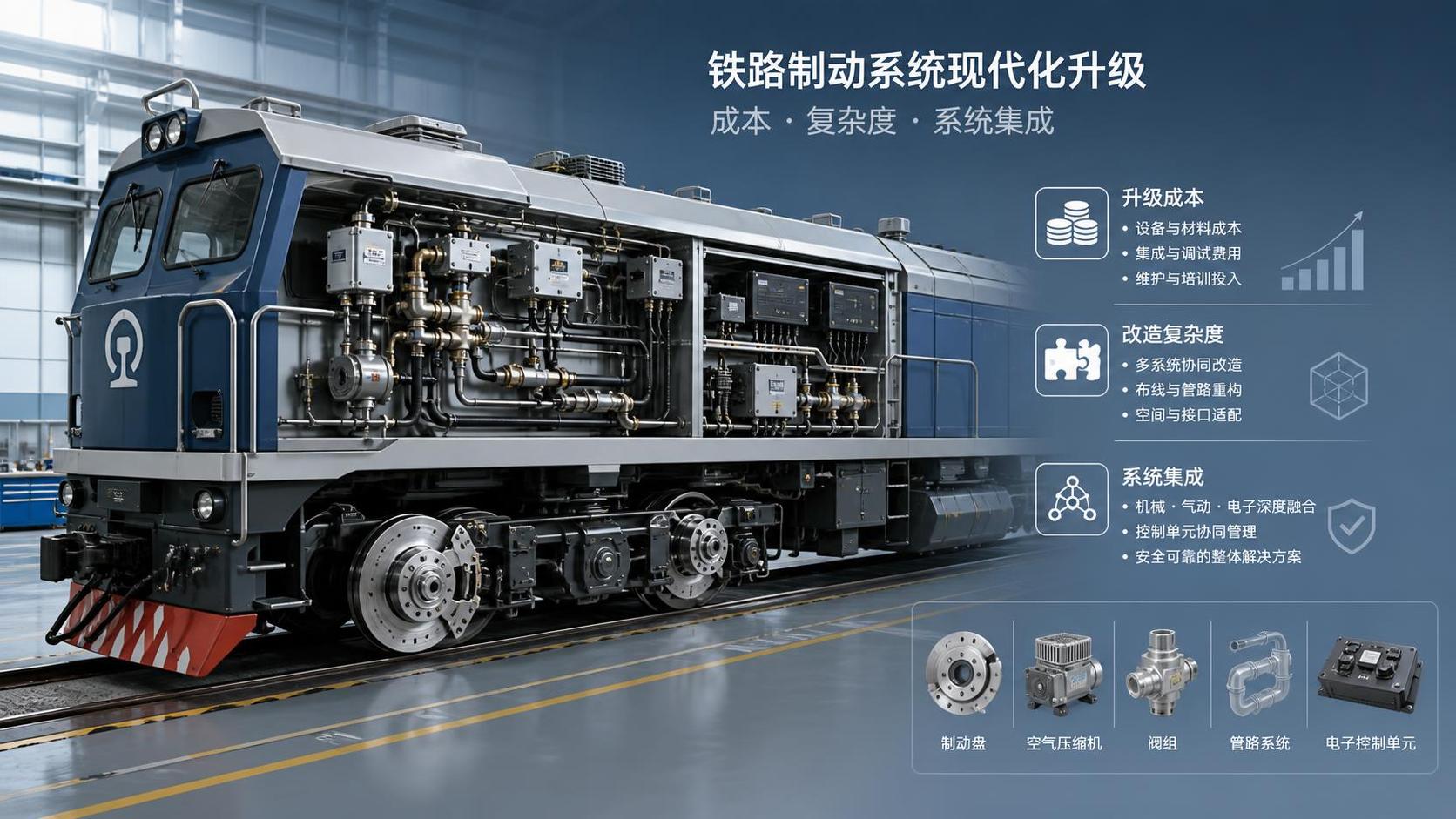
For finance approvers, the phrase railway braking system cost often sounds narrower than the actual decision in front of them. In locomotive upgrades, braking expenditure is rarely just a component purchase. It is a bundled capital decision that touches safety certification, retrofit engineering, train handling performance, downtime planning, spare-parts strategy, and the operating economics of the fleet for years after installation. That is why two projects with apparently similar brake hardware can produce very different budgets and very different financial outcomes.
The practical question is not simply, “What does the braking system cost?” It is, “What is driving total upgrade cost in this specific fleet, under this regulatory environment, with this locomotive architecture, and what risks sit outside the supplier’s unit price?” For organizations modernizing freight locomotives, that distinction matters because underestimating the non-hardware portion of brake upgrades is one of the more common causes of budget friction, delayed approvals, and post-installation scope expansion.
Why braking costs rise sharply during locomotive modernization
When braking systems are replaced in an existing locomotive, the buyer is not working with a clean-sheet design. The project inherits legacy electrical layouts, pneumatic routing, control logic, space constraints, axle load requirements, and interface assumptions that may be years or decades old. The older the fleet, the more likely it is that “like-for-like replacement” is not realistic, even if procurement initially frames the project that way.
In many cases, the upgrade also has to satisfy a broader modernization objective: higher hauling capacity, more demanding train lengths, improved stopping consistency, lower maintenance burden, better diagnostic visibility, or compatibility with newer train control and signaling environments. Once those goals are added, the braking package becomes part of a system-level redesign rather than a simple parts swap.
That is the first cost driver finance teams should keep in view: braking cost increases when the project objective moves from replacement to performance requalification. The hardware may still represent a visible line item, but engineering labor, integration work, testing, and certification begin to account for a much larger share of total spend.
Hardware is only the visible layer of the budget
Approvers naturally begin with the physical package: compressors, valves, brake control units, pipework, actuators, discs or tread-brake components where relevant, sensors, electronic interfaces, and operator controls. But procurement decisions become distorted when those items are treated as the whole budget story.
A more realistic cost view usually includes at least five layers:
- Core braking equipment and replacement assemblies
- Mechanical and electrical retrofit engineering
- Software and control-system integration
- Testing, validation, and certification
- Lifecycle support, spares, and maintenance adaptation
For finance review, this layered structure is more useful than a single equipment quote because it reveals where “hidden” cost concentration is likely to occur. On straightforward fleet renewals, hardware may dominate. On mixed-age fleets, cross-border freight operations, or locomotives requiring revised control architecture, engineering and compliance costs can grow faster than the equipment bill itself.
The biggest cost driver is often retrofit complexity, not brake technology
Buyers sometimes assume that the most advanced brake technology automatically creates the highest project cost. In practice, retrofit complexity often matters more. A relatively standard braking package can become expensive when installed into locomotives with limited mounting space, obsolete cabling, undocumented modifications, or difficult interfaces with propulsion and onboard diagnostics.
Several questions tend to determine whether retrofit complexity will materially affect cost:
- Is the existing locomotive platform well documented, with accurate as-built drawings?
- Can the new system use existing mounting points, routing paths, and cabinet space?
- Will the brake control logic need to interact with traction control, wheel-slide protection, event recorders, or train communication systems?
- Are there fleet variations that prevent a single retrofit package from being standardized?
- Can installation occur during planned overhaul windows, or will it create additional out-of-service time?
From a finance perspective, these are not engineering side notes. They directly influence labor hours, prototype iterations, workshop utilization, and fleet availability. A low purchase price can quickly lose its advantage if the installation path is disruptive or requires multiple rounds of redesign.
Compatibility with signaling and train-control environments changes the economics
In modern freight networks, braking cannot always be assessed in isolation from signaling and train-control requirements. Where locomotives operate under ETCS, GSM-R-linked operations, or other digitally supervised traffic environments, brake performance assumptions may affect compliance, train protection behavior, and data exchange expectations. Even where standards do not prescribe one specific brake product, they may shape testing depth, response validation, and interface requirements.
This becomes particularly important for cross-border or corridor freight operations, where locomotives may be expected to meet multiple national and interoperability requirements. In those cases, the braking system cost is influenced less by the component itself and more by proving that the upgraded locomotive will perform consistently within the broader safety architecture.
Finance approvers should be careful with proposals that present signaling compatibility as a minor integration add-on. In some projects it is minor. In others, it is the reason a budget shifts from manageable retrofit work into a full validation program. The commercial impact can include longer engineering lead times, expanded test campaigns, third-party assessment costs, and delayed return to service.
Certification and compliance are often underestimated at approval stage
One of the most persistent misconceptions in locomotive modernization is that certification is a predictable closing step after installation. In reality, compliance work can reshape scope much earlier. Depending on jurisdiction, operator requirements, and fleet role, braking modifications may trigger formal documentation updates, performance verification, safety-case revisions, or external review against UIC, EN, AAR, or local national frameworks. The precise pathway is project-specific and should be treated as such.
Where the upgrade materially alters braking behavior, control logic, stopping performance, fail-safe characteristics, or interoperability assumptions, certification costs can be significant. Even when the standards route is familiar, the expense is not limited to the certifier’s invoice. It includes test preparation, engineering documentation, instrumented trials, analysis time, and the cost of locomotives being unavailable for revenue service during validation.
For budget approval, the critical question is whether compliance assumptions are evidence-based or merely inherited from earlier projects. If the supplier is relying on precedent from a different locomotive family or operating regime, finance teams should treat the cost estimate as provisional.
Downtime may be more expensive than the brake package itself
For freight operators, the opportunity cost of locomotive unavailability can materially change the investment picture. This is especially true in heavy-haul or corridor operations where fleet utilization is tight and spare locomotive coverage is limited. A braking upgrade that looks efficient on a per-unit basis may become costly if it extends shop time, creates scheduling disruption, or forces interim leasing or substitution arrangements.
That is why workshop strategy deserves attention during financial review. A project installed during major overhauls may absorb better into the asset lifecycle than a stand-alone brake retrofit campaign. Similarly, prototype locomotives often carry a disproportionate cost burden because unforeseen fitment or software issues are resolved there before fleet rollout. Buyers should expect the first units to be more expensive and assess whether subsequent scale economies are realistic or simply assumed.
In other words, total braking upgrade cost should be modeled at fleet level, not just unit level. The true comparison is not only capex per locomotive, but capex plus downtime plus implementation risk over the modernization window.
Maintenance strategy can either justify the spend or undermine it
A common sales claim around brake upgrades is lower lifecycle cost. Sometimes that is true. Sometimes the savings depend on operating conditions, maintenance discipline, and spare-parts access that the buyer does not actually have.
Finance approvers should ask what exactly is expected to improve after the upgrade:
- Longer service intervals
- Lower failure rates
- Reduced wheel or brake wear
- Faster fault diagnosis
- Less unplanned maintenance labor
- Better parts availability over the remaining fleet life
Each of these can be financially meaningful, but none should be accepted in generic form. A digitally enabled brake control system may reduce troubleshooting time, for example, but only if depots are equipped and trained to use the diagnostics. A more advanced subsystem may promise reliability gains, yet increase dependence on imported electronics, proprietary software tools, or single-source spare parts. The procurement file should distinguish between theoretical lifecycle savings and savings that are operationally capturable.
Fleet age and residual life should shape the approval logic
Not every locomotive justifies an extensive braking system upgrade. The answer depends on residual asset life, expected traffic profile, reliability baseline, and the operator’s fleet strategy. A locomotive with limited remaining service life may support a narrowly scoped braking refresh, while a platform intended for another decade or more of freight service can justify deeper modernization if it improves availability and compliance resilience.
This is where finance and engineering need a shared asset-life view. If residual life assumptions are too optimistic, the project risks overcapitalization. If they are too conservative, the operator may defer necessary investment and absorb higher maintenance and performance penalties later. Neither decision should be made from brake hardware pricing alone.
A useful discipline is to evaluate braking investment against remaining ton-kilometers, overhaul cycle alignment, and route-criticality rather than age alone. An older locomotive assigned to strategic freight corridors may warrant more investment than a younger unit in declining service categories.
Supplier comparisons often miss the real sources of cost variance
When procurement collects competing proposals, price differences are frequently attributed to brand premium or technical specification gaps. Those factors matter, but they are not the whole story. Bids diverge because suppliers make different assumptions about scope ownership, interface responsibility, testing depth, local support, warranty risk, and parts provisioning.
Finance approvers should therefore look for commercial asymmetry hidden beneath apparently comparable quotations. One supplier may include engineering adaptation, software changes, and commissioning support; another may price only the equipment while leaving the operator or integrator to absorb the harder work later. The lower quote is not necessarily the lower-cost option.
This kind of comparison helps finance teams avoid a recurring problem in rolling stock procurement: approving the cheapest visible package, then funding the omitted scope through change orders and operational workaround costs.
What buyers often get wrong about “standardization”
Standardization is usually presented as an unquestioned cost saver, and often it is. Common brake platforms can reduce spares variety, simplify training, and improve maintenance consistency across fleets. But the argument becomes weaker when standardization forces expensive adaptation on locomotive classes that do not fit the chosen architecture well.
In mixed fleets, the economically sound approach may be controlled standardization rather than absolute standardization: aligning key consumables, diagnostic philosophy, and support arrangements while allowing some platform-specific engineering choices. A rigid one-system-for-all-fleets policy can create unnecessary retrofit complexity and dilute the intended savings.
For financial approval, the point is simple: standardization should be measured by total cost of supportability, not just by the appeal of having fewer part numbers on paper.
A practical approval framework for finance teams
Before approving a braking upgrade budget, finance decision-makers usually benefit from forcing the project into a few grounded questions:
- Is the project solving a compliance risk, a reliability problem, a performance constraint, or all three?
- How much of the cost is hardware versus engineering, testing, downtime, and support?
- What assumptions have been made about locomotive residual life and utilization?
- Which interfaces or certifications remain uncertain?
- What portion of lifecycle savings is demonstrable rather than projected?
- What costs move back to the operator if the lowest-priced bid is selected?
If those questions cannot be answered with reasonable clarity, the cost estimate is not mature enough for confident approval, even if the supplier quotation appears detailed. In rail modernization, uncertainty rarely disappears after purchase order issuance; it usually reappears as delay, change order, or availability loss.
That is the real driver behind railway braking system cost across locomotive upgrades. The brake system matters, but the bigger determinant is how deeply the upgrade interacts with the locomotive, the operating network, and the fleet’s remaining economic life. Approvers who see that early tend to make better capital decisions than those who treat braking as a narrow equipment line item.
Industry Briefing
Get the top 5 industry headlines delivered to your inbox every morning.